

What the risk is and who it affects
Command, control and signalling systems are critical to the safe operation of the railway because they control train movements, ensure trains are safely spaced apart and prevent conflicting movements. Failures in these systems can result in unsafe conditions and have the potential for catastrophic consequences, including multi-train accidents.
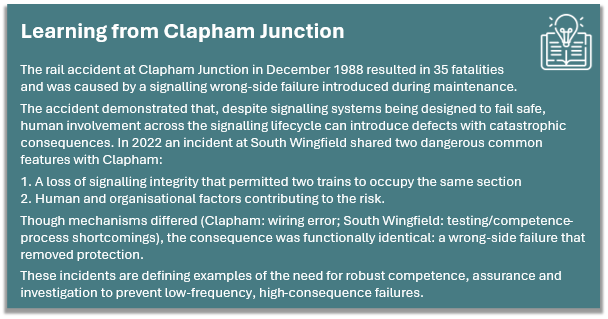
Although signalling systems are designed to fail to a safe condition, fallible humans are involved in the design, installation, testing, inspection, operation, maintenance and repair of signalling systems. As a result, failures can occur that may lead to an unsafe condition. Such failures are rare but potentially catastrophic.
The most significant signalling-related risks in this area are signalling wrong-side failures and overspeeding events, which can each lead to serious or catastrophic consequences.

The risk landscape
Historically, a significant proportion of train accident risk arose from Signals Passed at Danger (SPADs). The introduction of the Train Protection and Warning System (TPWS) on the mainline railway has substantially reduced this risk, with estimates indicating that around 85% of mainline SPAD risk was removed following its introduction. There has been no mainline fatality due to a SPAD since the Railway Safety Regulations 1999 came into force.
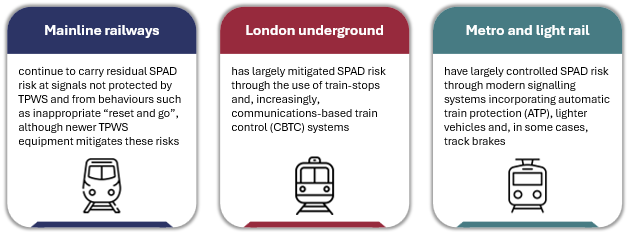
Risk profiles differ across the rail sector:
RSSB tools such as the Signal Over-run Risk Assessment Tool (SORAT) and Red Aspect Approaches to Signals (RAATS) are used to understand SPAD risk and inform appropriate prevention measures.
Residual and emerging signalling risks
Now that many SPAD-related risks have been eliminated or mitigated, the most significant signalling-related risks arise from signalling wrong-side failures and overspeeding. These failures are low frequency but high consequence, as they can permit trains to continue towards danger. Despite their rarity, they must be prevented so far as is reasonably practicable.
Effective management of this risk depends on high-quality investigation and reporting of signalling wrong-side failures and overspeeding, which are important precursors to catastrophic events. Although robust systems exist for recording and investigating such failures, there is a possibility that some events may go unnoticed, particularly where detection relies on human observation. This may lead to incomplete or skewed data, reducing the industry’s ability to understand underlying risk trends. Modern signalling systems increasingly provide automated alerts, which should reduce this risk over time.
System dependencies and degraded operation
All train protection systems are dependent on reliable brakes that can stop trains in a safe and repeatable manner. Braking systems vary in effectiveness depending on the type of rolling stock. Weather and railhead contamination affect adhesion causing significant differences in braking distances. This is critical in the management of wheel and rail interfaces with respect to train protection systems’ performance.
Recent incidents have highlighted that newer rolling stock, operating at higher performance levels, can expose limitations in legacy signalling and protection systems where overspeed risk is not adequately mitigated.

Signalling equipment is designed to fail to a safe condition – meaning that the immediate risk is controlled by preventing train movements. Whilst this is safe in the short term, it causes delay and inconvenience. To avoid this, most railway organisations introduce ‘degraded’ working – i.e. procedures to get train services moving again, when equipment has failed. By their nature, these processes are vulnerable, and there are few engineering controls to rely on. They depend on adherence to process and excellent communication.
As degraded working is inherently less reliable in controlling risks, it is desirable to avoid it so far as possible. Remote Condition Monitoring (RCM) of signalling equipment can be used to predict failure – so it can be safely remediated before it fails. This brings a safety benefit as well as a clear performance benefit. Similarly, the ORR is encouraged to see the development of certain systems that might bring a degree of technological assistance to degraded working if the main signalling system fails. Such innovation adds to the resilience of the entire railway system.
Why risk must be actively understood
The command, control and signalling risk landscape is shaped by a combination of legacy systems, human performance, system dependencies and emerging technologies. While many historic risks have been substantially reduced, residual and emerging risks remain, particularly those associated with signalling wrong-side failures and system transitions.
Understanding these risks, and how they differ across parts of the railway, is essential to managing train movement safety effectively and to supporting the safe introduction of future signalling and train control systems.