Why compliance matters
Health and safety legislation places clear duties on dutyholders to reduce risks arising from failure of Civils assets so far as is reasonably practicable, including risks to employees, passengers and the public. Failure of these assets can lead to derailment, serious injury or significant operational disruption.
Compliance expectations exist because long-standing challenges continue to affect Civils assets management, including incomplete asset information, examination and evaluation weaknesses, inconsistent implementation of standards, and vulnerability to extreme weather and third-party actions.
Compliance is also essential as the industry faces future changes, including more frequent and severe weather events, constrained renewals programmes, the need for more resilient design, and increased use of remote monitoring and system-wide engineering approaches.

The law
The management of Civils assets is governed by:
- Health and Safety at Work etc. Act 1974
- Management of Health and Safety at Work Regulations 1999
- Construction (Design and Management) Regulations 2015
- Railways and Other Guided Transport Systems (Safety) Regulations 2006
These laws require dutyholders to:
- reduce risks so far as is reasonably practicable;
- carry out suitable and sufficient risk assessments;
- ensure effective inspection, maintenance and renewal;
- manage construction, repair and operational activities safely (CDM duties).
ORR’s expectations of dutyholders
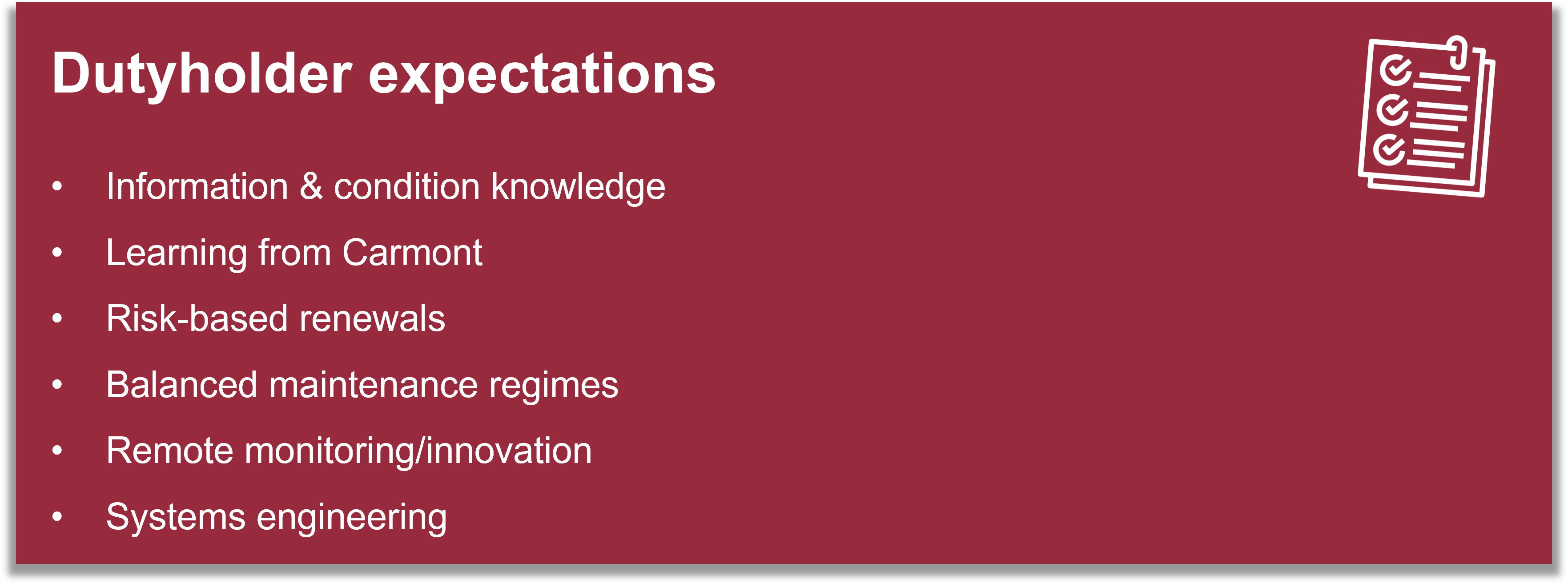
Dutyholders must maintain accurate asset inventories, recognising that incomplete asset registers or missing Civils assets data delays inspection, maintenance and renewal.
They must improve their understanding of asset condition, consequences of failure and control of risk, particularly where knowledge is variable.
Dutyholders must ensure that the reasonably foreseeable consequences of Civils assets failures are identified and mitigated.
Dutyholders must embed learning from the Carmont derailment, including improved understanding of water behaviour, drainage performance, and use of more accurate weather forecasting and real-time information.
Dutyholders are expected to ensure that improved intelligence about likelihood and consequence of failure informs prioritised renewal programmes and interim contingency arrangements.
Dutyholders should maintain effective programmes of examination and inspection, followed by assessment, and then renewal, refurbishment and maintenance, supported by complete and accurate asset information.
ORR expects increased adoption of technology and remote monitoring to reduce reliance on human systems and improve early identification of failures.
Dutyholders should adopt a systems engineering approach, recognising interactions between earthworks, drainage, structures and track, and between infrastructure and outside-party activities.
ORR activity
ORR undertakes inspection, investigation and liaison activities across all sectors, with significant emphasis on Network Rail due to residual risk levels and affordability constraints on renewals.
ORR is increasing its scrutiny of London Underground, light rail and heritage Civils assets management, reflecting their specific challenges and varying levels of maturity.
ORR focuses on helping dutyholders achieve an effective balance between renewal, refurbishment, maintenance and consequence management, ensuring compliance with the law.
The ORR will encourage duty holders to achieve this by prioritising:

Enforcement experience
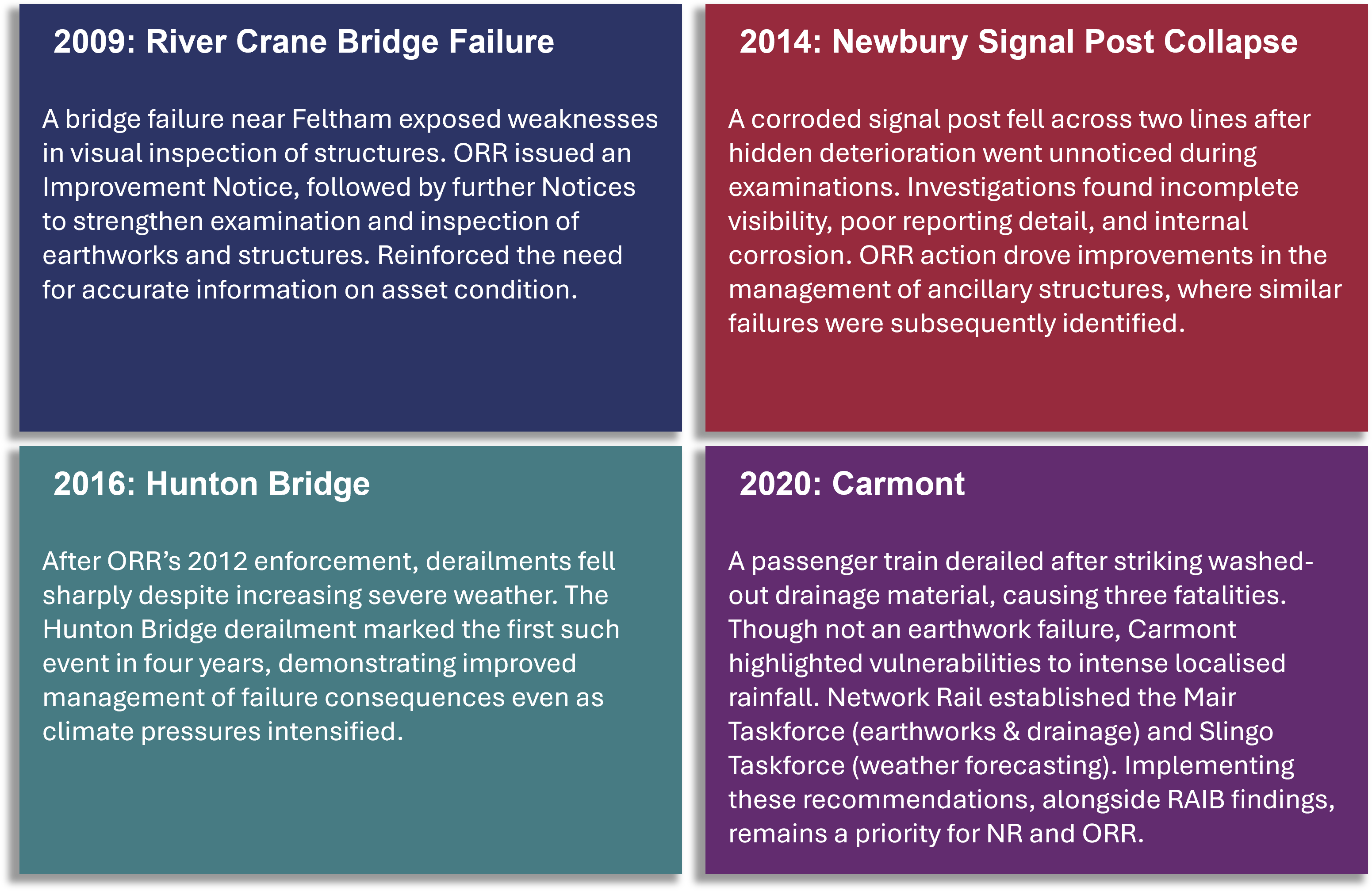
ORR’s enforcement history identifies priority risk areas. Improvement Notices have addressed visual examination weaknesses, earthwork inspection, and consequence management during adverse weather.
Enforcement action required Network Rail to strengthen consequence management, reflecting that many Civils assets cannot reasonably be renewed to modern standards in the short term. Enforcement has resulted in fewer derailments despite increasingly extreme weather.
Recent enforcement relating to ancillary structures (e.g. Newbury signal post collapse) highlighted the need for clearer examinations, removal of hidden elements and proper reporting of defects.
The following case studies summarise key events from 2009–2020 and the learning that has informed current compliance expectations: