We expect your water company to make sure it has sufficient water supplies to meet the needs of all of its consumers. Your water company must manage its water resources so that this happens.
To tackle water scarcity in drought periods, water companies must prioritise efforts to reduce leakage and drive improvements in both customer service and environmental impact. Water companies have a responsibility to communicate vital information to customers and promote water conservation practices effectively.
Ofwat, along with other regulators, is actively engaged in significant infrastructure initiatives aimed at enhancing water supply in the future.
Ofwat is a member of the National Drought Group, which is comprised of senior members from the English and Welsh governments, the Environment Agency, National Resources Wales, water companies, and farming and environmental groups.
- What does my water company do to make sure that I have enough water?
- How do companies manage water during droughts?
- Why do water companies sometimes have to restrict water supplies?
- Do you support hosepipe bans?
- Why don’t companies address leakage instead?
- What can I do to help save water?
- What is Ofwat’s role in responding to drought?
- Are droughts occurring because of Ofwat’s past decisions to block infrastructure schemes?
- What is the supply challenge we face regardless of how dry the weather is?
- What else are you doing to ensure drought is less likely in the future?
- Will I be entitled to a bill rebate as a result of any supply restrictions?
What does my water company do to make sure that I have enough water?
Every water company must prepare a 25-year plan for managing water supplies. These Water Resource Management Plans (WRMPs) must show how water companies will:
- make sure that sufficient water supplies are maintained and develop new sources of supply where required
- reduce leakage from the network
- encourage and support customers to use water wisely.
These plans must also show how water companies will meet demand during drought conditions over the long-term, taking account of things like:
- economic growth
- increases in the population
- protecting the environment by reducing the volume water taken from rivers, reservoirs and groundwater sources
- climate change.
Companies are given permission to publish their final WRMPs by the Secretary of State for the Environment, Food and Rural Affairs or by Welsh Ministers..
The latest version of WRMP guidance can be found here: Water resources planning guideline – GOV.UK.
Our water supplies are already becoming more scarce. We are raising ambition on leakage, helping to encourage water efficient behaviours and developing new sources of supply, but if we are to collectively meet the significant challenges of the future, we need to maintain a sharp focus on the issue.
How do companies manage water during droughts?
A water company’s drought plan details the actions it will take to manage water supplies and protect the environment during periods of dry weather and drought. It’s a statutory requirement from the UK government for water companies in England and Wales to produce drought plans and update them every five years, consulting on these plans with customers and other organisations.
Drought plans specify the triggers such as low rainfall levels or low reservoir levels that will prompt companies to take action to manage supply and water demand.
Different levels of action will be taken depending on the severity of the drought, including voluntary requests to customers to use less water and application of temporary restrictions on water use.
Ofwat is a statutory consultee on water company draft drought plans. Our feedback on the latest round of company drought plans can be found here: Ofwat’s engagement on company drought plans – Ofwat
Why do water companies sometimes have to restrict water supplies?
When a company crosses a drought plan trigger, due for example to increasing water scarcity issues in its area because of low rainfall, the company may need to introduce water use restrictions as a precaution.
This is to help the water company make sure that its customers always have enough water for drinking, cooking, and washing. Allowing unlimited water use during long periods of very dry weather could cause future supply issues (and more severe water use restrictions) and be very damaging to the environment.
Before reaching this point, companies, as part of their ongoing activities, should make every effort to encourage water efficient behaviours to minimise the environmental impact by reducing the need for abstraction from rivers or the implementation of water use restrictions.
However, water supply restrictions on non-essential use, including hosepipe bans, are important planned and proactive measures that are taken as part of broader drought plans to make sure that essential supplies are protected during periods of hotter, drier weather – and to reduce the impact of times of water stress upon the environment
In addition to taking action to reduce demand, companies should use their available resources to make sure supplies remain resilient. This includes actions such as transferring water between supply zones and taking bulk supplies from other companies where possible. Companies will also make use of back-up sources that are available and maximise the water available through their operational activities.
Find out - Hosepipe bans and non-essential use bans: what they mean for you.
Do you support hosepipe bans?
Ofwat supports water companies using water use restrictions such as temporary use bans (TUBs) to manage water resources during times of drought and dry weather. This intervention is an integral part of company drought plans and can help to avoid the need for more severe water use restrictions and to protect the environment. Companies should follow their drought plans and apply restrictions in line with the levels of service they have committed to deliver for customers.
Before imposing customer water use restrictions and during any period covered by drought plan interventions, companies should have been managing their water resources efficiently and optimising their available supplies. For example, where possible water can be transferred between a company’s water resource zones or transferred in from another company.
Water efficiency is a key part of ensuring supply and demand is balanced, even more so during periods of dry weather or drought. Therefore, it’s important that companies communicate clearly with customers during periods of dry weather and use TUBs effectively.
Why don’t companies address leakage instead?
Leakage in England and Wales is at its lowest ever level since privatisation, having been reduced by 41% since 1989.
Ofwat sets stretching targets for companies to reduce leakage, in the 2020-25 period we set targets for companies to deliver a 16% reduction in leakage and for 2025-30 we are expecting companies to deliver a further reduction of 17%.
To support this, we have made cost allowances of around £700 million to address leakage through pressure management, fixing leaks, and replacing water mains.
We have also made a further £1.7 billion cost allowance for the installation of 10.4 million smart meters to support reductions in leakage and consumption. Our targets and cost allowances are supporting companies’ commitment to deliver a 50% reduction in leakage from 2017-18 levels by 2050.
Ofwat closely monitors leakage performance and will take robust action when we find that water companies have not met their leakage commitments or where there is evidence that leakage has not been accurately reported.
Money is returned to customers in the form of lower bills where companies do not meet the commitments they have made to reduce leakage. Between 2020 and 2024, almost £50 million was handed back to customers in this way
We expect companies to effectively manage leakage levels in response to various external challenges. Responding to extended periods of hot weather is an example of this. During periods of hot, dry weather the ground tends to shrink as it dries up. You can see this effect where cracks start to appear in grassed areas. This can cause additional stress to be placed on water mains and unfortunately this can increase leakage.
Many companies are already engaging even more resources to find and fix these additional leaks, supported by the funding decisions made by Ofwat through the price review process.
It’s also important to note that even if leakage was completely stopped, our full water needs would not be met. There is also a need to work on reducing overall demand and increasing supply.
Water companies publish information about the services they provide, including work to reduce leaks: visit Discover Water website.
Find out more about reducing leakage in the water industry.
What can I do to help save water?
A wide range of practical ideas are available on our dedicated page: water saving tips.
As a customer, you are responsible for the supply pipe to your home. This is the pipe that runs from the boundary of your property into your home. About a third of all leakage is from customers’ supply pipes. A number of companies offer free pipe repairs. You should contact your water company to find out more.
You can also help by reporting leaks in public spaces such as burst water mains, to your local water company straight away. Many companies now make this easy, via their websites or by email or social media, alongside telephone and letters.
Your water company is responsible for fixing leaks in water mains as quickly as possible. Although priority is usually given to major bursts, companies should be quick to respond to your reports of visible leaks.
Your water company will also offer you help to save water, including advice and simple-to-fit measures, such as tap flow adjusters, low flow shower heads, and water butts. Some companies also work with charities to offer home advice visits.
Find more water saving tips.
What is Ofwat’s role in responding to drought?
Droughts reduce water supplies to different users, creating a range of impacts. They can also affect rivers or aquifers (underground water sources), depending on when the lack of rainfall occurs. Some droughts affect a large area, while others are concentrated in a few catchments.
The Environment Agency is responsible for safeguarding water resources in England and protecting the environment – having overall responsibility for safeguarding the environment during drought and overseeing the actions water companies take to secure public water supplies.
Find out more about how the Environment Agency works with government, water companies and others to manage water resources during a drought in England. In Wales this is overseen by Natural Resources Wales. Drought management in Wales is described here.
Responsibilities in more detail are as follows:
- Environment Agency and Natural Resources Wales – provide strategic oversight and are responsible for monitoring, reporting, advising and acting to reduce the impact of a drought on the environment and water users. in England Wales respectively.
- Water companies – responsible for managing water supply for their customers and taking a range of measures to maintain supplies whilst minimising environmental impact.
- UK Government (Defra – Department for Environment Food and Rural Affairs) and the Welsh Government – responsible for policies relating to water resources. Eg. ensure the legislative framework for water resource management is appropriate, direct water companies on water resources and drought plans, and work with other agencies like the Environment Agency and Natural Resources Wales during drought events.
Water companies are ultimately responsible for managing water supplies to meet the needs of customers while protecting the environment. It is the role of the Environment Agency and Natural Resources Wales to monitor, report and act to reduce the impact of drought.
Ofwat as the economic regulator does not have a lead operational response role in the event of any drought.
Dependent on need, the National Drought Group (chaired by the Environment Agency, is convened in England, whilst in Wales there is the Wales Drought Liaison Group (chaired by the Welsh Government). The Environment Agency and Natural Resources Wales also engage closely in respect to the cross-border catchments and related issues.
The Environment Agency does not use a single definition of drought. The Environment Agency drought framework has five stages of drought management: normal; prolonged dry weather; drought (TUBs are used from this stage); severe drought; and recovering drought stage.
Each of the Environment Agency’s 14 operational areas has a drought plan, outlining the steps taken at the local level. National-level actions include standing up the National Drought Group and maintaining communication with Natural Resources Wales (particularly regarding cross-border catchments).
In Wales, Natural Resources Wales classifies drought into four stages: normal, prolonged dry weather, drought and recovery from drought. The drought stage is defined as “Significant period of low river levels and shortage of rainfall. Significantly impacted ecosystems and pressures on the agricultural sector. High stress on the water supply system with potentially severe restrictions”. Unlike the Environment Agency, there is no severe drought stage – it all falls under the classification of drought.
Are droughts occurring because of Ofwat’s past decisions to block infrastructure schemes?
No. Droughts are naturally occurring events. However resilient our supply systems are, the environment and other sectors will face times of stress during prolonged periods of dry weather.
The sector is actively working to increase resilience of supplies to meet future challenges (climate change, the need to protect the environment, supporting economic growth etc) by reducing demand, improving efficiency and increasing sources of supply.
Ofwat aims to be an enabler of essential new infrastructure and has been working with the Environment Agency and Drinking Water Inspectorate to progress a pipeline of new water supply infrastructure through the Regulators’ Alliance for Progressing Infrastructure Development (RAPID) programme since the scale of our water supply needs became clear in the latter half of the last decade. Funding through PR19 and RAPID means supply projects are in fact now more advanced than they otherwise would have been.
At PR24, our decisions allowed for £5 billion to be spent on expanding supplies. This includes funding for 424 million extra litres of water per day – currently over three million people’s usage – to be delivered by 2030. Of this, £2 billion will kick off 30 large longer-term schemes, which will ultimately represent around £50 billion in investment.
The last large-scale infrastructure project to have been proposed but not delivered was the Cheddar 2 Reservoir in Somerset, plans for which were developed by Bristol Water to support a new power station.
When plans for the new power station were scrapped, the supporting reservoir plans were also discontinued in 2014. Ofwat determined that the costs to customers were not justifiable without the need for the power station. Ofwat’s position was then endorsed by the CMA when a challenge was raised on this decision.
Since this period, changes to abstraction permits to protect the environmental value of waterways, and a better understanding of climate change impacts on our water resources have significantly changed the scale of additional water supply that is now needed.
What is the supply challenge we face regardless of how dry the weather is?
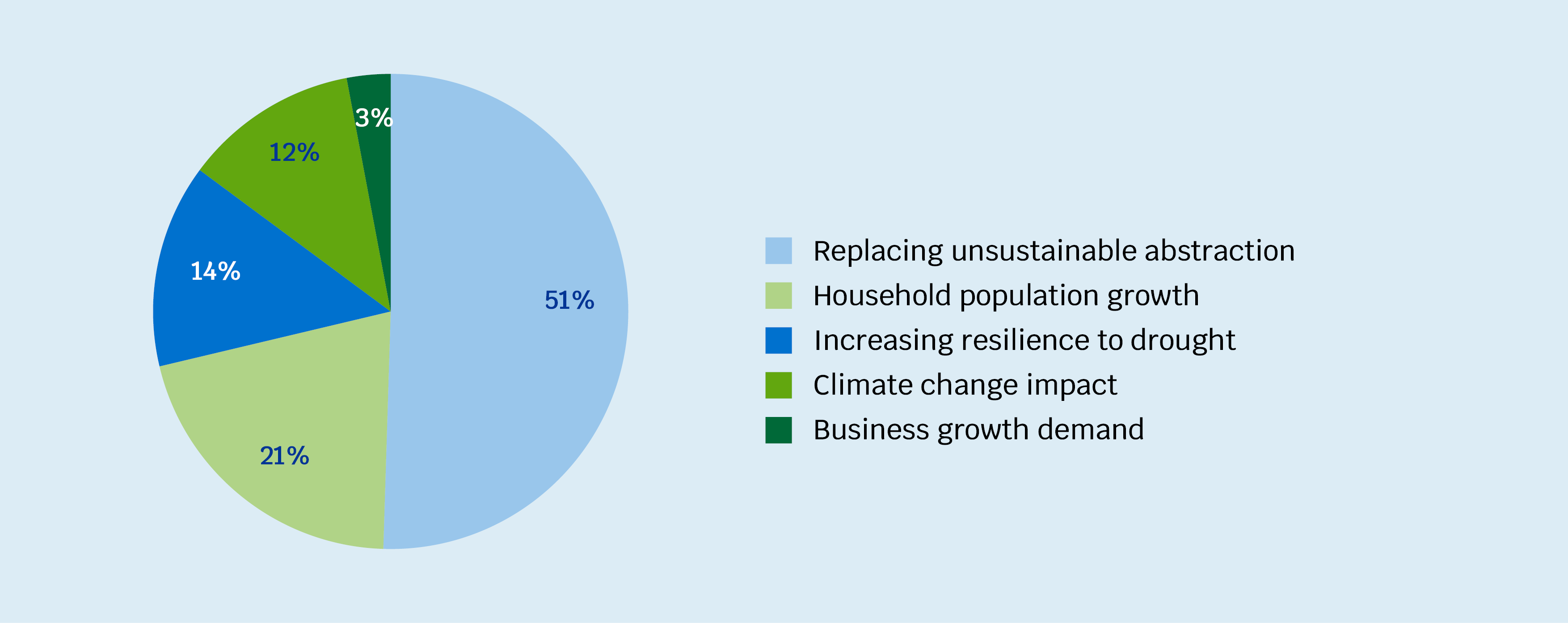
Without action to address water scarcity, and a halt to the current planning and investment into water resources, England and Wales would face a water deficit of around 5 billion litres per day by 2050 – equivalent to a third of the water currently in supply.
This is due to a combination of climate change, economic and population growth, and changes to abstraction licences. The need to protect our environment by taking less water from sensitive natural sources, such as the UK’s unique chalk streams, makes up over half of the supply deficit.
We need to address this challenge through a combination of approaches: reducing leakage, increasing efficiency of water usage, and new water supply infrastructure.
The supply challenge in 2025
What else are you doing to ensure drought is less likely in the future?
Drought is a natural occurrence that is becoming more likely because of the impacts of our changing climate.
Over the coming decades, nine new reservoirs will be created to create enough additional capacity to serve the daily needs of 2.5 million households. In total, 30 major infrastructure projects will provide enough water to meet the daily needs of around a third of England and Wales’ population. This will help us adapt to climate change, build resilience to drought and leave more water in the natural environment.
The Ofwat Innovation Fund, which is being doubled to £400million, and the introduction of the £100million Water Efficiency Fund and Campaign will help address sector-wide challenges. The Innovation Fund will continue to encourage fresh approaches; the Water Efficiency Fund will use a range of water efficiency approaches to stimulate a sustained and measurable reduction in water demand across England and Wales.
And through PR24, more than 10 million smart meters will be installed between 2025 and 2030, helping customer better manage their water use and ultimately their bills – as well as enabling earlier detection of water loss due to leakage. We have also set targets across the 2025-30 period to incentivise companies to reduce leakage by 17%, per capita consumption by 6% and business demand by 1%.
Will I be entitled to a bill rebate as a result of any supply restrictions?
All companies are required under licence conditions to pay compensation to customers where essential household water supplies are interrupted as a result of restrictions authorised by emergency drought orders. This includes water supplies for purposes such as:
- cooking
- washing
- drinking
- flushing the toilet
It does not include uses such as watering the garden, car washing or filling a pool.
Although his measure is not part of the guaranteed standards scheme laid down by government, it does mean that customers have access to compensation if essential supplies are not maintained.
Find out more about standards of service.