This section provides a brief history of AI, its different types, its applications and its limitations.
This section supports Principle 1: You know what AI is and what its limitations are.
What is AI?
AI is not new. The term ‘artificial intelligence’ was coined at Dartmouth in 1956 during a gathering of scientists who were intent on exploring the potential of computing to emulate human reasoning. Since then, there have been recurring waves of progress and excitement, followed by periods of waning interest and investment which are referred to as ‘AI winters’. We use the definition of AI as adopted by countries in the Organization for Economic Co-operation and Development (OECD), which publishes the following in updates to the OECD’s definition of an AI system explained:
“An AI system is a machine-based system that, for explicit or implicit objectives, infers, from the input it receives, how to generate outputs such as predictions, content, recommendations, or decisions that can influence physical or virtual environments. Different AI systems vary in their levels of autonomy and adaptiveness after deployment.”
The UK government’s paper establishing a pro-innovation approach to regulating AI suggests that these systems are adaptable because they can find new ways to meet the objectives set by humans, and autonomous because, once programmed, they can operate with varying levels of autonomy, including without human control.
Fields of AI
AI comprises multiple complex and interconnected fields which include diverse algorithms, modes and methodologies. Rather than the retroactive enhancement of previously trained models, advances in just one of these fields will typically inspire and inform new developments across related technologies, leading to the creation of more accurate, capable, and innovative models over time.
The following diagram illustrates the interdependencies between some existing and emerging fields of AI. As you can see, capturing the evolving complexity of AI is a challenging task.
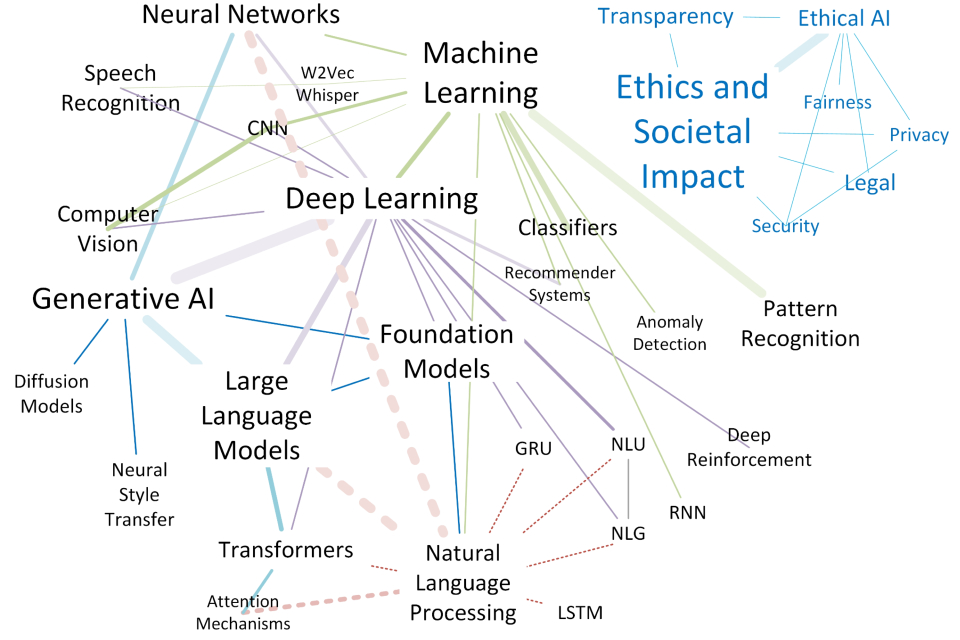
The complexity of the AI space continues to increase. As AI technologies evolve, they often branch out, advancing some research areas while leaving others unchanged. For example, in the field of computer vision (CV) some legacy systems still thrive today due to the simplicity of their behaviours, their low computational and memory requirements, and their stability and well-proven performance. These legacy CV systems fall within the domain of machine learning (ML). However, some more recent and capable CV systems, such as those used in self-driving or medical imaging systems, are considerably more complex.
As software and algorithms are advancing, so too is hardware infrastructure. Traditional computer processing units (CPUs) can struggle with the large amounts of data and calculations AI requires. New types of hardware have been implemented to train and run AI models faster and more efficiently.
The modern AI system (which can also be conceptualised as advanced modern algorithms) can have hundreds of billions, or even trillions, of settings that can be adjusted to learn faster from the data. These systems are also trained on advanced hardware for parallel computing.
Below is an overview of the main fields of AI. For a deeper understanding of these fields, you can:
take the free e-learning courses available on Civil Service Learning
use the other training opportunities mentioned in the acquiring skills and talent section
refer to the AI insights articles
Neural networks
Neural Networks (NNs) are a computational model inspired by biological NNs in the human brain. According to the history of Neural Networks, they were initially created as an aspect of ML in the 1940s but they may now be considered as components of more elaborate Deep Learning (DL) systems.
How do NNs work?
An NN learns through exposure to data in training cycles. During these cycles, the model gradually adjusts the connections between different parts of the network, setting the weights between nodes of adjacent layers. When the model makes an error, the network uses optimisation algorithms such as gradient descent to change its internal parameters to minimise the difference between predicted outputs and actual target values to check how far off it was. The error is then adjusted backwards through the network by updating the weights by a very small amount, also known as the learning rate, in the direction that will serve to minimise that error. Repeated executions of this process during the training phase tune the network so that it can generalise faithfully on related data it has never seen before.
Applications of NNs
NNs have a wide range of applications due to their ability to recognise patterns, process new data, make predictions and improve over time. NNs are often deployed in image recognition applications, medical imaging, speech recognition models, autonomous systems, and in many other examples.
Machine learning
ML is the branch of AI that learns from data. It does this by extracting features from data and learning the relationships between those features. ML can provide the public sector with unique and quantifiable insights into data that were previously impossible, expensive, or of limited or short-term utility.
How does ML work?
ML uses algorithms to analyse data, learn patterns, and then make predictions or decisions based on new data. To work effectively, ML systems must be trained using carefully selected information. This training helps to create an optimised model that identifies pertinent features in the data, and weights their relationships to understand how they relate to each other.
ML models can be trained using either labelled or unlabelled data, or a combination of both. Labelled data is data that has been tagged or categorised in advance. This form of training is called supervised learning because the model is trained under the supervision of labelled data.
Each example in the training data set comes with a correct answer, or label, from which the model is supposed to learn. When unlabelled data is used, the model learns to identify patterns, groupings or structures on its own. This is referred to as ‘unsupervised learning’.
Applications of ML
The ability of ML models to learn from data, identify changes, and update based on changes in underlying data enables a host of capabilities that would simply not be possible through traditional linear, deterministic systems. ML models can function either as components within larger AI systems or as individual processing steps in workflows. They underpin applications such as fraud detection, sentiment analysis, image processing and summarisation, and act as data processing participants in a sequence of operations.
Large language models (LLMs) are advanced machine learning models built using deep neural networks.
Deep learning
Deep learning (DL) is a part of machine learning that uses more advanced models, especially large neural networks, to learn patterns from big sets of data. While deep learning can handle very complex problems, such as understanding images or speech, it usually needs a lot of data and computing power.
On the other hand, traditional machine learning works well for simpler tasks. It’s also easier to set up and can be used even when there isn’t much data available. Deep learning builds on machine learning, but each has its strengths depending on the problem.
How does DL work?
DL models initially detect simple features, such as edges in an image, and gradually combine them to recognise more complex patterns, such as identifying a face or understanding speech.
Applications of DL
DL is used in advanced applications like biomedical research and autonomous driving, but also in image and speech recognition (SR), natural language processing (NLP), personalised recommendations, and more.
Speech recognition
SR, sometimes referred to as automatic speech recognition (ASR), is a field of ML dedicated to processing speech. SR includes both systems that convert speech into text (STT) and new speech-to-speech (S2S) systems.
How does SR work?
Computers only understand numbers, so the challenge with SR is to turn spoken words into numbers while keeping their meaning and context. To do so, SR models first convert speech into numeric representations called spectrograms, which show sound frequencies over time. DL models then analyse these spectrograms to identify sounds, words and sentences. In STT, this process results in written text. In S2S, the recognised words are further processed by another model that translates the text into a different language, which is then turned back into spoken words.
Applications of SR
SR has expanded considerably over recent years, especially in terms of voice recognition. This technology is now used in banking, personal agents like Siri and Alexa, and general SR functionality built into phones and cars, among other things. Modern SR applications include call analytics, emergency services, meeting summarisation, media subtitling, and more.
Computer vision
CV is a field of AI and ML that enables computers to interpret, analyse and understand visual information such as images and videos in order to perform tasks such as object recognition, facial recognition and scene understanding. Although CV has been researched since the 1960s, it has progressed considerably in recent decades due to a combination of developments in model architecture, hardware performance, and data quality and volumes.
How does CV work?
CV systems aim to automatically extract meaningful information from visual data which enables machines to perform accurate interpretation and analysis. Common tasks include image classification, object detection, video analysis, and image segmentation.
To perform these tasks, CV uses algorithms to break down images into pixels and process the pixels to detect edges, shapes and colours. The system then uses this information to recognise objects, people or scenes, which is similar to how our brains process visual information. This allows computers to identify the content of images.
Applications of CV
CV has many applications in fields such as facial recognition, quality control, healthcare, medical imaging, surveillance, robotics, and more.
Natural language processing
Natural language processing (NLP) is a field within AI that focuses on processing human language. NLP combines computational linguistics and machine learning to analyse large amounts of natural language data and comprehend, interpret, translate, and generate language and language-related data. LLMs, which are in widespread use, are a subset of NLP, with NLP preceding them by several decades according to this technology review of Natural Language Processing.
How does NLP work?
NLP involves preprocessing techniques such as noise reduction, tokenisation, stop-word removal, stemming (or lemmatisation), vectorisation and embeddings to transform text into numerical representations. These representations are analysed using ML models that learn during training to identify important patterns and linguistic features. The models use elements such as word order and contextual relationships to interpret the meaning of text accurately and to generate desired outputs.
Applications of NLP
NLP is used for a wide variety of applications and tasks related to language, including machine translation, document classification, sentiment analysis, parts-of-speech tagging, named-entity recognition, text summarisation and conversational AI.
For government departments, NLP can play an important role in managing and processing large volumes of human language data from sources like emails, letters and online forms, enabling efficient and meaningful analysis.
Generative AI
Generative AI is a subset of AI capable of generating text, images, video or other forms of output by using probabilistic models trained across various domains. Generative AI learns from large amounts of specially curated training data to discern and replicate complex patterns and structures. The output of generative AI models mimics the characteristics learned from the training data, enabling a range of novel applications. These include personalised content generation, advanced analysis and evaluation, and aiding creative processes.
Examples of publicly accessible generative AI tools are ChatGPT, Claude, Gemini and Llama. Generative AI is also becoming increasingly integrated into mainstream products. Examples of this include the Adobe Photoshop Generative Fill tool, AWS ChatOps Chatbot, Microsoft 365 Copilot and Google Duet AI.
How does generative AI work?
Generative AI uses large quantities of carefully selected data to train models so they can learn the underlying patterns and structure of data. A well-known example of generative AI are LLMs, which are large neural networks specifically trained on text and natural language data to generate high quality, text-based outputs. However, there are many other generative AI models that are not purely text-based.
Once trained, generative AI models are capable of generating new content consistent with the features and relationships learned from the training data. When a user provides a prompt or input to an LLM, the model evaluates the probability of potential responses based on what it has learned from its training data. It then selects and presents the response that is likeliest to be the right fit for the given prompt.
Applications of generative AI
The applications of generative AI go beyond the simple generation of new text or images. For example, generative AI is used in medicine to test molecular structures for drug discovery, and in the financial sector to generate multimodal data surfaces approximating trading and market conditions in order to test safety, security, trading and trade surveillance models.
Generative Adversarial Networks (GANs) are commonly used for generating synthetic datasets to enhance the training of ML models, as well as in applications such as creating realistic images, including text-to-image synthesis.
You can explore more applications of generative AI in the applications of AI in the government section. For more information on how to build, fine-tune and use generative AI solutions, refer to our series of AI insights.
Agentic AI
Agentic AI is a class of artificial intelligence systems which are designed to operate as autonomous agents. These digital agents are capable of perceiving their environment, making decisions, and executing actions toward achieving defined goals.
Unlike traditional AI systems that focus on narrow tasks or outputs, agentic AI systems combine perception, reasoning, planning, and action within an integrated control loop. This enables agentic AI to operate with a degree of independence and to adapt dynamically to changing contexts and objectives without the need for constant human oversight.
Agentic AI systems rely on language models, including those that are augmented by modules such as planners, memory systems, and tool interfaces. These components allow the agent to break down complex tasks, call external functions or APIs, and to continuously refine the AI’s actions through feedback.
A few examples of publicly known agentic AI systems include OpenAI Operator, Anthropic Computer Use, CrewAI, AutoGPT, and Beam AI. These systems are all designed to autonomously decompose tasks, use tools, and to achieve multi-step goals.
Types of AI agents
AI agents can be broadly categorised by their level of sophistication and autonomy. These categories are:
simple reflex agents, which act purely on immediate inputs using predefined rules
model-based agents, which maintain an internal representation of the environment to make more informed decisions
utility-based agents, which weigh different outcomes to maximise overall benefit
learning agents, which improve their performance over time by learning from interactions and feedback
How AI agents work
AI agents work by combining perception, reasoning, planning, and action into a continuous loop that allows them to operate autonomously toward a goal.
At its core, an AI agent perceives its environment using sensors or digital inputs. It then interprets this information and uses reasoning techniques such as chain-of-thought or tree-of-thought methods to understand the problem and break it down into smaller tasks.
The agent then develops a plan to accomplish these tasks. This will often include deciding which tools, APIs, or actions to use to reach its objective efficiently. Once this plan is in place, the agent carries out actions in the environment. It will gather new observations and adjust its behaviour in real time.
This cycle allows the agent to refine its approach, handle uncertainty, and learn from outcomes using memory or feedback mechanisms.
Applications of AI agents
The applications of AI agents extend far beyond simple task automation. They can reach into fields that require continuous decision-making, adaptability, and multi-step execution.
Within software development, AI agents can act as autonomous coding assistants by helping to write, test, and optimise code.
When integrated within customer service roles, agentic AI can handle complex inquiries by combining conversation, database access, and policy reasoning.
In cybersecurity, agents are able to monitor systems for anomalies and automatically respond to emerging threats. When applied to the government and public service sector, they can assist with tasks such as processing documents, analysing policy and governance processes, and even helping to engage with members of the public.
AI agents are also transforming industries such as finance by powering algorithmic trading, and offering assistance with risk management and fraud detection. Likewise, in the manufacturing sector, agentic AI offers predictive maintenance and supply chain operation optimisation.
As AI agents become more advanced, their use in multi-agent systems and human-AI teams will open new frontiers in scientific research, business operations, and personalised digital assistants.
Risks of AI agents
For all of their benefits, the potential technical risks of AI agents can go beyond ordinary software bugs. It’s important to understand that the very nature of agentic AI’s autonomy and adaptability can introduce new modes of failure.
For example, agents can experience goal misalignment, which is where they pursue unintended objectives or exploit loopholes in their instructions, leading to unpredictable or harmful outcomes. They may also hallucinate false information or make flawed decisions due to limitations in reasoning or data quality.
Another critical technical concern is security. AI agents are vulnerable to adversarial attacks, system hijacking, and malicious misuse, such as being repurposed for automated cyberattacks or the spread of disinformation at scale.
Ethically, AI agents can produce opaque or biased decisions, making it difficult to trace how outcomes are reached or to ensure fairness and accountability. In sensitive domains such as healthcare, finance, or criminal justice, these issues can lead to unjust or harmful outcomes. You can read more on this in the Automated decision making (ADM) section.
Mitigation of AI agent risks
The mitigation of technical risks in AI agents must focus on building systems that are secure, robust, and transparent.
A key part of this is ensuring the implementation of rigorous testing, validation processes, and introducing failsafe mechanisms that can pause or shut down agents when anomalies are detected.
Additionally, incorporating explainability features such as logging and traceable decision outputs makes it easier to audit agent behaviour and to correct errors before they escalate. These features will allow you to intervene when necessary.
To address ethical risks, it is critical to embed principles of fairness, transparency, and accountability into the design and deployment of agentic systems.This can be achieved by developing clear ethical guidelines requiring agents to comply with privacy and non-discrimination standards. Post-hoc interpretability tools that allow stakeholders to understand how decisions were made by AI systems are vital for this.
It should be noted that although agentic AI introduces new challenges, robust and clear risk management should allow you to confidently explore the abilities of this technology.
You can learn more about AI agents, Agentic Workflows, and Integrated Agents in our AI insights series.
Ethics and societal impact
As research developments have increased the presence of AI in the public sector and everyday life, ethical considerations, social wellbeing and public good remain essential to the adoption and use of AI.
Applications of AI in government offer important benefits to improving productivity and enhancing access to services. However, there are also limitations of AI. It can have two-sided impacts if not used in responsible ways and with the appropriate safeguards in place.
You can read more on the legal, ethical and security implications of AI in the using AI safely and responsibly section.
Applications of AI in government
AI has a broad range of capabilities and has been relevant to the work of the government for many years. The ability of generative AI to process language and produce new text, images and code has further enhanced the potential applications of AI technology.
You can find an overview of how government bodies are using AI, including the central government’s plans for supporting the adoption of AI, in the report on the use of artificial intelligence in government by the National Audit Office (NAO).
The following table presents some examples of potential applications of both AI and generative AI technologies in government.
| Application | AI | Generative AI |
|---|---|---|
| Speed up the delivery of services | Machine learning and optical character recognition (OCR) algorithms can support the processing of thousands of handwritten letters per day, reducing response times. | Can retrieve relevant organisational information faster to answer digital queries or route email correspondence to the right parts of the business. |
| Reduce staff workload | AI technologies for facial recognition and data analytics allow for the automatic control of passports in airports, freeing staff from this task. | Can suggest first drafts of routine email responses or computer code, acting as an autocomplete tool for algorithms. |
| Perform complicated tasks | ML can analyse very large data sets, identify trends and anomalies in complex historical data, and support data-driven decision-making. | Can help review and summarise huge amounts of information, as well as identify and correct errors in long algorithms. |
| Perform specialist tasks more cost-effectively | Predictive analytics can identify future needs for resources, optimising budget allocations and planning. ML can detect fraudulent activities in different fields, preventing financial losses and protecting against cyber threats. | Can summarise documentation containing specialist language like financial or legal terms, or translate a document into several different languages. |
| Improve the quality of services |
Recommender systems can help users navigate government web pages and find the information they need. AI can also analyse thousands of feedback messages and suggest service improvements. | Can improve the readability and accessibility of information on web pages. For example, by simplifying complex language, improving formatting and generating alternative text for images. |
The section on identifying use cases for AI can help you to select appropriate applications of AI tools. For real-life examples of some of these applications, refer to Appendix: AI use cases in the public sector or the tools library in the AI Knowledge Hub.
However, AI systems still have limitations. You should make sure that you understand these and build appropriate testing and controls into any AI solutions.
Limitations of AI
The capabilities of AI are improving over time but they do not provide the answer to every problem. Some of the limitations of AI systems include:
- bias, where several mechanisms can cause the predictions or outcomes of an AI model to systematically deviate from true values, affecting overall performance. Model bias reflects inherent inaccuracies within the structure or assumptions of the machine learning model. For instance, if a model is too simplistic, it may fail to capture the underlying patterns in its training data which can lead to systematic errors in predictions.
Algorithmic bias, on the other hand, arises when these systematic errors result in the unequal treatment of different groups or individuals. Algorithmic bias often stems from biased training data or from the decision-making criteria embedded in the AI system.
For more information, refer to the review into bias in algorithmic decision-making and the introduction to AI assurance guidance. There is more about the ethical implications of bias in the fairness, bias and discrimination section
data quantity and quality, as AI systems heavily depend on both the quality and quantity of data to achieve accuracy. Insufficient data can hinder the model’s ability to generalise effectively, while poor quality, biased or noisy data can lead to inaccurate outcomes if not appropriately managed
accuracy and robustness, as it’s difficult to produce an AI system which provides 100% accurate outputs under all conditions. AI models can also be sensitive to minor perturbations or adversarial attacks, leading to incorrect predictions or decisions when faced with unexpected input. It is important to consider the objective measures against which AI outputs will be assessed and to recognise any factors that impact these measures
transparency and explainability, as some AI models, such as deep learning architectures and convolutional or recurrent neural networks, can be so sophisticated that tracing how a specific input leads to a specific output becomes challenging. This complexity hinders the ability to provide easily interpretable explanations, making it difficult for users to trust or understand how the model arrived at a specific outcome
cost and sustainability as, depending on the tools being used, AI implementation can be complex, time consuming and have considerable compute costs. Ongoing investment is needed to maintain these systems, update them with new data if required, and ensure their performance remains stable over time. It’s important to consider the sustainability impact of deploying AI systems and check if there are more environmentally friendly alternatives
Generative AI also has specific limitations. Having checks and assurance in place when using generative AI in your organisation will help to avoid limitations such as:
hallucination or confabulation, where LLMs and other probabilistic generative models are susceptible to producing content that appears plausible but may be factually incorrect. This occurs because these models generate content by returning the most likely output for a given input based on patterns learned from their training data without any actual understanding of the content. It can sometimes be very difficult to detect this hallucinated content, as LLMs have been designed to be highly proficient at generating coherent and contextually appropriate text even in uncertainty, making the false information appear credible and often indistinguishable from accurate content
lack of critical thinking, personal experience and judgement. While LLM-based AI systems can generate outputs that may seem reasonable and human-like, they lack true critical thinking and judgment. These models do not possess the ability to assess context beyond the data they have been trained on, which can limit their capacity to provide nuanced insights or to make informed decisions. Consequently, their responses may oversimplify complex issues or fail to account for important factors, leading to potential inaccuracies or misunderstandings
sensitive or inappropriate context, where LLMs can generate offensive or inappropriate content if not properly guided, since they can replicate any bias or toxic material present in the data they were trained on
domain expertise, as LLMs are not domain experts. They are also not a substitute for professional advice, especially in legal, medical or other critical areas where precise and contextually relevant information is essential
dynamic real-time information retrieval as, although many well-known LLMs such as ChatGPT, Gemini, Claude and Copilot are able to include access to real-time internet data in their results, there are still LLMs that do not provide real-time access to the internet by default
Understand AI
This information complements and updates the AI Playbook for the UK Government . It reflects the latest guidance and best practice. This will be updated as needed.