Jolani: from Chance Purchase to Community Enterprise

The Story of a Swedish barque wrecked off Berwick-upon-Tweed in 1916

Modern colour oil painting of barque in port view on a calm blue sea against light grey clouds, dwarfing smaller sailing vessels around her
The Jolani under full sail, by Christer Hägg, former Captain of the Royal Swedish Navy, RSwN, ret, 2026. © and by kind permission of Christer Hägg

We welcome back Maritime Research Specialist Tanja Watson, who writes:

Built in Germany, registered in Hawaii, community-owned for a period in Sweden, and eventually wrecked off the Northumberland coast in November 1916, the barque Jolani had a 40-year career that spanned multiple owners, registries, and oceans. This article traces the vessel’s history from her construction in 1876 to her loss in 1916, exploring how one ship became associated with global trade networks, maritime enterprise, and local memory.

Ship origins and a Hawaiian Connection

Constructed in 1876 at the Johann Ahlers shipyard in Elsfleth, Germany, Jolani was built for tropical service and was notable for her unusually refined construction and fittings. Constructed from pitch-pine with fittings of teak, beechwood, and ebony, she possessed unusually elegant proportions, with the form and grace more commonly associated with a clipper than a working cargo vessel. Measuring approximately 52 metres in length, 9.5 metres in breadth, and 5.5 metres in depth, she was 798 net register tons, 1,400 gross.

The vessel was commissioned for Bremen shipowner H. Hackfeld, whose commercial interests were closely connected to Hawaii. For economic reasons, much of Hackfeld’s fleet operated under Hawaiian registry, and Jolani was accordingly registered in Honolulu, despite being German-owned. The ship’s fittings reflected these Pacific associations. The elegant salon gave her an almost yacht-like character, while a large, signed portrait of King Kalākaua displayed aboard encouraged a long-standing belief that the ship had once belonged to Hawaiian royalty.

Historic black & white portrait photo of indigenous Hawaiian with black curly hair and a curly beard and moustache in a European-style braided military uniform covered with extensive regalia
Hawai’i State Archives image of King David Kalākaua (reigned 1874-91).
By James J. Williams – Hawaii State Archives. Call Number: PPWD-15-4.018, Public Domain, https://commons.wikimedia.org/w/index.php?curid=10830218

That story persisted for decades but appears to have been incorrect. Research undertaken in the 1950s demonstrated that royal ownership was unlikely. Instead, the Hawaiian imagery seems to have functioned as both tribute and commercial branding. Even the vessel’s name reflected these connections: Iolani is linguistically closer to the Hawaiian spelling, as the letter J does not exist in Hawaiian. The name has been interpreted as meaning “God of Heaven,” although alternative translations exist.

Arrival in Sweden and the Viken Years

Jolani entered Swedish ownership in 1884: local tradition says that Captain P. A. Andreasson Lilja suddenly decided on a whim to purchase the vessel at auction in Hamburg for 75,000 kronor. Financing such a vessel, however, required far broader support, and ownership quickly developed into a community-backed venture involving 25 guarantors from the seafaring community of Viken on Sweden’s south-west coast.

The purchase reflected wider developments in Swedish maritime history. During the 1880s, locally organised shipping partnerships flourished during the height of the bondeseglation (“farmer-sailing”) era, when communities pooled capital, labour, and risk to participate in expanding global trade. Within this context, Jolani became one of the best-known vessels associated with Viken, serving as the town’s flagship between 1884 and 1897.

The vessel’s significance extended beyond ownership structures. Captain Andreasson Lilja commanded the ship until 1896 and appears to have developed a particularly close attachment to her, naming a son who was born shortly after the purchase “Jolani”. That son would later pursue a maritime career himself.

Trading Across Oceans

Under Swedish ownership, Jolani entered trading networks extending far beyond Scandinavia. Voyages regularly passed Germany, Holland, and England before continuing towards Mauritius, the Far East and India, South Africa, and South America, with occasional voyages reaching North America.

Although the vessel rarely returned to Sweden, her links with Viken remained visible. Whenever Jolani passed near the town, the large Hawaiian flag retained aboard was reportedly hoisted from the home of principal owner Tufve Pettersson. Measuring almost six metres in length, the flag became a memorable sight above the village’s low buildings—a reminder that this locally owned vessel spent much of her working life on distant oceans.

Historic sepia photograph reprodced in newspaper, so not hi-res, of twelve men arranged in three rows (6-4-2), with the front two holding a lifebelt with the ship's name. All the men are in working clothes with hats.
Photograph of Jolani‘s crew in 1908, with captain Lars Göransson in the centre. Published in Swedish newspaper Kristianstadsbladet, 5 January 1956.

New Owners and the Final Voyage

After leaving Viken ownership in 1897 under Captain Nils Pettersson, Jolani continued under Swedish ownership while passing through several ports of registration. She transferred first to Malmö, later to Åhus in 1907, and finally to Stockholm in 1916.

Her final voyage began in Gothenburg during November 1916, still under Captain Lars Göransson. Bound for Newcastle-upon-Tyne with pit props and railway sleepers, the ageing vessel encountered severe weather in the North Sea. The storm destroyed her sails, smashed the lifeboats, and left the barque increasingly unmanageable before she stranded near Goswick Bay on the Northumberland coast on or around 19 November 1916 with 14 crew aboard. (Becoming unmanageable in severe weather was a not uncommon fate for vessels with railway sleepers as part of the cargo – if they broke loose, due to their size and weight, they were a significant liability.)

Modern internet map of the North Sea with the UK to left (west) and Denmark and Sweden to right (east)
Google map centred on Viken, Jolani‘s homeport until 1897, depicting the intended voyage from Gothenburg (upper right) to Newcastle-upon-Tyne (lower left)

Rescue at Goswick Bay

The Holy Island lifeboat crew were alerted to the disaster and hauled their lifeboat, Edward and Eliza, some 4½ miles across the sands towards Goswick using six horses. Conditions remained extremely difficult, with rescuers wading waist-deep through the swollen channel known as the Gut before launching into the foaming surf. (For more on horse-powered RNLI launches, see this RNLI article.)

Repeated attempts to reach the wreck failed as darkness, heavy seas, and powerful surf drove the lifeboat back towards shore. Nevertheless, the rescuers persisted through the night. Eventually, ropes and lifebelts enabled contact with the wreck, and all fourteen crew members were brought safely ashore during the early hours of the morning. Contemporary descriptions vividly portray the disintegration of the vessel, with masts collapsing and gradually breaking up as rough seas crashed over the hull.

An account published in a Swedish newspaper in 1956 equally vividly described the conditions aboard (translated from Swedish):

The river rose, so that no one could get ashore. It was a difficult time for the 14 people on board. Huge rough seas constantly crashed over the ship. The fore and main masts snapped and went overboard. The planks were literally torn away from the hull, and the stern was torn off just before the cabin. The mizzen rig remained standing, however, and those on board clung to it, while the ship was gradually ground to coffee grounds in the cauldron of rough seas. It was not until nightfall that the coast guard, with the help of rocket launchers, was able to get out its lines and rescue everyone on board. (Kristiansbladet, Thursday 5 January 1956, p11)

Members of the lifeboat crew were later recognised by the Royal National Lifeboat Institution for their actions during the rescue and the Jolani is a good example of a wreck lost during wartime that was not lost to war causes.

Artefacts and Legacy

Today, much of Jolanis history survives through the collections of Viken’s Maritime Museum. Preserved artefacts include four original logbooks, photographs, literature, a silver leaf artwork from Cape Town depicting the vessel, and an armchair from the captain’s cabin donated by descendants of the Lilja family, as well as paintings by Allan Fröjd, T. G. Purvis, and Christer Hägg.

Open wooden sea chest with a portrait of the ship Jolani painted inside the lid in a half-moon set against a painted orange background, and inside the body of the chest three closed dark wood compartments
Hand-painted sea chest belonging to Jolani’s last captain. © Vikens Sjöfartsmuseum (Viken Maritime Museum), Sweden, June 2026

Interest in Jolani continues today through ongoing research and public engagement. This blog is published to coincide with a presentation at the Viken Maritime Museum on 26 July 2026 by marine artist and former captain in the Royal Swedish Navy, Christer Hägg exploring the history of the vessel alongside two newly completed paintings inspired by Jolani and her long maritime career, and celebrates the international connections that make research into our wrecks possible.

With many thanks to Vikens Sjöfartsmuseum and Christer Hägg for their very kind help and an interesting collaboration and exchange of ideas: for our part, we were able to provide more details on the vessel’s fate and contextualise her type by reference to other vessels of the period wrecked in our waters. And, of course, once again many thanks to Tanja for writing this blog!

References

Illustrated Berwick Journal, “Details of Wrecked Vessels”, Thursday 23 November 1916, p. 5

Kristianstadsbladet, “Julseglats med kungaskeppet Jolani”, by Orvar Nilsson, Thursday 5 January 1956, p. 11

Lloyd’s List, Friday 24 November 1916, p. 7

Liverpool Journal of Commerce, https://www.wrecksite.eu/wreck.aspx?206803, accessed 2 June 2026 

South Wales Daily News, Friday 24 November 1916, p.6 Top of Form

The Times, “Casualty reports”, 24 November 1916, p. 14

Vikens Sjöfartsmuseum, https://vikensbyaforening.se/fartygshistorik/, accessed 2 June 2026 [in Swedish]

Email correspondence with Vikens Sjöfartsmuseum and Christer Hägg, June 2026.

A Summer Trip to the Sea

We have a close relationship with the Historic England Archive, source of some of the excellent images which tell a maritime story in many of these blogs – very often we are able to collaborate and tell a story that has never been told before, such as finally locating the last known images of Cretehawser and Cretestem at Hendon Dock in WWII.

Sometimes we are approached to identify a wreck image from newly-acquired or -identified collections. This was the case with the image showcased here, from the Janette Rosing Collection acquired by Historic England as part of the UK Government’s Acceptance in Lieu scheme in 2025.

The only written clues that we had to go on were that the ship ashore was the brig Avance and the location was the Yorkshire coast. No date, no precise location, no nationality or cargo: just the ship’s name, a type, a rough location on a lengthy stretch of coastline, and the internal evidence within the photograph.

It clearly couldn’t be earlier than the medium of photography itself, so that ruled out a date before around 1850-1860: the clothes worn by the people in the photograph suggested a date in, perhaps the last 20 years of the 19th century or perhaps at most the first 10 of the 20th: stylistically a little earlier, around 1885-1895, I felt was probably a good guess.

The first port of call was to search within Historic England’s National Marine Heritage Record for any wrecks called Avance, but the three wrecks of this name could all be eliminated on the grounds of location, date, vessel type and manner of loss: the Avance schooner of 1815, from an East Prussian milieu, is the wrong type, is too early, and was wrecked in Chale Bay, Isle of Wight; a British fishing vessel of this name was captured and sunk by German submarine off Portland Bill in 1917; and the last ship known as Avance was a Swedish steamer torpedoed and sunk off Flamborough Head in 1918 – certainly off Yorkshire, but in deep water, and the wrong vessel type in any case.

The wreck looks fresh, as if it had newly occurred: the vessel doesn’t look greatly the worse for wear – although appearances can sometimes be deceptive on that score – but it is enough to tell us that the wreck is recent. The bows of the ship are to the right of the photograph, which, combined with the knowledge that the location is said to be on England’s east coast, suggests a southbound vessel, i.e. bows pointing south. The ship is broadside on to the shore and clearly lies in the inter-tidal zone with the sea partly surrounding her – the photo has been taken at the point that the stern is in the water but the bows remain dry – so we can tell that this is a stranding or a grounding (vessel temporarily ashore, later recovered).

The numbers of visitors suggest fine weather, warm and dry enough for what is presumably a family group sitting on the sand, and a larger group of men, women and children approaching the wreck. Indeed, one man and a boy at the bow end are very close to the wreck – they don’t seem to be concerned about her collapsing on them – but the further group seems more aware of the photographer than the family nearest the camera, as most people are turned or turning towards the camera (the older young lady in the group nearest the viewer seems to be laughing into the camera, however).

The whole is redolent of a summer visit to the seaside with the stricken ship as an attraction in, perhaps, the last two decades of the 19th century, judging from the clothes. The cartouche visible astern (to the left of the photograph) suggested a possible Norwegian origin for the ship, as do her lines and colour scheme. At that stage this was a hunch built on experience rather than anything concrete, but the ship’s own name supports this idea in that two of the three wrecks with this name in our records came from a Scandinavian/Baltic context.

For tourists to visit the wreck, it must have been in the news – and in the late 19th century, shipwrecks were newsworthy, filling up many column inches in the specialist (Lloyd’s List), regional, and national presses. So it was to the British Newspaper Archive I turned, in order to find this particular needle in a haystack. It wouldn’t be any good looking for ‘Yorkshire’, for example, as the wreck was likely to be reported from the actual place of loss or a nearby town, which at this stage was still unknown. At least this ship wasn’t a Friends or Two Brothers (the Smith and Jones of the maritime world).

I tried a basic keyword search first: brig + Avance, trusting to the fact that the name was sufficiently unusual + narrowed down by vessel type for hits to be readily identifiable immediately, but without unnecessarily narrowing it down, perhaps incorrectly, with the hunch it might have been Norwegian. This brought up the following from the Hornsea Gazette:

Very early on Wednesday morning [24 June 1891], the Norwegian brig
Avance of Risor [Risør], 211 tons, Captain O. Olsen, laden with pit props and birch, and bound from Carlscrona [Karlskrona] to Hull, came ashore during a fog, about 100 yards south of the pier. . . The vessel was lying broadside to the sea, driving up on the rising tide . . . The vessel continued to drive up until high water at six o’clock, and when the tide fell again, she was left high and dry. [1]

I knew we had our ship: Norwegian, as I had surmised; southbound from Sweden for Hull, broadside on to the sea, in the inter-tidal zone, on the Yorkshire coast, in summer, and within the last 20 years of the 19th century. The vessel ‘fell over on her bilge’ on Thursday 25 June, which is the state in which we see her in the photograph. The crew started to throw the deck load overboard in order to lighten the vessel, but there was some difficulty getting locals to assist since the pit props were ‘worth little in this locality’ – being consigned after all for the South Yorkshire coalfields via Hull – but eventually ‘a few young men worked through the night’ to salvage the cargo. There is no sign of the deck cargo in the photograph, so it must have been taken after that point.

On Friday 26 June an attempt was made to tow the ship off but her position was ‘more unfavourable’ and it was unsuccessful, blamed on the delay in unloading the cargo. ‘She is an old vessel, having been built in 1857, and as the tides are falling off, it will probably be some time before she is got afloat, even if she ever sails the seas again.’ As there is no sign of the deck cargo in the photograph, it was probably not until after this attempt on Friday 26 June that the photograph was taken, so that narrows the date range by another day.

It must be have been taken before two tugs from Hull attempted to refloat the brig on Sunday 5 July. This attempt was unsuccessful and a third tug had to be sent for from Hull to accomplish the task, with £90 at stake from the underwriters for successful completion of the mission. At high water on Monday 6 July ‘their perseverance was rewarded . . . by a series of cleverly-managed rushes or jerks gradually dragging her over the shallows.’ [2] The operation was watched by ‘the residents and visitors, and there was no little cheering and waving of hats from the large gathering . . . ‘ so the Avance was a tourist attraction from first to last – a twelve days’ wonder for the summer season at Hornsea in 1891. No wonder the ship looked relatively unbattered and a ‘fresh wreck’, as I thought when I first saw the photograph.

No wonder, too, that the ship was unrecorded in our database, since she did not, after all, end up a wreck! On the other hand, we have confirmed that the minimal documentation associated with the photograph is correct, provided a fairly narrow date window and precise location for it, and helped our Archive colleagues.

Interestingly, the newspaper report places the wreck in relation to a now-vanished pier built in 1880, but bedevilled by financial and structural problems from the outset, being demolished in 1897. It was exactly contemporary with this photograph, which was clearly taken from a vantage point south of the pier looking towards the wreck, but of the pier too no trace remains. What we see is a summer photograph that is a snapshot in time for late Victorian tourism in Hornsea.

Our blog A Detective Story tells the story of another image identified for the Historic England Archive, which also became a tourist attraction, and for another that drew the crowds over the Easter holidays in 1919, see A Tourist Attraction. With many thanks to our Archive colleagues for bringing this to our attention and for their collaboration over many years.

Footnotes

[1] Hornsea Gazette, 27 June 1891, No.1,470, p4; details of the vessel and her build are in confirmed in Det Norske Veritas: Klasseregister over Norske Skibe 1890 (Christiania (Oslo): Carl C Werner & Co.) in both Norwegian and English, although the port of registry is stated as Østerrisør, the former name of Risør.

[2] Hornsea Gazette, 11 July 1891, No.1,472 p4

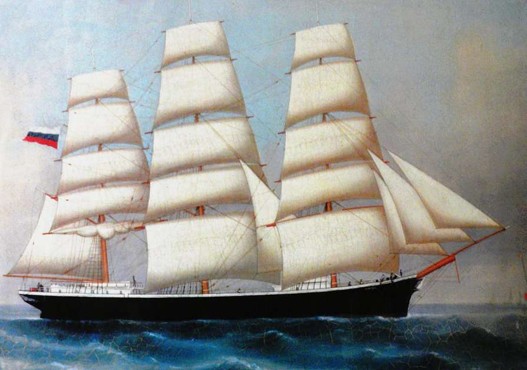
The Life and Loss of the Finnish Barque Vanadis (1874–1903)

Oil painting of the ship under full sail, bows to the right of the image, on a stylised blue sa and under grey-blue skies
A 19th-century oil painting of the Vanadis under sail, by unknown artist, courtesy of Pietarsaari (Jakobstad) Museum, Finland. Between 1809–1917, when Finland was a Grand Duchy of the Russian Empire, Finnish ships used the Russian national (civil) ensign for merchant purposes. The Russian white-blue-red tricolour was also the official flag of the Grand Duchy.

Introduction

As part of the Nordic Shipwrecks project my colleague Tanja Watson, Maritime Research Specialist, has taken a look at a Finnish shipwreck on the north-west coast. Finnish wrecks form a rather unusual nationality sub-group in Historic England’s National Marine Heritage Record (NMHR), [1] where Finnish vessels currently account for just under 3.5% of England’s records of over 1,600 Nordic shipwrecks.

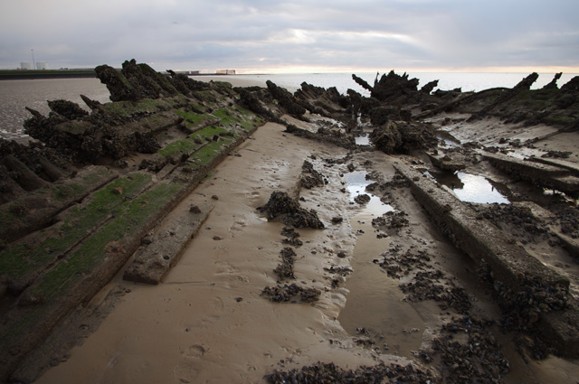
This is the story of a regular cargo vessel, Vanadis, wrecked in bad weather on 22nd February 1903 in Morecambe Bay. The remains of the wooden hull lie embedded in the sand in a small, shallow embayment called Half Moon Bay on the Heysham coastline in Lancashire, north-west England. Occasionally exposed to beachgoers by weather and changing sands, they serve as a reminder of the elegant three-masted ships that sailed this coastline some 120 years ago.

Vanadis (Vanadís) is an epithet for Freyja – the Norse goddess of love, beauty, fertility, war, and magic. [2] For almost thirty years the Finnish sailing vessel crossed the world’s oceans, carrying coal, timber, and trade between Europe, Asia, Africa, and North America. Built in 1874, it survived hurricanes, volcanic catastrophe, collisions, and the loss of crew at sea – only to be lost in the comparatively confined waters of Morecambe Bay – due to extreme weather, mechanical failure, and difficult navigational decisions – but thankfully without any loss of life.

Construction

The Vanadis was built in 1872-74 by master shipbuilder Johan Löfhjelm (1816-1878), at the Carlholmen shipyard in Jakobstad (now called Pietarsaari), on the west coast of Finland. It was one of three built for Otto August Malm of The Malm Trading House, one of the most prosperous shipping magnates at the time. Launched on 19 September 1874, the vessel was constructed as a full-rigged, three-masted wooden fregattskepp or frigate [3] copper- and iron-fastened, carvel-built, and sheathed with felt and yellow metal. It had one deck and was roughly 56 metres in length, 11m in breadth, and 10m in height (185 ft × 35 ft 1 in × 33 ft 3 in), with a carrying capacity exceeding 1,000 net register tons. It was one of three large frigates built at the yard for Otto Malm, the other two were called Equator and Europa. [4]

By the late nineteenth century, the Vanadis had been converted from a full-rigged ship to a barque, reflecting changes in crewing practices and economic conditions. (A barque retained much of the speed and cargo capacity of a full-rigged ship but was easier to operate, requiring fewer crew.)

Eventful voyages

Throughout its career, the Vanadis demonstrated both the resilience and vulnerability of wooden deep-sea sailing ships – captured in letters written by its crew members, held by Pietarsaari (Jakobstad) museum and compiled by Jukka Mikkola. [5] These track passages to Singapore, Java, Hong Kong, New York, South Africa, and later repeated timber runs between North America and Europe.

Its first voyage to England took place two months after its launch, on 12 November 1874, destined for Hull. Some particularly eventful voyages are recorded for the following years:

1882: Tragedy struck the frigate on 7 December, while en route from Cardiff to Singapore, the frigate encountered a severe storm in the English Channel. Heavy seas swept across the deck, carrying five crewmen to their deaths; a sixth later died of stomach trouble. The ship sought refuge in Falmouth before continuing its voyage.

1893: In August, Vanadis was sailing near Krakatoa, Indonesia at the time of the catastrophic volcanic eruption. Ash fell onto the vessel, a thick layer of pumice floated on the sea, and the ship sailed for a week half buried in debris from one of the most violent natural disasters in recorded history.

Historic black and white photograph of explosion of Krakatoa, seen from the sea: large clouds of dust and smoke rise up in the air. The image has been historically retouched and enhanced in a fashion typical of late 19th to early 20th century photos to bring out the key subject.
De uitbarsting van de Krakatau, University of Leiden, public domain
https://hdl.handle.net/1887.1/item:788817

1894: In July, the Vanadis was struck by a hurricane as it sailed towards the Florida coast. The ship was battered for many hours by storm force winds but arrived in Pensacola, despite all sails having been blown to shreds and severe damage to masts and rigging.

1898: On 25 August the Vanadis left Plymouth heading for the north American coast to pick up a cargo of timber. On 2 October they were hit by another massive hurricane north of the Bahamas. The main top sails were torn to pieces and the mast was destroyed. Somehow the crew survived and set to work to put up masts out of the wreckage left on the decks and rig up the sails and get the ship sailing again. In a letter to his wife, first mate Frans Hägglund described this hurricane as so devastating the Vanadis could easily have been ‘lost with all hands’. But after a few more days at sea the ship was able to limp into the city of Savannah in Georgia. The Vanadis stayed there until early 1899 as repairs took many months. [6]

On 27 July 1899 the vessel was sold to Captain John Andersson and his partners Victor Sundman and K A Karlsson, of Mariehamn, Åland (now part of Finland). Under new ownership, it continued to trade primarily in timber, making repeated transatlantic voyages between Georgia and northern Europe.

Mechanical failure

Vanadis set off on what was to become its final voyage on 12 January 1903, departing Darien, Georgia, for Fleetwood, Lancashire, with a cargo of pitch pine and softwood logs. The passage was difficult for the fifteen-strong crew. The vessel was reported overdue to Lloyd’s of London before finally being sighted off Rathlin Island (Northern Ireland). After 41 days at sea, it finally reached Fleetwood about 5pm on Sunday 22 February 1903. The weather at the time was exceptionally mild (14°C). A “spectacular dry dust fall”, likely originating from the Sahara, had darkened the skies earlier that day and covered everything on land with yellow sand, while there were storms at sea. [7]

Pilot Albert Iddon boarded the barque at the Morecambe lightship and anchored it, with sails furled, in Lune Deep near Wyre Point. Gale-force winds from the southwest rapidly worsened. During the night, the ship’s windlass failed on the starboard side, placing enormous strain on the anchor cables. The chains were torn from the hold, resulting in the loss of both anchors and cable, leaving only a spare anchor without cable. [8]

Later testimony from Jakobstad museum records indicates that the windlass had not been properly maintained by the new owners, a fact agreed upon by both captain and pilot as the primary cause of the wreck. The windlass was a critical, heavy-duty mechanical device located on the forward deck (forecastle) used to raise the anchors and manage anchor chains. By the turn of the 20th century, these mechanisms had evolved from simple manual devices into sophisticated, often steam-assisted, machinery.

Sepia pen and ink drawing of seven men pulling on a windlass aboard ship: six men, three on either side, operate the windlass, while the 7th man in left foreground pays out the chain. The image is canted at an angle to right, suggesting the movement of a ship at sea, while seagulls fly in the sky.
Print of a wooden windlass in use, from Dr. Isaac I. Hayes, Cast Away in the Cold: An old man’s story of a young man’s adventures as related by Captain John Hardy, Mariner (Boston, Lee and Shepard Publishers: 1892) Public domain: Wikimedia Commons

Heysham Rescue

The pilot advised the Master, Karl Oskar Karlsson, to head for the sandbanks at Heysham, as this was considered the safest area in Morecambe Bay: anywhere else was too risky. The vessel reached a position at 54.3N, 2.54W NNE of Heysham Pier with high tide at 8.07pm.

According to Pilot Iddon, the ship experienced a calm night with very little rolling. However, at 3am, one of Vanadislifeboats was launched carrying five crew members and Pilot Iddon, reaching the shore just 100 yards away without difficulty. The men then walked to the Higher Heysham post office, arriving at around 4am. As there was no immediate danger, the captain and nine crew members remained aboard the Vanadis. They would have been able to disembark at low tide since the vessel was lying level; however, as the tide rose, the gale intensified and by dawn it was making signals of distress. At 7:30am, the lifeboat station at Fleetwood fired a gun after harbour authorities received a telegram confirming that Pilot Iddon and five crew members were safe. The lifeboat crew launched the lifeboat Maude Pickup at 8am, setting sail towards the Vanadis 12 miles away, in very rough seas, reaching the vessel in under an hour, and rescuing the remaining 10 crew. The ship had run aground on Sunderland Bank at the entrance to the River Lune, but with no effective anchoring capability and conditions deteriorating, it floated off the bank and drifted up past the entrance to the new Heysham Harbour (not open to ships until 1904). [9]

Breaking Up

Newspaper and maritime reports from February and March 1903 documented the vessel’s rapid deterioration. The Vanadis had missed stays, had sprung a leak, and was full of water. It lay partially submerged and slowly sinking deeper into the sand close to the pier at Heysham, having unshipped its rudder. By 25 February it lay almost dry but was unfavourably positioned; a day later, embedded in sand, it was losing ground as strong westerly winds drove water into its hull. It was condemned as a total loss. [10]

Once condemned, a hole was cut in the stern to access the hold. The cargo of softwood logs was hauled out by horses and carts and sold to the highest bidder. The hull was partially stripped for scrap metal, while masts, decking, and superstructure were cut away. Over time, the remains slowly broke apart on the beach until “virtually nothing was left” above the sand. [11]

Historic black and white photograph of the Vanadis, seen in port bow view with her masts having collapsed over the side. An inset at top right shows the detail of the figurehead from the same photograph.
The stranded Vanadis with broken masts, and figurehead still intact. The figurehead [inset] may still exist: it was displayed in the rose gardens of Heysham Head until it closed (date unknown). It was a carved full-length figure of a woman in a long dress with large collar, painted in pale colours, with dark, pinned hair, standing on a plinth. Image courtesy of Lancaster Maritime Museum.

Today’s remains

Modern digital colour photograph of the 'ship shape' of the exposed hull timbers full of sand and pools of water, looking out towards the sea.
Remains of the Vanadis, taken by Ian Taylor, 12 February 2010
Wikimedia Commons (CC BY-SA 2.0)

Photographs of Vanadis aground are preserved in Lancaster Museum and Heysham Heritage Centre, while archaeological investigation has confirmed the extent of dismantling and loss. Although largely buried, elements of Vanadis continue to surface on re-exposure due to the shifting sands, a feature common to the several other ships also known to have been lost in the area over the last few centuries.

A three-foot long cannon was recovered from the wreck in 2005 by two Heysham locals, believed to date from the ship’s earlier service in eastern seas when defensive armament was common against pirates. The cannon is displayed at the Heysham Heritage Centre, along with the ship’s bell and several other items salvaged from the site.

Modern digital colour photograph of a black cannon displayed indoors on a black wheeled gun carriage
The Vanadis cannon, displayed on a modern gun-carriage. Photograph by Graham Dean: image by kind permission and courtesy of Heysham Heritage Centre


Footnotes

[1] At the time of writing in 2026, the NMHR is currently publicly accessed via the Heritage Gateway portal

[2] Vanadís – as Vana dís – occurs as an epithet for Freyja in the Skáldskaparmál within the Prose Edda, compiled by Snorri Sturluson (1179-1241) in Old Icelandic: cf also the element vanadium, named after Vanadis by the Swedish chemist Nils Gabriel Sefström (1787-1845). It seems to have been a reasonably popular name in contemporary Scandinavian circles – see, for example, four Norwegian ships of this name in Det Norske Veritas 1879, p405, and HM Fregatt Vanadis (HSwMS Vanadis), commissioned 1862.

[3] Although a cognate, the English word ‘frigate’ does not accurately convey the vessel type, as in English it has historically predominantly referred to a warship during the age of sail or later. In the Nordic languages fregatt or fregattskepp (and variants) instead refer (by transference from the form of warship so called, which was also the initial primary meaning) to a three-masted full-rigged fast-sailing ocean-going vessel such as the Vanadis: see Store norske leksikon: fregatt. Although by no means an exact equivalent, the English-language clipper ship such as the Cutty Sark is both contemporary with, and better conveys the function of, the non-naval Nordic fregattskepp in English.

[4] Larn, Richard & Bridget. Shipwreck Index of the British Isles, Volume 5: West Coast and Wales. Section 2, Lancashire, 2000; ‘Vanadis’, by Jukka Mikkola. https://www.jamikko.fi/Purjelaivat_Vanadis.htm, accessed 14 Jan 2026; ’Jakobstad’, Uppslagsverket Finland, https://www.uppslagsverket.fi/sv/view-170045-Jakobstad, accessed 14 Jan 2026; wrecksite.eu, ‘Vanadis’: UK Hydrographic Office Wreck Report and information from Lloyd’s Register, compiled by Chris Michael. https://www.wrecksite.eu/wreck.aspx?65359, accessed 14 Jan 2026 [subscription required].

[5] Vanadis’, by Jukka Mikkola. https://www.jamikko.fi/Purjelaivat_Vanadis.htm, accessed 14 Jan 2026. This is the source for all the voyages described.

[6] ibid; “Shipwreck still interests Heysham inhabitants”, The Visitor, published 8 Nov 2007. pdf, , accessed 14 Jan 2026     

[7] wrecksite.eu; ‘Weather – Feb 1903’, https://community.netweather.tv/topic/99882-february-1903-exceptionally-mild-a-dustfall-and-a-great-gale/, accessed 19 Mar 2026

[8] Åland Newspaper Report, 25-FEB-1903, No.16, pp 2, 4.

[9] The Visitor

[10] Åbo Underrättelser [in Swedish] 03-MAR-1903, No.60, p 3; 04-MAR-1903, No.61, page 3; 06-MAR-1903, No.63, page 4; Historic England Archive, Archaeological Diving Unit, Report No. ADU 97/04: Vanadis, Half Moon Bay, Heysham

[11] ibid; ‘Weather – Feb 1903