

Everything you ever wanted to know about the Rosetta Stone
You've probably heard of the Rosetta Stone. It's one of the most famous objects in the British Museum, but what actually is it? Take a closer look...
What is the Rosetta Stone?
The Rosetta Stone is a broken part of a bigger stone slab, known as a stela. It has an official message called a decree carved into it, in three different types of writing. It was an important clue that helped experts learn to read Egyptian hieroglyphs (a writing system that used pictures as signs).

How old is it?
The inscriptions on the Rosetta Stone were carved in 196 BC, making it over 2,200 years old. The date marks the first anniversary of the coronation of the young ancient Egyptian king, Ptolemy V (reign 204–181 BC).
The text on the Stone is very similar to wording first used in decrees about a hundred years earlier in the 3rd century BC.
Are there other Rosetta Stones?
The Rosetta Stone is the name given to the first stela to be discovered with these inscriptions on it, but there are three almost exact copies of the Ptolemy V decree that are currently known about, and a number of very similar decrees from the reigns of kings Ptolemy III, IV and VI.
To date, 29 of these decrees on stones have been discovered across Egypt, starting with the Rosetta Stone in 1799. The majority of them (22) remain in Egypt. Some of these stelae have helped scholars to understand the full hieroglyphic text, which is only partially preserved on the Rosetta Stone.
Why is it important?
The writing on the Rosetta Stone is an official decree about Ptolemy V. The decree was copied onto these large stone slabs, called stelae, which were placed in every temple in Egypt.
The message is important because it says that the priests of a temple in Memphis, in Egypt, confirmed Ptolemy V's status as a divine ruler, despite him being Macedonian rather than Egyptian.
But the most important thing about the Rosetta Stone is that the decree is inscribed three times, with three different forms of writing, which finally allowed scholars to translate Egyptian hieroglyphs.
What languages are on the Rosetta Stone?
The decree on the Rosetta Stone is written in two forms of Egyptian script – hieroglyphs, the sacred symbols suitable for a priestly decree, and Demotic, the cursive Egyptian writing used for daily purposes, meaning 'language of the people'. The decree is also written in Ancient Greek, the language of the Greco-Macedonian rulers of Egypt who were installed following Alexander the Great's conquest.
The Rosetta Stone was found broken and incomplete. It features 14 lines of hieroglyphic script:
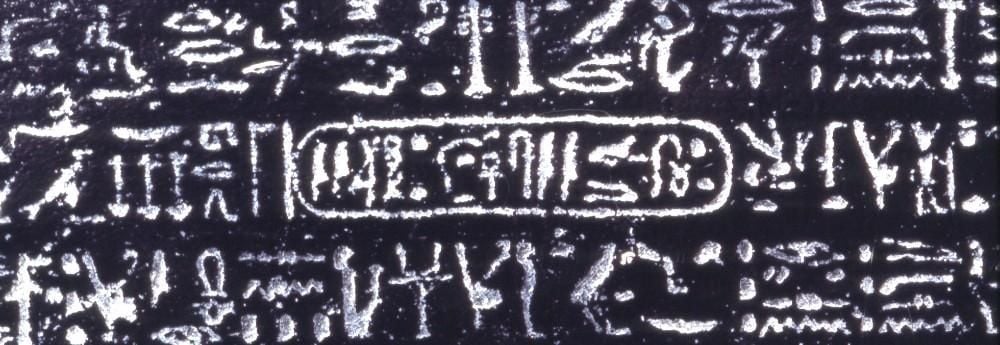
32 lines in Demotic:

and 54 lines of Ancient Greek:

The importance of this to Egyptology is immense. When it was discovered, nobody knew how to read ancient Egyptian hieroglyphs. Because the inscriptions say the same thing in three different scripts, and scholars could still read Ancient Greek, the Rosetta Stone became a valuable key to deciphering the hieroglyphs.
When and where was it found?
The Rosetta Stone gets its name from the place where it's believed to have been discovered by soldiers in Napolean Bonaparte's army. Rashid, a port city on the Nile Delta, was known by the French as Rosetta.
Napoleon campaigned in Egypt from 1798 to 1801, with the intention of dominating the East Mediterranean and threatening the British hold on India. Although accounts of the Stone's discovery in July 1799 are now rather vague, the story most generally accepted is that it was found by accident by soldiers on 15 July 1799 while digging the foundations of an addition to a fort near Rashid (Rosetta). It had apparently been built into a very old wall. The officer in charge, Pierre-François Bouchard (1771–1822), realised the importance of the discovery.

Who cracked the code?
Soon after the end of the 4th century AD, when hieroglyphs had gone out of use, the knowledge of how to read and write them disappeared. In the early years of the 19th century, scholars were able to use the Greek inscription on this stone as the key to decipher them. Thomas Young (1773–1829), an English physicist, was one of the first to show that some of the hieroglyphs on the Rosetta Stone wrote the sounds of a royal name, that of Ptolemy.
The French scholar Jean-François Champollion (1790–1832) then realised that hieroglyphs recorded the sound of the Egyptian language. This laid the foundations of our knowledge of ancient Egyptian language and culture. Champollion made a crucial step in understanding ancient Egyptian writing when he identified the hieroglyphs that were used to write the names of non-Egyptian rulers. He announced his discovery, which had been based on analysis of the Rosetta Stone and other texts, in a paper at the Academie des Inscriptions et Belles Lettres at Paris on Friday 27 September 1822. The audience included his English rival Thomas Young, who was also trying to decipher Egyptian hieroglyphs.
Champollion inscribed this copy of the published paper (see image 'Tableau de Signes Phonétiques') with alphabetic hieroglyphs meaning 'à mon ami Dubois' ('to my friend Dubois'). Champollion then made a second crucial breakthrough, realising that the alphabetic signs were used not only for foreign names, but also for Egyptian names. Together with his knowledge of the Coptic language, which derived from ancient Egyptian, this allowed him to begin reading hieroglyphic inscriptions fully.

What does the inscription actually say?
The inscription on the Rosetta Stone is a decree passed by a council of priests. It is one of a series that affirm the royal cult of the 13-year-old Ptolemy V on the first anniversary of his coronation (in 196 BC). Read the full transcription.
According to the inscription on the Stone, a copy of the declaration was to be placed in every sizeable temple across Egypt. Whether this happened is unknown, but copies of the same bilingual, three-script decree have now been found and can be seen in other museums. The Rosetta Stone is therefore one of many mass-produced stelae designed to widely disseminate an agreement issued by a council of priests in 196 BC.
In fact, the text on the Stone is a partial copy of a prototype that was composed about a century earlier in the 3rd century BC, so in some passages, only the dates and names were changed. Yet despite its formulaic nature, the decree also recounts real events from the reign of Ptolemy V, including the turmoil of the Great Rebellion, a sweeping Egyptian uprising that challenged Ptolemaic rule for nearly two decades (204–186 BC).

What does the Rosetta Stone actually say
How did the object come to the British Museum?
On Napoleon's defeat, the Stone became the property of the British under the terms of the Treaty of Alexandria (1801) along with other antiquities that the French had found. The stone was shipped to England and arrived in Portsmouth in February 1802. It was presented to the British Museum by George III in July of that year.
The Rosetta Stone and other sculptures were placed in temporary structures in the Museum grounds because the floors were not strong enough to bear their weight. After a plea to Parliament for funds, the Trustees began building a new gallery to house these acquisitions.
The Rosetta Stone has been on display in the British Museum since 1802, with only one break. Towards the end of the First World War, in 1917, when the Museum was concerned about heavy bombing in London, they moved it to safety along with other, portable, 'important' objects. The iconic object spent the next two years in a station on the Postal Tube Railway 50 feet below the ground at Holborn.
Where can I find the Rosetta Stone in the British Museum?
The Rosetta Stone is on display in the Egyptian sculpture gallery (Room 4) on the ground floor of the British Museum.
Visitors can view it for free, along with an incredible range of statues charting 3,000 years of ancient Egyptian history, including the colossal bust of Ramses II.
There's also a replica of the Rosetta Stone in Enlightenment (Room 1) that you can get even closer to and actually touch.


