

Who were the samurai?

Samurai (3 February – 4 May 2026)
What do you think of when you hear the word samurai?
Many will immediately imagine a formidable male warrior in a suit of armour wielding a sword and motivated by unwavering loyalty. However, the real story wasn't always as fantastic as Hollywood portrays. Samurai were artists, government officials and even firefighters. In this blog, we'll explore how samurai have played many different roles over their 1,000-year history, from the battlefield to the latest videogames.
When did the first samurai emerge?
The samurai began as mercenary warriors in the 10th century, paid to fight on behalf of members of the imperial court. During the 12th century, there was a series of rebellions and open battles on the streets of the Japanese capital, Kyoto. The samurai used this unrest to acquire political power and establish the first shogunate (military government) in 1185 based in Kamakura (south-west of present-day Tokyo).
Why are they called samurai?
The word samurai comes from the Japanese verb saburau meaning 'to serve'. This hints at the samurai's origins as men who served governors and landowners. Historically, the terms musha, bushi and mononofu were used in Japan to describe these members of the warrior ruling class. The word 'samurai' is more commonly used in the West.

How did the samurai fight?
Though the curved Japanese sword has become synonymous with the samurai, it was not their main weapon during their early centuries of warfare. The main technique was mounted archery, using a long but flexible bow of lacquered bamboo. Foot soldiers used polearms (naginata) with a long shaft and curved blade. Swords served more as symbols of status and authority. By 1500, battles involving hand-to-hand combat had increased and swords began to be used more widely. During the later 16th century, Japanese warfare changed dramatically due to the arrival of European traders who brought guns.
These changing styles of combat affected the design of armour worn by samurai. Early Japanese armour has large shoulder-guards that act like shields to deflect arrows while on horseback. During the Warring States period (1467–1600), elaborate helmets were created to make samurai commanders identifiable on the battlefield. With the advent of ballistic weaponry, armour began to incorporate bulletproof metal panels to protect the wearer. This suit of armour has an iron breastplate based on that of Portuguese soldiers. This shows that though samurai are a uniquely Japanese phenomenon, they evolved through international exchange.

What did samurai wear off the battlefield?
Samurai expressed their taste, refinement and wealth through clothing. When not in armour, they wore different outfits depending on their rank. As might be expected, higher-ranking samurai wore lavish textiles that featured silk embroidery and imported textiles. These elite samurai wanted to be seen as equal to the elegant courtiers and would wear hitatare, an embroidered jacket and trouser set that had been fashionable for noblemen of the Heian period (AD 794–1185). In later periods, it was expected for samurai to wear a kamishimo, a two-piece with exaggerated shoulders and pleated trousers, for formal occasions, including audiences with the shogun.
It was different for lower-ranking samurai, who might not even wear trousers. Nevertheless, a man's samurai status was always advertised by his right to wear a pair of swords (a long katana and a short wakizashi). Samurai commissioned different mounts and sword-guards (tsuba) to express their stylish sensibilities. Tsuba came in all shapes and sizes, most were made of iron but could be copper, enamel and brass. Some tsuba designs were inspired by folktales or stories of heroic warriors, while others represented cutting-edge knowledge, like this one that has a map of the world on it.

What training was required?
Samurai were schooled in martial combat, learning how to use various weapons. Archery in particular was an essential skill. The level of training varied depending on rank and location. Samurai were also expected to be culturally literate, participating in refined social gatherings. In parallel to their martial duties, they were expected to learn the arts of calligraphy, painting and flower arranging, and were well versed in classical poetry. Alliances were essential for samurai, and these could be strengthened through participating in these cultural pursuits. The tea ceremony offered an important space for political negotiation as it allowed for power-brokering samurai to come together, and one's mastery of these cultural codes was sometimes a matter of life and death.

Could anyone be a samurai warrior?
The Warring States period (1467–1568) was a time of social flux, 'with the lower overthrowing the upper' (gekokujō), and a man of determination and military skill could rise through the ranks. The most famous such example was Toyotomi Hideyoshi (1537–98), who rose from a peasant background to become one of the most powerful samurai in history. Despite his meteoric rise to power, Hideyoshi began to formalise the criteria for samurai status. In 1588, Hideyoshi ordered a sword hunt to prevent farmers and peasants from owning weapons. His successor, Tokugawa Ieyasu (1543–1616) cemented the social system, decreeing four classes: samurai, farmers, artisans and merchants. For about 250 years, the samurai was a social class, comprising on average 10% of the population. Officially, the only way to be a samurai was to be born into a family of that class (buke).

Could women be samurai?
Yes! The samurai class included women who played many different roles in society. From the 12th to the 16th century, high-ranking women held great power, such as Hōjō Masako (1157–1225), who married the first shogun, Minamoto Yoritomo (1147–1199), and acted as regent several times. It was common for the lord's wife to lead the defence of a besieged castle, using polearms (naginata) or archery. There are also rare examples of samurai women on the battlefield, such as Tomoe Gozen (1157–1247), who commanded a battalion at the Battle of Awazugahara in 1185. During the Tokugawa period, half of the samurai class was comprised of women, who had the important roles of running the household and raising children. As before, high-ranking women in the shogun's court often wielded significant influence.

Were the samurai loyal?
Samurai displayed loyalty but were often driven by self-interest, leading them to be pragmatic in battle, even switching sides. When the de facto leader of Japan, Toyotomi Hideyoshi died in 1598, he appointed five regents to take care of his heir, Hideyori (1593–1615). Among these regents was Tokugawa Ieyasu. Despite this, Ieyasu fought against Hideyori and achieved a decisive victory at the Battle of Sekigahara in 1600, the largest in Japanese history. Before the battle, forces loyal to the Toyotomi clan outnumbered the Tokugawa by 45,000 soldiers. However, during the fighting several powerful warlords defected to the Tokugawa cause, helping capture the victory. Tokugawa Ieyasu finally defeated the Toyotomi clan at the Siege of Osaka in 1615. This set the stage for the Tokugawa to establish a military government (shogunate) that would last for more than 250 years.

But what about the 'way of the warrior'?
Though samurai interaction was often determined by conventions, there were no written or ideological rules that bound a samurai or a universal 'way of the warrior'. The book Bushido: The Soul of Japan, first written in English in 1899 by Nitobe Inazō (1862–1933), spread the belief internationally that the samurai possessed a chivalric moral code, but this was not grounded in any evidence. When the book was translated into Japanese in 1908, it was heavily criticised by historians in Japan. Notwithstanding the lack of a samurai code, many warriors were concerned with the morality of killing. Faith played an important role in samurai life and warriors adorned their armour with Buddhist symbols and sponsored religious activity, such as temple building or sutra (religious texts) writing. Victories on the battlefield showed that the gods were on your side.

Did the samurai keep fighting under Tokugawa rule?
After 200 years of fighting, the Tokugawa manged to unify Japan under their control, ushering in an era of peace. After so many years of fighting no one knew if the peace would endure, so the Tokugawa government implemented strict rules to prevent any military uprisings. They ordered the lords (daimyo) of every domain to fund expensive biannual processions with their retainers to the shogun's power-centre, Edo (present-day Tokyo). This not only reduced funds that daimyo might use to topple the Tokugawa, but it also allowed the shogunate to keep a watchful eye on each lord.
What did samurai do during peacetime?
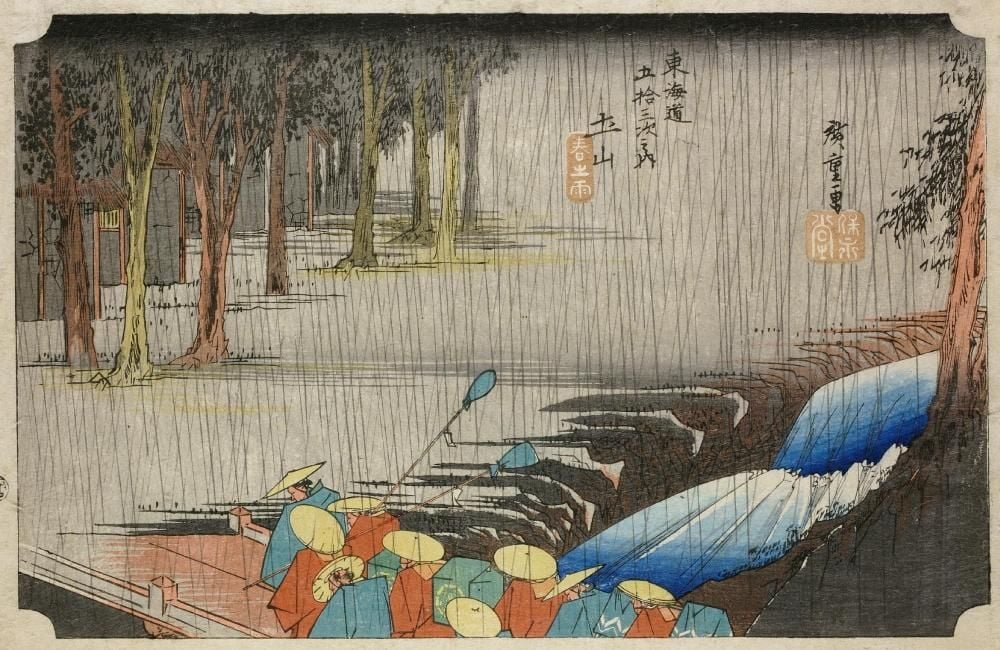
Under the prolonged peace of Tokugawa rule, the samurai had no reason to fight. Instead, they served as bureaucrats and administrators. They staffed the many positions within the government, police, judiciary and, especially important given Japan's densely packed wooden cities, firefighting. There were many ranks within the samurai class, which affected the civic role a man was assigned. As the years went by, there were fewer available official positions for samurai. They received a stipend from the government, which was paid in rice, but over the decades this decreased in value. Many samurai were in debt. These circumstances prompted some samurai to turn to new avenues of moneymaking, including monetising their hobbies. A few talented men of samurai rank made a living from their art. Later, in the 18th and 19th centuries, some creative samurai designed woodblock prints, such as the renowned artist Utagawa Hiroshige (1797–1858), who was the subject of a recent British Museum show. Unemployed samurai, known as rōnin, became increasingly problematic for Tokugawa society. They became known for rabblerousing and even criminal activities.

Do the samurai exist today?
International pressure to engage more fully in trade in the mid-1800s, created a period of uncertainty and unrest in Japan. Eventually, the Tokugawa shogunate collapsed in 1868 and a new government was formed to start the process of building a modern Japan. As part of this modernisation process, samurai status was abolished in 1876. Since then, there have been no samurai. Despite this, samurai have not left our lives completely. They live on in popular media as heroes of manga and anime, or as the protagonists in videogames. The world associated with the samurai continues to permeate society, with unemployed businessmen in Japan still being referred to as rōnin. Though the samurai are long gone, they survive in our imaginations and fuel our creativity.

Conclusion
The objects Joe discusses were available to view alongside over 300 objects charting the history of the samurai in the major exhibition Samurai (3 February – 4 May 2026).
Supported by
The Huo Family Foundation


