

Introduction to 'Hawaiʻi: a kingdom crossing oceans'

Hawaiʻi: a kingdom crossing oceans (15 January – 25 May 2026)
Join lead exhibition curator Alice Christophe for a tour of 'Hawaiʻi: a kingdom crossing oceans', exploring how an alliance formed over 200 years ago continues to shape our understanding of this Pacific island nation.
In November 1823, Liholiho (Kamehameha II), King of Hawaiʻi, set out from Honolulu to London with members of the royal Hawaiian court. Their voyage, across two oceans, sought to secure protection and alliance with the British Crown. It was a time of tremendous change, driven both internally and externally and as the presence of foreign powers rapidly increased in Hawaiian waters and lands.
Through this major diplomatic mission, the Hawaiian Kingdom's representatives were also redefining Hawaiʻi's place in the world for the West, not as a distant and isolated group of islands in the North Pacific, but as a global nation with deep cultural roots in expansive international networks.
The exhibition brings these histories into vivid focus by centring movements and stories initiated from Hawaiʻi itself. Building on years of collaboration with Native Hawaiian artists, practitioners and scholars, it traces the journeys of Hawaiian leaders to Britain, reframing these relationships on their own terms. Shining new light on exceptional objects and extraordinary stories, Hawaiʻi: a kingdom crossing oceans is a celebration of the artistry and history of Hawaiʻi and embraces multiple ways of knowing and experiencing the ancestral and contemporary works on display.
In the presence of Kū
Visitors are first greeted outside the exhibition entrance by a monumental carving of Kū, a god whose realm includes warfare and governance and whose season in the Hawaiian ritual calendar coincides with the time of the exhibition. This figure likely stood on a heiau (place of worship) in Kona on the island of Hawaiʻi, the largest island of the Hawaiian archipelago, and may have been brought to London by King Liholiho in 1824. For the exhibition, Kū is dressed with a contemporary malo (loincloth) made by artist Verna Takashima, and stands on a pole rediscovered inside an old plinth during exhibition preparations.

This decision, like many others, was guided by members of the Exhibition Stewardship Group, a dedicated group of Hawaiian stewards, or co-creators, including Leah Caldeira, Noelle M.K.Y. Kahanu, Umi G. Kai and Jsohnel Pacarro. This group and others across the Hawaiian archipelago worked with curators on multiple aspects of the show, from narrative structure and cultural protocols to design, object placement and the care of collections behind the scenes. In parallel, Hawaiian language specialists integrated ʻōlelo Hawaiʻi (Hawaiian language) and Hawaiian language words throughout the show and the accompanying book, reconnecting ancestral works with the words used to describe them in Hawaiʻi. This collaborative approach – a striking embodiment of continuity, agency and allyship – gives the exhibition a vital energy, embodied from the outset through the presence of Kū.
Eia Hawaiʻi: Hawaiʻi is here
The visitor's journey begins over 1,000 years ago, as Polynesian ancestors continued their centuries-long travels on earth's largest ocean, Moananuiākea, the Pacific Ocean. Navigating by the stars and following the movement of migratory birds with an acute understanding of the currents and the environment, they reached a group of islands in the northern Pacific from islands in the south. Oral histories tell of the arrival of the first master navigators and chiefs to this place, which they called 'Hawaiʻi'. Making landfall to the south of the archipelago, they chanted as they sighted the shores of the present-day town of Hilo: 'Eia Hawaiʻi, he moku, he kanaka [...]', 'Here is Hawaiʻi, an island, a person [...]'.
Moving into the exhibition, a chant, accompanied by a deep beat, recorded with prominent Kumu Hula (Dance Master-Teacher) Laʻakea Perry, fills the space with the ancient words 'Eia Hawaiʻi – Hawaiʻi is here', or 'here is Hawaiʻi'.
Inside the gallery, visitors encounter the source of the beat: a spectacular drum named Akeanaliʻi. Drums were brought by relatives of those Polynesian travellers who first made landfall in Hawaiʻi. The first drum in the exhibition is a contemporary piece, which echoes these ancient drums. It was carved by the artist Kanaʻe Keawe, who takes inspiration from historical drums in museum collections and aims to recreate them identically as a way of hearing the voices of ancestral instruments. This drum was gifted to the museum to mark the moment of this exhibition. It honours those who have come before while giving a vivid voice to those who will come after.

Gods, chiefs and people
The first major section explores the interconnected bonds between akua (gods), aliʻi (chiefs) and kānaka (people) – relationships fundamental to Hawaiian society. Exquisite examples of feathered cloaks associated with Hawaiian chiefs, carved images of gods and large kapa (barkcloth) reveal the artistry, devotion and power embedded in these works.

Among these mea kupuna (ancestral works) on display, mahiole hulu manu (feathered helmets) were worn in battle and in ceremonial contexts, where they embodied the mana (authority) and identity of their bearer as chiefs. These helmets are made from the aerial roots of the ʻieʻie plant and feathered with endemic birds' plumage. Each mahiole is unique, incorporating different ways of weaving the basket structure and attaching feathers, and forming a wide diversity of patterns.

ʻAhu ʻula, or feathered cloaks, which were also worn by aliʻi (chiefs) in battles and in ceremonies, could be passed down, gifted and transformed. Some were made with hundreds of thousands of upland forest bird feathers tied to a net made from olonā fibre, a plant of the nettle family and endemic to Hawaiʻi. Creating them would have mobilised multiple groups of experts including bird catchers, who collected feathers from the birds before releasing them, allowing the feathers to grow back in time for the next harvest, and featherworkers, who assembled the feathers into small bundles before affixing them onto a net made of olonā.
This large, feathered cloak is thought to have been presented by high chief Kahekili of Maui to British Captain Charles Clerke, when he accompanied Captain James Cook on a voyage to Hawaiʻi between 1778 and 1779. For the first time, the cloaks are mounted as they would have been worn, a delicate and collaborative process that reveals their striking appearance as chiefly garments.
Progressing through the exhibition, the narrative turns to one particular chief: Kamehameha I – Liholiho's father and the first Hawaiian chief to unify the entire Hawaiian archipelago into a kingdom. His 1810 letter to King George III, requesting support and protection, is shown for the first time alongside the extraordinary ʻahu ʻula (feathered cloak) that accompanied it – both on loan from the Royal Collection Trust/HM Charles III. This ʻahu ʻula is the largest known ancestral Hawaiian cloak in the world and is now on display for the first time in over 100 years. Across from this magnificent cloak is a piece of British regalia: the coronation surcoat of George IV, the British king who received the letter and cloak two years after they left Hawaiian shores and after succeeding his father. In this space, and through their garments, the monarchical figures face each other, both adorned in red and golden yellow. This moment of mirroring and meeting – which never took place between the two kings – announces the next chapter of the exhibition: the journey to Britain of Kamehameha I's own son, Liholiho.


Allying kingdoms
The second section follows King Liholiho, son of Kamehameha I and the first reigning Hawaiian monarch to come to the UK (though not the last). With Queen Kamāmalu and their royal delegation, they sought alliance and protection from the British Crown on their 1823–24 diplomatic mission to England. Lithographic portraits by British court artist John Hayter, depict the Hawaiian king and queen when they reached London in May 1824 after five months at sea. Realised a few weeks after their arrival during their tour of London (which included a trip to the British Museum), while awaiting an audience with George IV, these lithographs send a powerful signal to the viewer. Hawaiian royals, dignified and self-fashioned in Western garments, present themselves as sovereign peers, projecting an image of Hawaiʻi as a global nation.


In July 1824, the Hawaiian delegation caught measles while visiting London. All recovered, except the King and Queen, who passed away, aged just 26 and 22 respectively. Here, the exhibition offers a moment to reflect on and acknowledge their passing, just a few streets from the Museum.
This tragic turn of events meant that the Hawaiian royal delegation would meet with George IV without their monarchs. Nevertheless, they successfully secured support from Britain in protecting Hawaiʻi from external powers. The meeting would solidify an alliance between these two nations for decades to come.
Gifts presented and received by the delegation during this royal audience are gathered in this space for the first time since this meeting, alongside objects presented by the British crew that returned the deceased monarchs and living members of the delegation home to Hawaiʻi, including pieces currently on loan from the Bernice Pauahi Bishop Museum in Honolulu, Hawaiʻi.

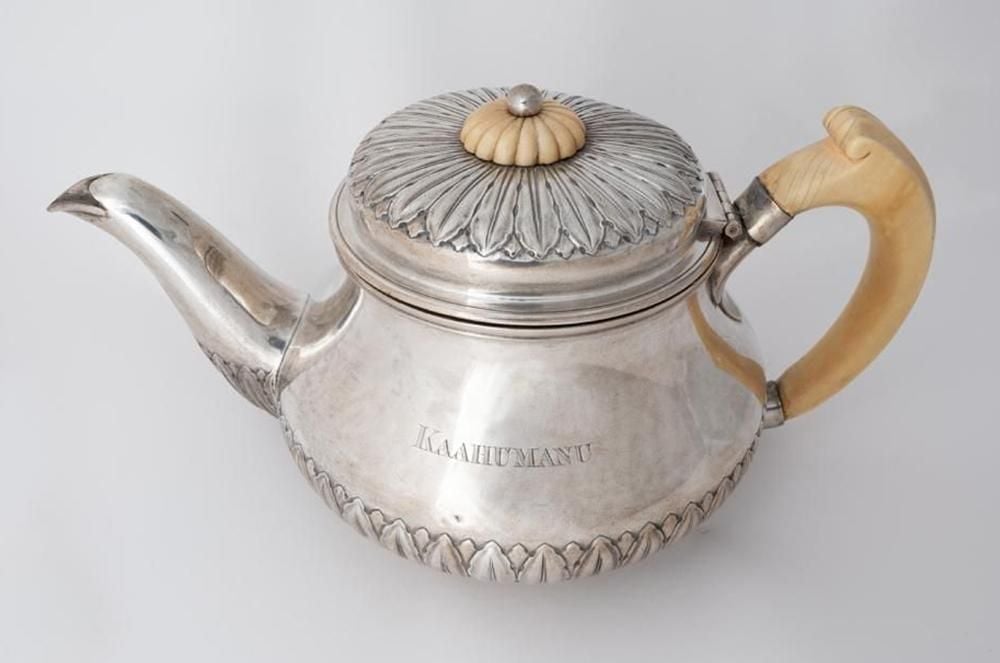
Following the death of King Liholiho and Queen Kamāmalu, the British crown readied a ship to return their remains, and the remaining delegation, to Hawaiʻi. Arriving in Honolulu in May 1825, the British officials accompanying them home presented several gifts to the Hawaiian royal family, including this silver teapot which was given to Kuhina Nui (Premier) Kaʻahumanu, wife of the late Kamehameha I, and Queen Regent. It was engraved by Robert Hennell II – who is known for having engraved the plate of George III's coffin – with, on one side, the British arms and, on the other, with the name Kaʻahumanu.
As this section comes to a close, the story turns to Kamehameha III, Liholiho's brother and heir to the Hawaiian throne. Under his reign, in 1843, the Anglo-Franco Proclamation formalising the independence of Hawaiʻi is signed in London, while the royal Hawaiian coat of arms is drafted in the city, using a cloak at the British Museum as a model. In an unprecedented display, these crucial documents are brought together in one space. Here again, the UK and London serve as an epicentre for expressions of Hawaiian sovereignty.
Resistance, co-existence and resilience
The last section of the exhibition explores the themes of resistance, co-existence and resilience of Hawaiʻi as a nation, and as a people.
Resistance is showcased through the contemporary portrait by artist Kapulani Landgraff of the Native Hawaiian scholar Haunani-Kay Trask, overlaid with the words 'We Are Not American; Hawaiʻi Au Mau a Mau, I am Hawaiian forever and ever', juxtaposed with a letter from the last reigning queen of Hawaiʻi, Liliʻuokalani, requesting support from Britain during the overthrow of the Hawaiian Kingdom by the US military in 1893. Though the British Minister resident forcefully defended the Hawaiian monarchy, Queen Victoria decided not to intervene, failing to fulfil the promise made by George IV during the audience of 1824.
Co-existence takes the shape of a contemporary barkcloth piece by Bernice Akamine, showing the Hawaiian national flag, which incorporates the Union Jack – a marker of the UK-Hawaiʻi relationship in the fabric of Hawaiian sovereignty.
We reflect on resilience as people across the archipelago continue to learn, relearn and reactivate ancestral knowledge by reconnecting with ancestral works in museum collections in Hawaiʻi and across the world, including at the British Museum. Relearning after trans-generational loss is a process that takes generations, and one in which museums can play a meaningful role.

The show ends by opening onto a horizon, with the words of the contemporary Hawaiian poet Brandy Nālani McDougall, written for children and read by Hawaiian youth of Kamehameha Schools: '[...] For you, may there always be refuge, safety within the walls you reach, behind borders, under flags and in your own bodies. May you always be grateful for peace, for open harbors not freely entered, for treaties honored, for nothing taken that was not first given, for iwi still earthed, for new coral growth unbleached, for black cloud cover and trees, breathable air, a beach, stream, or ocean without plastic tangle or sewage or toxic seep. [...] May you remember something of you, something of all of us before, something of all of us to come are these islands. May this always be with you: e ola mau, e ola nō.'
These remarkable works and their extraordinary stories were on display in Hawaiʻi: a kingdom crossing oceans (15 January – 25 May 2026).
Watch a behind-the-scenes video of our Conservation team mounting an exceptional ʻahu ʻula (feather cloak) for display in the exhibition.


