

Metal protector: Celebrating 50 years of the Oddy test

Fifty years ago, the Oddy test changed how museums protect and display objects forever.
Developed at the British Museum in the 1970s by conservation scientist Andrew Oddy OBE FSA FIIC Hon Fellow RNS, the Oddy test is now an important tool worldwide for preventing metal objects from becoming tarnished or corroded when on display.
In June 1975, the Oddy test was announced in an international journal: it could help to predict whether materials used around objects are suitable for long-term use in display and storage cases by artificially ageing them using heat.
To mark the 50th anniversary of the Oddy test, we reveal how it was created, how it works and why it's still being used by museums across the globe today.
How the Oddy test was born
In 1972, the director of the Wallace Collection contacted the British Museum's Research Laboratory to ask for help. They needed to understand why some of their silver objects were tarnishing after having been on display for only a few months at their museum in Marylebone, London. What was going on and why?
Andrew Oddy and his team at the Research Laboratory took up the challenge. As part of his investigation, Andrew found that the Wallace Collection's new display cases were made mainly of an African pseudo-mahogany timber. Fresh samples of the wood were found to be chemically inactive, so what was causing the problem?
The team suspected the timber had later been treated with a chemical, possibly a fire retardant or insect repellent, and that the display cases were emitting these harmful chemicals in the form of a gas – known as 'off-gassing'. This was thought to be creating a damaging environment within the display cases, resulting in the tarnishing of the items. But how to prove it?
In response to this puzzle, Andrew devised the test that to this day is known by his name.
What is the Oddy test?
Over time, metals such as silver, copper and lead become tarnished with exposure to the air.

However, the process of tarnishing and corroding can sometimes be significantly accelerated by contact with, or close proximity to, materials used in the construction of cases for storing or displaying objects.
The Oddy test tells museum conservators whether a specific material used in their storage or display cases contains chemicals that could lead to these reactions and potentially damage the objects in their care.
The sorts of chemicals being looked for are organic acids, solvents, oxidants and sulphur compounds. The types of materials tested include wood, fabrics, card, adhesives, plastics and metals – literally anything that can come into contact with the collection items.
How the Oddy test works
Samples of silver, copper and lead – known as coupons – are cut, cleaned and polished to ensure they have no tarnishing or corrosion on them.
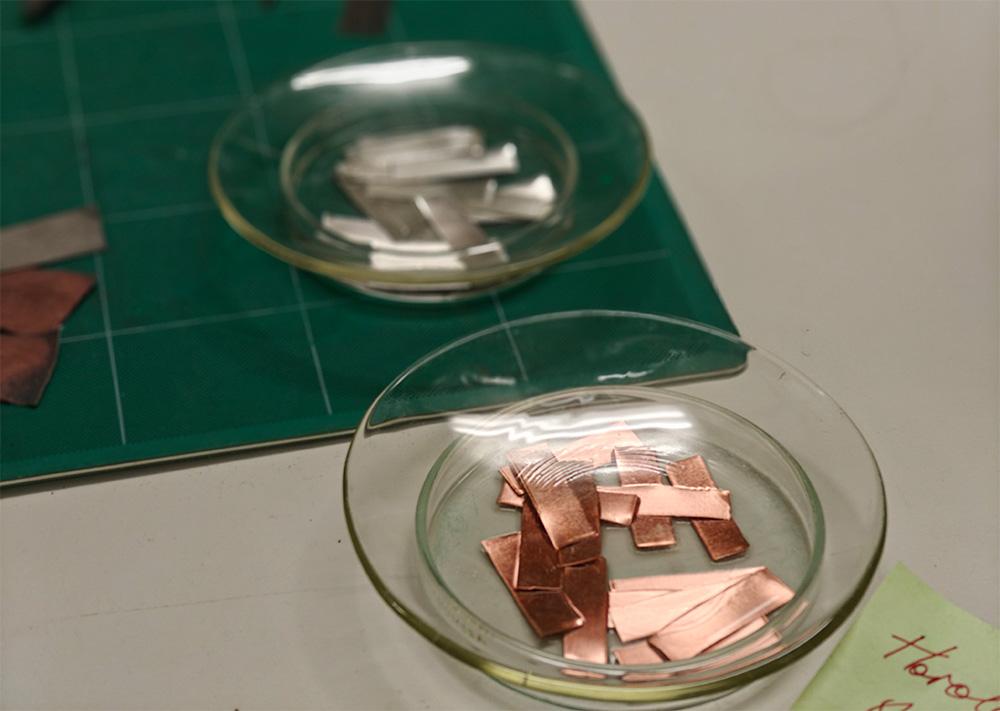
The material being tested is then placed in a sealable glass vessel such as a test tube together with a few drops of water. The metal coupons are suspended above the material and the water, so that they do not touch each other.

The sealed vessel is placed in an oven at 60°C for a minimum of 28 days. This accelerates any chemical processes that could potentially tarnish the metal coupons. A control sample is also made up, containing the coupons but none of the material being tested. This provides a comparison of the effects of the process without the presence of the material being tested.
Because there's currently no agreed quantitative method of measuring the corrosion on the coupons, the outcomes of tests are qualitative, based on the testers' assessment of how much tarnishing or corrosion has occurred and whether the material is safe to use.
Results are reported as either:
- Fail – not to be used in display cases
- Qualified Pass – suitable for use in temporary exhibitions
- Pass – suitable for use in permanent exhibitions

Refining the Oddy test
Andrew first published a brief article on the Oddy test in the Museums Journal in 1973. This was a short explanation of how to conduct the test. It included the handy tip not to use the top of a radiator to heat up samples as the plastic container would melt! This says much about the equipment that was available to Andrew and the science team at the time.
In 1975, Andrew shared a more detailed explanation of the test and its first improvements with the global conservation community via a presentation and publication for the International Institute for Conservation. Other colleagues at the Museum had helped with the experiments and they too are acknowledged in the article, as museum science and conservation are always a collaborative effort.

Conservators and conservation scientists around the world still use the test to this day, and it continues to be developed and refined. Over the decades, there have been a number of reviews and updates by the British Museum and others. In 1996, for example, Lorna Lee and David Thickett published a British Museum Occasional Paper entitled Selection of Materials for the Storage or Display of Museum Objects, which described the latest procedures for carrying out Oddy tests. And right now the Preventive Conservation team here at the Museum is working on a small project looking at improving the way test results are measured.
A shared legacy

One man will always be recognised as having initiated and developed this very particular field of test research. Andrew remembers in the early 1990s being at a conservation conference in the USA where a young conservator read his name badge and exclaimed 'are you the Oddy test?'
But developing and applying the test is an ongoing process. At the British Museum today, the Preventive Conservation team continue to use Oddy tests to check materials coming into contact with, or close to, the collection – although unlike in the early stages of test development, we now use an oven rather than a radiator to help with the accelerated ageing! Oddy tests are performed every time we change a display, so hundreds of times a year.
Ultimately, Andrew's experiment has helped preserve museum and gallery collections for the enjoyment and education of the visitors around the world – and that's a legacy that all of us aspire to.


