Greek freighter, SS Mount Othrys, in collision on the Thames (1945)

Historical photograph of the SS Mount Othrys, a damaged cargo vessel, highlighting its collapsed structure due to the aftermath of a collision.
Undated photograph of what may possibly be the damaged front section of Mount Othrys at the time of the accident. Unknown photographer. Copyright: © Historisches Marinearchiv, HMA (by kind permission, 17/01/2025)

Written by Tanja Watson, Maritime Research Specialist, Historic England

This week’s blog looks at the loss event of the SS Mount Othrys (όρος Όθρυς) – a Greek cargo vessel which collided with MV Erinna, a Dutch oil tanker, on the narrower part of the river Thames, near Canvey Island, on Sunday 7 January 1945. While not a war loss, the Greek-owned Panamanian-flagged freighter demonstrates an accident that can easily happen in a busy thoroughfare. Both vessels caught fire in the collision but thanks to the quick response of a nearby fireboat stationed at Holehaven, the oil tanker and most of its cargo could be rescued. The steamer, however, became a total wreck and its remains were later scrapped.

Greek support

Just over 100 losses of Greek-owned vessels have been recorded within the 12 nautical mile limit of England’s coastline; circa twenty of these date from the Second World War.[1] The Mount Othrys offers the opportunity to highlight the important role Greek shipowners played under German occupation during the Second World War. Long-standing connections with the British shipping industry before the War made them an obvious ally, and their continued support of Britain throughout the War – allowing almost the entire Hellenic merchant fleet to be used for transporting goods (40 million tons of supplies) and troops alongside the Allied Forces, at great cost to the shipowners themselves – were invaluable in the fight against the Axis alliance of Germany, Italy and Japan.[2] By the end of the War, the Greek merchant fleet had lost almost 80% of their ocean-going freighters, every passenger vessel, and more than 2,000 seamen.[3]

Mount Othrys

At the outbreak of the War, Greece had the ninth largest merchant marine in the world, consisting of around 500 vessels, with an additional 100 Greek-owned steamships sailing under British and Panamanian flags. The British government chartered a number of these, Mount Othrys being one of them. A regular on the large Allied slow convoys; sailing the Sierra Leone (Freetown)/ Halifax (later New York)/ Sydney (Cape Breton) or Halifax or New York and the UK routes, it participated in 14 convoys between 1940-44, transporting supplies such as coal, pitch, and potatoes.[4]

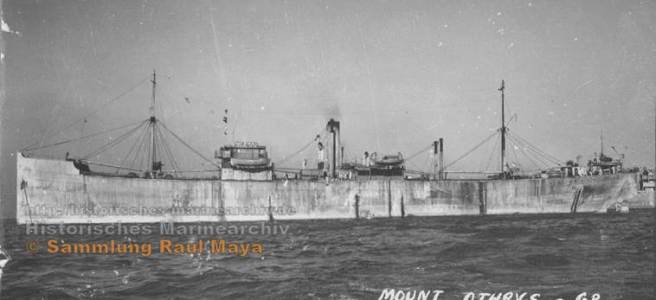
Black and white photograph of the SS Mount Othrys, a Greek cargo vessel, in the water. The ship is shown with masts and cargo equipment visible, taken from the side with some coastline in the background.
Photograph of the SS Mount Othrys at sea, taken in September 1943 by the U.S. Coast Guard. Copyright: Historisches Marinearchiv (HMA), Raul Maya collection, HMA (by kind permission ).

The steel-hulled freighter was originally built by Harland and Wolff of Belfast in 1919 as SS Newton and under ownership of Lamport & G. Holt, for the Brazil & River Plate Steam Navigation Co. Ltd. in Liverpool.[5] In 1933, Newton was changed to Mount Othrys on transfer to Greek ownership (first Theseus Shipping Co. Ltd, Athens; then Rethymnis & Kulukundis, Panama; and in 1936, Kulukundis Shipping Company). Her final owner, Emmanuel Markou, purchased her in 1938, continuing her registration under Panamanian flag. Markou was related to the family of Manuel Kulukundis – a British-Greek banker, shipowner, and chief negotiator with the British government in the discussions around chartering the Greek merchant fleet around that time. Kulukundis and his cousin had founded the famous Rethymnis & Kulukundis (R&K) in 1921, which eventually became the largest Greek shipping office in London.[6]

The collision

On the morning of the collision, at around 10.30am, the MV Erinna, a 9,100-ton Shell tanker built in 1936, laden with 8,000 tons of motor spirit (80% octane), was pulling out into the fairway from Coryton Wharf, assisted by two tugs and heading down river, outward bound. Meanwhile, the SS Mount Othrys, a 6,500-ton vessel, was about to arrive to its destination, London, having picked up its cargo from the Canadian Port of Saint John on Newfoundland.[7] It was transporting Quaker Oats in cardboard boxes and bulk grain, and was making upriver, passing Holehaven, the creek to the west side of Canvey Island on the lower Thames.

Black and white photograph of the Greek cargo vessel SS Mount Othrys at sea, showing its steel hull and smokestack.
Photograph of the Dutch oil tanker MV Erinna, date and photographer unknown. Copyright: Stichting: Maritiem-Historische Databank, (Permission granted)

For whatever reason, as the Erinna moved out into the fairway, the Mount Othrys collided with her – striking the Erinna on the port side and bursting No7 port tank. Some 350 tons of petrol gushed out and showered the two ships and surrounding water. A spark must have ignited and both vessels were suddenly engulfed in flames. The crews on both vessels started abandoning ship, some even diving into the flaming water.[7]

The National Fire Service

Fortunately, the collision was heard by the crew of the National Fire Service (NFS) fireboat, the F.B.282 Laureate, normally stationed at nearby Holehaven, and upon seeing the flames the crew immediately scrambled to assist, laying out hose and foam branches on the deck of the fireboat. During World War II, the London Fire Brigade’s Thames River Formation used fireboats to fight fires along the banks of the Thames and protect ships in the river. It had about 70 craft, including fireboats, fire floats, and other tenders, and was ‘the first to be equipped with radio communications’.[8]
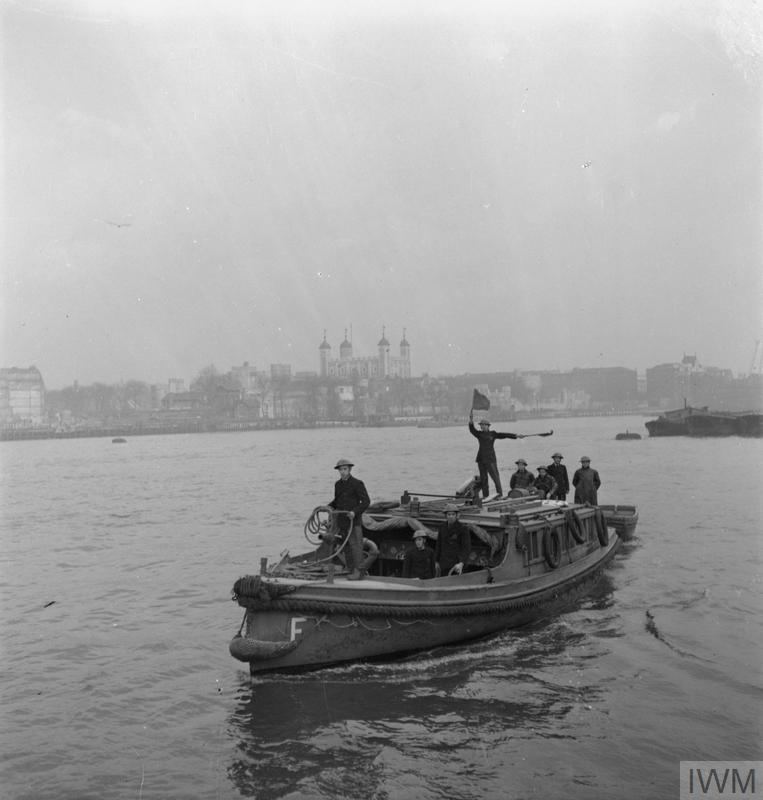
A black and white image showing a group of crew members on a small boat in the river Thames, with some members waving flags. The Tower of London is visible in the background.
With the Tower of London in the background, NFS firemen of the River Thames Formation travel down the river on their way to an incident in 1943. (D 17215) Copyright: © IWM https://www.iwm.org.uk/collections/item/object/205200557

As the first arrival to the scene, an immediate decision had to be made as the two burning vessels were starting to drift apart. The section leaders on board the Laureate judged the tanker as in the greatest danger as well as the greatest threat to any nearby shipping, jetties and wharves. Approaching the tanker’s starboard side, the firefighters clambered on board with their hoses which soon changed spraying water to foam. Altogether, the NFS men were reported to have worked for 21 hours, with some injured and taken to hospital.[9]

“The speed and effectiveness with which this was done was due not only to the resolution of the branch operators, but also to the unflagging energy of the pump operators, who, in using nearly 600 gallons of foam solution, had rapidly to unseal and empty more than 100 5-gallon tins into the multiple jet inductor.” [10]

Several members of the crews of the two ships were reported missing, believed drowned. Eventually the flames were put out and the tanker was saved with very little loss to the cargo. Other vessels continued to try and save the Mount Othrys, the Thames tug Sun VIII being one of them [11], but eventually the freighter had to be beached at Scar’s Elbow on Canvey Island.[12]

On January 8th, the day after the collision, the cargo vessel was re-floated and four tugs attempted to tow it to nearby Tilbury. This failed and the vessel was re-beached at Mucking. The superstructure and majority of the accommodation amidships had completely burnt out. The engine and boiler rooms were flooded, and the vessel hogged and was badly cracked. On the 20th January, at 02:30, the ship broke into two parts and was declared a total loss.[13]

Commendations were awarded to some of the Thames firefighters involved in putting out the fires, among the last to be given national gallantry awards: one British Empire Medal and nine King’s Commendations for Brave Conduct.[14] Three of Mount Othrys‘ crew were killed in the accident – two Greeks (both stokers) and a Brit.[15]

Footnotes

[1] National Marine Heritage Record (NMHR), Historic England. Marine records are currently searched via the Heritage Gateway (Mount Othrys, record id 1260991)
[2] Greek Shipping Miracle: Decimation of the fleet 1940-1945
[3] Voudouris, Dr. Ioannis, The Contribution of the Hellenic Merchant Fleet during the WWII (April 30, 2017)
[4] Arnold Hague Convoy Database, OS/KMS Convoy Series
[5] WWI Standard Ships, War Justice (the name given to Mount Othrys in initial construction phase)
[6] Greek Shipping Hall of Fame, Manuel E. Kulukundis (1898-1988)
[7] Historisches Marinearchiv (HMA), Mount Othrys
[8] Pike, David C, A retired London Fireman: A short history of London’s fireboats (April 18, 2021)
[9] The Crawley & District Observer, 22 September 1945, page 2
[10] Canvey Island: History & memories of a unique island community, Thomas Henry Setchell BEM
[11] Thames Tugs: London Tugs Limited, Sun VIII
[12] Historisches Marinearchiv (HMA), Mount Othrys
[13] Pike, David C, A retired London Fireman: A short history of London’s fireboats (April 18, 2021)
[14] Historisches Marinearchiv (HMA), Mount Othrys

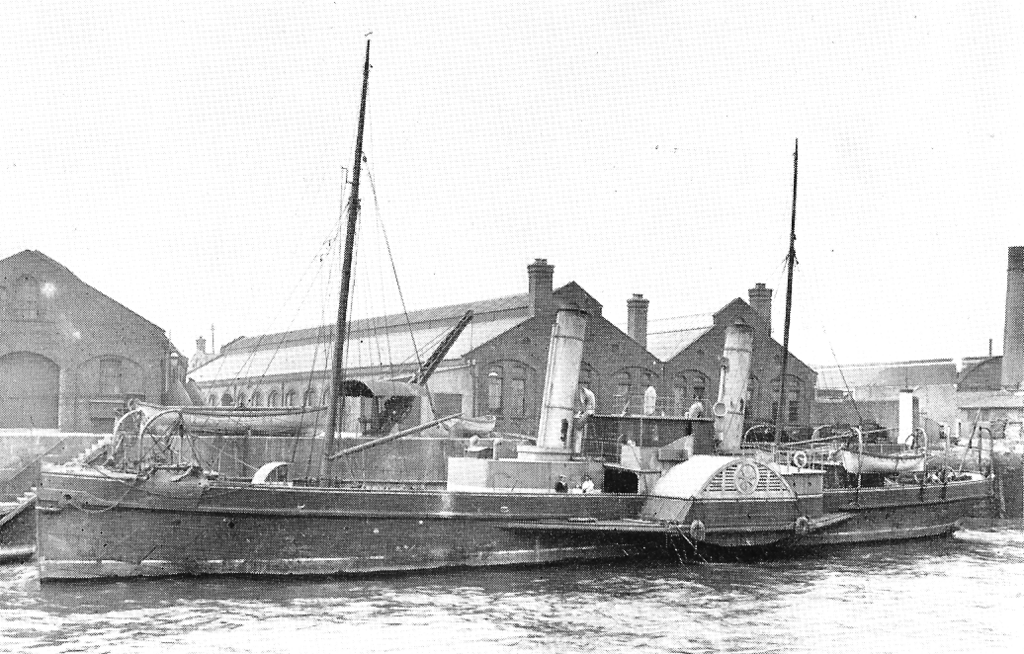
HMTS Monarch III (1916-1945)

Photograph of the third HMTS Monarch, taken in 1916 by an unknown photographer. Credited to Swan, Hunter & Wigham Richardson and sourced by K. R. Haigh, Cableships and Submarine Cables, Adlard Coles Ltd., 1968. Public Domain image. Source: https://en.wikipedia.org/wiki/CS_Alert_(1890)#/media/File:CS_Monarch_(3).png

With accusations of sabotage of pipelines and cables in the news here is a topical wreck of the week. Written by Tanja Watson, Marine Research Specialist at Historic England.

Today marks the 80-year anniversary of the loss of HMTS Monarch (III), a cable repair ship built in 1916 for the General Post Office (GPO) – the institution in charge of the state postal and telecommunications systems between 1870-1969. [1] There are two main types of cable ships: cable repair ships, also known as cable cutters – which tend to be smaller and more manoeuvrable, still capable of laying cable but the primary job is fixing or repairing broken sections of cable; and cable-laying ships – which are wider and designed to lay new cables.

An elegant steamer of single deck construction in steel with two screw-driven, steam turbine 6-cylinder engines, the HMTS Monarch (III) was one of several cable ships built by Swan, Hunter & Wigham Richardson Ltd at their shipyard in Wallsend, Tyne and Wear. [2] With a crew of 65 – measuring almost 68 metres in length, 10 m in breadth, and 1,150 gross register tons – it was equipped with three cable tanks and various specialist tools and features designed to sever and repair submarine telegraph cables in British waters for the next thirty years. [3]

Several of the early cable repair vessels were called HMTS Alert (I & II) and HMTS Monarch (I – V). This is about the third cable ship to be called the Monarch. The first one, built in 1830 as a passenger and cargo paddle steamer by Pearsons of Thorne for the Hull Steam Packet Company, was converted to a cable ship in 1853 for the Electric Telegraph Company, finishing as coal hulk and later broken up post 1874. The second was built in 1883 by Dunlop & Co, Port Glasgow, for GPO. It was sunk by a mine or torpedo off Folkstone in September 1915. Due to this event, the new vessel was named the Monarch (III). GPO had originally intended to replace the aging HMTS Alert (I), built in 1871 as The Lady Carmichael by A. McMillan & Son of Dumbarton, Scotland, and converted and used as a cable ship between 1890-1915, but the loss of Monarch (II) changed plans. The vessel was wrecked at Redcar (North Yorkshire), refloated and scrapped in 1932. [4]

Cable laying in the 1850s

The first telegraph cable across the English Channel was laid in 1850 by the English Channel Submarine Telegraph Company of Jacob and John Watkins Brett. [5] The following year, the British connected England, Holland, Germany, Denmark and Sweden. Another cable connected Italy with Corsica and Sardinia. By the mid-1850s, a 300-mile cable was laid across the Black Sea, allowing England and France to connect with their armies instantly (the Crimean war). In 1858, after numerous attempts, a telegraph cable was finally laid between Great Britain and North America. [6]

First World War

On 4th August 1914, within an hour of Britain declaring war on Germany, the HMTS Alert (I) was dispatched to cut the German communication cables in the Atlantic Ocean. Other ships would eventually eliminate the remainder of Germany’s cable network, but Germany was now forced to communicate by wireless transmission, which the British could intercept and decrypt. As the BBC describes it, the Alert undertook “one of the first strategic acts of information warfare in the modern world. A few hours later, the Alert had cut off almost all of Germany’s communications with the outside world. It had hit the kill switch.” [7]

Meanwhile, the Monarch (III) carried on with cable repair work around the British Isles throughout the First World War and in between the wars until she was requisitioned (or possibly charted) by the Admiralty in 1939. [8]

Photograph of HMTS Alert, by unknown photographer. Credited to Postmaster General of the United Kingdom and sourced by K. R. Haigh, Cableships and Submarine Cables, Adlard Coles Ltd., 1968. Public Domain image. Source: https://en.wikipedia.org/wiki/CS_Alert_(1890)#/media/File:CS_Alert_(1).png

Second World War

The British Admiralty requisitioned and equipped at least seventeen cable ships for cable service during the war. [9] HMTS Monarch (III) being one of them, was tasked with providing a telephone connection to France during preparations for Operation Neptune, the naval component of Operation Overlord. [10] In the days and nights following D-Day, the cable ships Monarch (III), under Captain Arthur Troops, and St Margaret’s were used, together with a smaller cable barge, to lay a 160-mile-long telephone cable. [11]

Landing ships with barrage ballons putting cargo ashore on one of the invasion beaches during the Battle of Normandy. Likely similar to the barrage ballons used by the British cable ships, e.g. HMTS Monarch (III). Public Domain image Source: https://en.wikipedia.org/wiki/Barrage_balloon#/media/File:NormandySupply_edit.jpg

On Tuesday 13th June 1944, at around 1300 hrs, while the Monarch, equipped with a barrage ballon overhead to discourage air-attack, was being guarded by Trentonian (K368), a Royal Canadian Navy warship, the 1,000-ton Flower-class corvette – a squadron of US warships appeared in the vicinity. On approaching them, one of the American destroyers, USS Plunkett (DD-431), a 1,630-ton Gleaves-class destroyer, tried to contact them, first firing star shells to illuminate the area in the night, but no response was given by the Trentonian, who spotted that they were an ally and believed the signals were coming from German positions on the coast. The Canadians repeatedly flashed their recognition lights. However, these signals were missed by the USS Plunkett who opened fire on the Monarch, hitting the barrage ballon overhead. The Trentonian manoeuvred to make its identification as an Allied warship more visible, but the Americans continued to fire. About a kilometre away, while still desperately sending out messages by radio and signal lamp, the Trentonian finally moved between the Monarch and one of the US destroyers and only then did the firing stop.

The attack lasted about 10 minutes. The Monarch had been hit – the bridge was destroyed, its superstructure and steering damaged. Two of the crew were killed and 30 injured, including Captain Troops who later died from his wounds. The telephone cable the Monarch had been laying was lost over the side, and the Canadians were told not to share the incident with anyone. [12]

Four crew members standing on the deck of the HMTS Monarch (III) post the attack, surrounded by damaged cable-winding equipment and machinery.
The damage to Monarch was extensive; the broken structure to the right of the photo is Monarch’s bridge.  The communications cable she was laying was cut and lost into the channel. Source: “The Roger Litwiller Collection, courtesy Bruce Keir, RCNVR, HMCS TRENTONIAN.” (Warm thanks to Roger Litwiller for providing the image).

The following year both vessels went down by enemy action. The Trentonian was sunk by the U-1004 near Falmouth, Cornwall, in February; and the Monarch was sunk off Orford Ness, a foreland spit on the Suffolk coast, on 16th April 1945. Two crew members of the cable layer were lost. One of the survivors, Denis Simmons, stated in 2005 that they had been torpedoed on the starboard side by U-2324 (Kapitänleutnant Konstantin von Rapprad) while returning to Felixstowe, having repaired the Suffolk-Netherlands cable. [13] However, according to German sources, the U-2324 did not sink or damage any ships during its 37 day patrol between March and 9 May 1945. [14] Another crewman, Ernest Hunt, Seaman Cable Hand, who served on the Monarch ‘just prior to its sinking’, claims they “were sunk by an acoustic mine off the East Coast whilst returning to Harwich, April 1945”. [15] (A type of naval mine which monitors audio activity in its vicinity).

The wreck lies some 10 miles SE of Orford Ness, on a bed of sand, at a general depth of 30 metres. [16] It sits upright but it is very broken and is draped in marine cable. Giant cable-laying rollers lie at the bows. [17]

The Monarch almost survived the war. On the day it sank, the Allies announced that future operations over Germany would focus on cleanup rather than strategic targets, effectively ending the air war, and that Berlin was now surrounded by the Red Army. [18]

A rare type of vessel

Cable ships have always been a rare sight. In 1892, two-thirds of the world’s submarine cables were owned by Great Britain, yet in 1896, there were only 30 cable ships in the entire world, of which 24 were owned by British companies. The global telegraphic cable network was established around 1900. [19] Today there are roughly 60 cable-laying ships in the world, according to the International Cable Protection Committee (ICPC). [20] 99% of the world’s digital communications rely on subsea cables, with a global network of 1.4 million km (870,000 miles) of telecommunication cables on the seafloor. [21] The UK currently has over 70 active telecommunication cable systems, consisting of several hundreds of individual cables, managed by The Crown Estate. [22] All these, and the power cables needed to carry the electricity derived from wind, wave and tidal installations, the renewable energy, ashore – require these specialized types of vessels and remotely operated underwater vehicles (ROVs) to repair and lay new ones.

Footnotes

[1] HMTS (His Majesty’s Telegraph Ship) was a prefix used for cable ships owned by the British General Post Office (GPO) before they became a public corporation, changing to CS (Cable Ship). 

[2] History of the Atlantic Cable & Undersea Communications, Swan, Hunter & Wigham Richardson, Ltd.

[3] Wrecksite, SS Monarch (III), [subscription required]

[4] History of the Atlantic Cable & Undersea Communications, Glover, Bill, CS Lady Carmichael/ HMTS Alert (1)

[5] History of the Atlantic Cable & Undersea Communications, 1850 Dover-Calais Cable

[6] Onfray, Robert, The Cable Cutters, 11 August 2023

[7] See note [5]

[8] History of the Atlantic Cable & Undersea Communications, Monarch (3)

[9] History of the Atlantic Cable & Undersea Communications, Eric Tate and the Admiralty Cable Ships 1944-1947

[10] Kemp, Paul, Friend or Foe: Friendly Fire at Sea 1939-1945, pp. 37–38, Pen and Sword, 1993, ISBN 0850523850.

[11] Mackenzie, Duncan S., PK Porthcurno, Monarch Under Fire

[12] Litwiller, Roger, White Ensign Flying: Corvette HMCS Trentonian, 2014

[13] See note [3]

[14] uboat.net, Kapitänleutnant Konstantin von Rappard

[15] History of the Atlantic Cable & Undersea Communications, Glover, Bill, HMTS Monarch (3)

[16] UKHO Wreck Report No. 10253 [subscription required]

[17] See note [3]

[18] History – How Stuff works, World War II Timeline: April 16, 1945-April 26, 1945

[19] Naval Historical Society of Australia, Clifton, Fairlie, Occasional Paper 95: Grandfather was a cableman (18 Nov 2020)

[20] DCD, Swinhoe, Dan, The cable ship capacity crunch (6 Dec 2022)

[21] Minds and Machines, volume 34, issue 3, 2024, Submarine Cables and the Risks to Digital Sovereignty, Volume 34, article number 31

[22] The Crown Estate, Marine: Cables and pipelines

A Tale of Prize and Wreck: Part I

The Modeste

Modern colour aerial photo of coastline to left of photo, showing beach at bottom left and at upper left the land partially inundated and overflowing onto green fields.
Aerial photograph of the Wainfleet area 20618_006 flown 12 October 2006 © Historic England Archive

Our guest blogger Mike Salter returns with a follow-up from his blog on the Sea Adventure in March 2024 on the Modeste, a ship with an intriguing tale behind her. Our thanks to him for providing such an interesting story!

He writes:

The same “Dreadful Storm” that accounted for the Sea Adventure also wrecked 60 other ships between Whitby and Great Yarmouth, in particular La Modeste, which has a number of intriguing circumstances.

She ran aground on the Main, or strand near Wainfleet on the Lincolnshire coast at 7am on Sunday 11th November 1810 [1]. As with the Sea Adventure, wrecked about 20 miles east, across the Wash on Holbeach Marsh, La Modeste was forced ashore by a powerful ESE wind which also produced an extremely high tide, flooding many miles of low-lying coastal lands and marshes.

Her Name

The majority of newspaper and other reports at the time named her as La Modeste, [2] but later, as we will see, she was referred to as Modeste. However, some newspaper reports from sources published closest to the wreck site named her as La Minerva instead. [3]

Both names were in popular contemporary use, for example the Royal Navy frigates Modeste, operational from 1793-1814, and Minerva, 1805-1815.

Details of the Wreck Event

Lloyd’s List stated on 20 November 1810 that: “A fine new, American-built ship, about 500 tons and pierced for 18 guns; Prize to the Hussar frigate, by whom she had been captured in the Cattegat, went ashore at seven o’clock on Sunday morning (11thNov.) on the Main above Wainfleet, where she bilged (i .e. had serious leaks to the hull after running aground). The name of the wreck was the Modeste. She was captured from the Danes off Kiel.”

The first advertisement for the auction of the ship on 5th Dec. 1810 named her the Modeste and said she was copper-bottomed and about 350 tons. [5] She had cost $25,000 a few months previously ($600,000 today), so was a valuable prize. Most reports say she was a prize to HMS Hussar, a 38-gun frigate built in 1807 which saw significant worldwide service, including the Baltic in 1807 and 1810, and whose commanding officer at the time was Captain Alexander Skene.

At the time of the wreck the Modeste was in the hands of Lieutenant W. MacDougall, suggesting that he had been charged with bringing her to a UK port as a prize. Steel’s Navy Lists at the National Maritime Museum show a Lieutenant J MacDougall who was appointed in 1800, but the ships on which he served are not shown. A Lieutenant Drummond was appointed to the Hussar in November 1810, so it may have been as a replacement for MacDougall if he moved to another ship.

Auctions of the Modeste and Subsequent Events

There were two known auctions associated with the Modeste. The first, as above, was on 7 December 1810 at the farm of a Mr Carrott in Friskney, near Wainfleet. It sought those ‘experienced in getting off or breaking up a vessel; and if there was no sale the farmer would buy it and break it for firewood!

The second advertisement, headed “SHIP STRANDED”, was placed in the Stamford Mercury in April 1811 by Messrs. Barnard and Chapman of Boston who had clearly bought the wreck. They wanted someone to get her off for a fixed sum or part share. The ship was in ballast and they tried to arouse interest by saying “it is supposed to have valuable items on board”.

In June 1812 the same paper reported an Inquest on two men who had drowned after a late-night boat trip to “view the means resorted to for raising the wreck”. Sadly, on leaving their boat, they had waded out to sea in the darkness, instead of towards the shore. [6]

Gold in Ballast?

Edmund Oldfield, a local historian writing in 1829, says there was hope for several years the Modeste would be refloated but this came to naught. The ballast was ”a heavy black ore“ which it was surmised contained gold. This ballast was to be the reward of those who laboured on the wreck and some people were induced to buy the labourers “shares of the booty”. After repeated analyses in London hopes of riches were dashed and it seems that the ballast may well have been copper slag which was beginning to be used at that time. The hull was eventually broken up. (Copper slag does contain gold, but at such a small percentage – a fraction of 1% – as to be worthless.)

Modeste Figurehead

I came across, by chance, a reference in a newspaper article of 1854, to “the figurehead of the Modeste, wrecked off the Lincolnshire coast some years since” which was being displayed in an Exhibition at the Boston (Lincs.) Athenaeum and which had previously been shown in the Vauxhall Pleasure Gardens in the Skirbeck quarter of Boston. [7] This would seem to confirm that the ship wrecked on 11 November 1810 was the Modeste, as also referenced by the Stamford Mercury auction and inquest reports on the two drowned men of 1812, and not La Minerva.

Historic B&W photograph of commercial building surmounted by a triangular pediment. Cars and buses are parked outside and a sign on the building points the way to a public air raid shelter.
A 1942 photograph of the Exchange Buildings, Market Place, Boston, Lincolnshire, near the Athenæum, also in the Market Place. The Athenæum was established in 1851 and by 1854 had taken over the site of the demolished Green Dragon Inn. In turn it would be demolished in the 1960s.
OP19538 Source Historic England Archive

There was also an oblique reference to the Aztec king Montezuma immediately after the reference to the figurehead, the significance of which later became clear, and is addressed later in this article.

Modeste, prize to HMS Hussar

There are prize reports for several ships named [La] Modeste at this time, but none recorded as a prize to HMS Hussar, frigate, in the circumstances described: capture from the Danes in the Cattegat off Kiel.

A schedule of Hussar‘s movements can be reconstructed from various newspaper, Lloyd’s List and Navy List reports, including a stint in the Rear Squadron in the Baltic Fleet Order of Sailing of July 1807. [8] Along the way there were false reports that she had been wrecked, a diplomatic row in January 1810 after on boarding the American ship John Adams, bound for a blockaded Dutch port, [9] before she sailed once more from Yarmouth to join the Baltic fleet on 3 July 1810.

In July Hussar captured the Resolution and passed through the Belt (between Sjælland and Fyn, Denmark) to the Baltic with 332 sail. [10] By 3 August she was returning through the Belt with HMS Orion and 120 sail. [11] As an indication of the sailing time, in September 1810 the Hero sailed from the Baltic to England in a mere 6 days, although 2-3 weeks was probably more usual.

On 18 August Hussar captured Julia (no location given), which was auctioned after being condemned in the High Court of Admiralty [12]: distribution of prize money was recorded in the London Gazette of 21 July 1812. This shows the procedure: sending in to a UK port; application for condemnation as prize; sale by auction and later distribution of prize money. This could take some time: two years in this case, but immediate sale could be ordered if there were good reasons.

On 2 October 1810 Hussar was reported to be back in the Yarmouth Roads: “Roebuck, Lord Gardner, Hussar 74 guns [sic] and other warships remain in the Roads.’ Lord Gardner was flag officer on the Roebuck. This report continues: ”Upwards of 20 sail, prizes to the North Sea fleet, have entered this port; the principal part of which are laden with wheat.” [13] In mid-December Hussar arrived at Leith from the Baltic, thence sailing to Portsmouth.

Date of capture of Modeste and conclusions:

From the above voyages of Hussar, it seems Modeste could have been captured, as described in newspaper reports in the Baltic, at any time from mid-August to late October (excluding the visit to Yarmouth in early October if that newspaper report is correct).

No date in July 1810 is given for the capture of the Resolution, while the Julia was captured 18 August 1810, location unknown, so these may /may not have been in the Baltic, although it seems likely.

After Hussar’s return to the Baltic in October there would have been time to send in Modeste to a UK port if she had been captured up to about the third week of that month, which suggests that Lieutenant MacDougall was put in charge of her return late in October, but was then shipwrecked on 11 November, before reaching a port where prize proceedings could be started.

All newspaper reports of the Modeste wreck and the two sales by auction of the wrecked hull state that she had been captured by HMS Hussar, but none that she had been condemned as prize to her. No Notice appears in the London Gazette which did report the capture and condemnation of the Resolution and Julia. [14]

The first auction advertisement for Modeste was on 5 December 1810, taking place two days later at the farm of Mr Carrott in Friskney, less than a month from the date of the wreck. As a local landowner with a large acreage bordering the sea he may have had ‘rights of wreck’, or it was simply a convenient venue.

The appointment of a Lieutenant Drummond to the Hussar in November 1810 may have been as a replacement for MacDougall conveying the prize to England.

It has been an interesting journey, unravelling some events surrounding the loss of a new and valuable ship, captured from the Danes, taken as prize by HMS Hussar, wrecked in Lincolnshire along with many others: speculated over for riches and finally, ignominiously broken up and sold for fence posts or firewood. The dashing HMS Hussar’s exploits in the second Baltic fleet are integral to the story.

Serena writes: There we must end Part I, but Part II will follow in which Mike explores further details of the capture and wreck of Modeste. Very rarely are we able to expose such detail in our understanding of wreck events, particularly at this period, and my thanks go to Mike for his painstaking research.

Footnotes

[1] Topographical Account of Wainfleet and Ingoldmells, Edmund Oldfield, 1829

[2] Edmund Oldfield (op.cit.); Sun (London) 17 Nov 1810; Hull Packet, 20 Nov 1810; Evening Star 5 Dec. 1810; Stamford Mercury 12 April 1811 and 18 June 1812; Lloyd’s List; London Gazette.

[3] Stamford Mercury 16 Nov. 1810; Bury and Norwich Post

[4] Rif Winfield Royal Navy in the Age of Sail 1793-1815

[5] Evening Star (London) 5 Dec. 1810

[6] Stamford Mercury 19 June 1812

[7] Lincolnshire Chronicle 24 March 1854

[8] Morning Post, 5 July 1807

[9] Hampshire Chronicle 1 January 1810; St. James’s Chronicle, 16 January 1810

[10] London Gazette, 21 July 1812; A M Ryan, The Saumarez Papers, Navy Records Society, 1968

[11] Star (London), 12 October 1810

[12] Public Ledger & Daily Advertiser 1 January 1811; London Gazette 21 July 1812

[13] Star (London), 3 October 1810

[14] See note 10 above

Diary of the War – December 1944

The archaeology of Allied convoy attacks by U-322

A historic black & white photograph  of a man in duffel coat on deck looking out at the convoy with plumes of smoke in the distance, against a swelling sea.
Leaning against a Thornycroft Depth Charge Thrower Mark II, the quarterdeck lookout on board HMS Viscount is searching the sea for submarines, with other ships in the convoy in the distance. (A 13362) Copyright: © IWM. Original Source: http://www.iwm.org.uk/collections/item/object/205186129

By Tanja Watson, Historic England

U-322, a German Type VIIC/41 U-boat, departed Horten Naval Base, south of Oslo, Norway, for her second combat patrol on 15 November 1944. Embarking on a less trafficked route around northern Scotland and western Ireland, she entered, nearly six weeks later, the heavily patrolled and mined waters of the western English Channel.

This is an account of the archaeological evidence left when she came across two Allied convoys within the space of six days.

The Type VIIC/41 submarine, one of ninety-one made, was built in 1943 by the Flender Werke yard at Lübeck, and was commissioned on 5 February 1944 under the command of twenty-four-year-old Oberleutnant zur See Gerhard Wysk. After completed training, she began her operational career with the 11th Flotilla on 1 November, departing from Kiel to Horten Naval Base the following day with the standard 52 men onboard. [1]

The 11th U-boat Flotilla was stationed in Bergen (Norway) and mainly operated in the North Sea and against the Russian convoys in the Arctic Sea. The U-322, however, was ordered to Britain and departed nine days after arriving at Horten.

At this late stage in the war, new Allied convoy tactics and technology, using high-frequency direction finding and the Hedgehog anti-submarine system, made any patrol a high risk, but particularly in the confined waters of the heavily protected English Channel a strong possibility.

The first convoy she encountered, MKS 71G (Mediterranean to the UK Slow), was an Allied convoy going from North Africa via Gibraltar to Liverpool. It was made up of 24 merchant vessels (the majority British) and seven escorts which had departed from Gibraltar on 16 December, was due to arrive in Liverpool on 24 December. [2] At 11.50 hours on 23 December 1944, the British-built but Polish-owned steam merchant SS Dumfries carrying 8,258 tons of iron ore from Bona, Algeria to the Tyne, was torpedoed and sunk by U-322 south of St. Catherine’s Point, Isle of Wight. [3]

The crew onboard the vessel, which was owned by Gdynia America Shipping Lines Ltd, Gdansk [4] were rescued by HMS Balsam, a Flower-class corvette who picked up the master (Robert Blackey) and seven crew members, landing them at Portsmouth; and HMS Pearl, an anti-submarine trawler, who picked up the remaining 41 crew members, eight gunners and two passengers, taking them to Southampton. [5]

The sinking of Dumfries was for many years attributed to U-722, but its involvement was disproved after its wreck was discovered elsewhere. [6]

The Dumfries wreck was most recently recorded by the UK Hydrographic Office [UKHO] in 2007 and noted it was sitting upright on a bed of gravel at a depth of 37 metres, largely intact. The remains are 11-12m high, 120m long, and 18m wide with a starboard lean and showing signs of breaking up. [7]

The second convoy encounter occurred seven miles southeast of Portland Bill Lighthouse on the 29 December 1944. This convoy was TBC-21, the Thames Estuary to the Bristol Channel route, bound from Southend in Essex to Milford Haven in Pembrokeshire, Wales. [8]

No longer equipped with her full torpedo load (14), after the attack on Dumfries, U-322 launched at least two torpedoes at the convoy which struck two large US Liberty ships within minutes of each other.

The first to be hit was the SS Arthur Sewell, the fourth ship in the port column. Travelling from Southampton for Mumbles, Wales, she had joined the convoy part of the way for protection. The 7,176-ton American cargo vessel was severely damaged, but the ship held and a tug, HMS Pilot (W 03), towed her to Weymouth. Five men were injured, and one killed out of a crew of sixty-nine. An injured sailor died the next day.

Built in March 1944 by the New England Shipbuilding Corporation, Portland, Maine, she was under the command of the US Maritime Commission at the time.

After the war she was first towed to Portland, temporarily repaired, and then to Bremerhaven where she was loaded with chemical ammunition, towed to sea and scuttled in the North Sea on 26 Oct 1946. [9] Her remains have yet to be located.

Historic black & white aerial photograph of large ship at centre towed by three smaller vessels to the right
Salvaged Liberty Ship, wrecked off Deal in July 1945, towed by three tugs en route to the salvage and repair yards. (CH 15583) Copyright: © IWM. Original Source: http://www.iwm.org.uk/collections/item/object/205454706

The second Liberty ship to be struck was the SS Black Hawk, the last vessel in the starboard column, travelling in ballast from Cherbourg via the Isle of Wight to Fowey on behalf of the US Army Transport Service. [10]

Four of the ship´s 41 crew were injured, one later died. There were no casualties among the 27-man armed guard. [11] The men were picked up by HMS Dahlia and landed at Brixham at 20.30 hours. [12] There is a photograph of the ship sinking.

The torpedo struck the ship on the port side, and the engines were immediately secured as the ship started to sink by the stern. A crack appeared at the #3 hatch and only the two forward compartments kept the ship afloat.

The vessel broke into two large sections, with the aft or stern end sinking into the sea off the Bill of Portland, while the bow or fore section stayed afloat. [13] This section was towed to Worbarrow Bay where it was beached on 30 December 1944. The site was marked by a can buoy until the Worbarrow Bay pipeline was laid and the large section had to be dispersed, using explosives, in 1968. Today the bow lies at a depth of 13-15m, surrounded by 50m of debris. It can be identified by the heavy anchor chain that runs almost 75m south to a 3-ton anchor. [14]

The large stern end (30 feet) which had sunk off Portland Bill, was discovered in 1963, lying in two sections, on its starboard side with a gun still bolted to its platform, at a depth of 31-45m. Dispersal operations were carried out in November that year. At some point a bronze propeller was salvaged, possibly in the 1970s, according to an image published in Diver Magazine, October 1999. The remains were not identified as potentially a Liberty ship until 1975, with the Black Hawk attribution only confirmed in 1987.

Modern colour photograph: elevated aerial view of a long stretch of green landscape with the lines of the hillfort on the left, and a sandy coastline with a bay on the right-hand side
View of Flower’s Barrow coastal hillfort looking east towards Worbarrow Bay and Worbarrow Tout.
DP 438558 © Historic England Archive

The final wreck that day is that of U-322. Having fatally damaged the two cargo vessels, she was not long after sunk by one of the convoy escorts, HMCS Calgary, a Canadian Flower-class corvette, using depth charges. She went down on 29 December 1944 in the English Channel south of Weymouth. Fifty-two men died; there were no survivors.

The wreck was identified as U-322 by Axel Niestlé after it had been initially thought that it was U-772. [15] She is recorded by UKHO as intact with extended mast, 59m long x 18m wide at a depth of approximately 42m. [16]

The wreck of the U-322 is part of a distribution of archaeological remains telling the story of one series of attacks by a submarine in WW2.

It illustrates the complications of recording and interpreting the submerged remains with a story of partial sinking, conflicting records, misidentification, salvage, clearance for navigational safety and erasure by development.

Footnotes

[1] uboat.net https://uboat.net/boats/u322.htm

[2] MKS Convoy Series, Arnold Hague Convoy Database, http://convoyweb.org.uk/mks/index.html

[3] Uboat.net, SS Dumfries, https://uboat.net/allies/merchants/ship/3396.html 

[4] Historic England, NMHR Ref No. 1246514 – record accessed via the Heritage Gateway

[5] Wrecksite, SS Dumfries, https://www.wrecksite.eu/wreck.aspx?4651

[6] See note [3]

[7] UKHO Wreck Record 18917 (Dumfries)

[8] Convoy route TBC, https://uboat.net/ops/convoys/routes.php?route=TBC; TBC-21 http://www.convoyweb.org.uk/hague/index.html

[9] Arthur Sewall, https://uboat.net/allies/merchants/ship/3405.html 

[10] https://uboat.net/allies/merchants/ship/3405.html and https://uboat.net/allies/merchants/ship/3406.html; https://www.wrecksite.eu/wreck.aspx?78432

[11] Skindeepdiving, Black Hawk

[12] https://uboat.net/allies/merchants/ship/3406.html

[13] UKHO Wreck Report No. 18557 [stern]; UKHO Wreck Report No. 18677 [bow]

[14] See note [11]

[15] https://uboat.net/boats/u322.htm

[16] UKHO Wreck Report 18541

Diary of the War – November 1944

HMS Grethe Mortensen

A light blue vessel is seen in broadside view berthed alongside a quay, with her small wooden cabin on deck. A white oil tanker lies behind, and behind the tanker coastal dunes are visible against a blue sky.
The 1931-built Esbjerg cutter E1 Claus Sørensen, now in preservation, gives an idea of what Grethe Mortensen might have looked like as a two-masted motor fishing vessel.
Photographed in 2019 by Thomas Dahlstrøm Nielsen Wikimedia Commons CC-BY-4.0

‘A riddle wrapped in a mystery inside an enigma.’ So spoke Winston Churchill during a radio broadcast in October 1939, focusing on what the main actors would do next following the invasion of Poland. One of the key, and much-repeated, phrases that have come down to us from the Second World War, it could have been applied to many of the war’s subsequent events.

Prize of war

One of those events was the loss of HMS Grethe Mortensen, whose name suggests origins outside the Royal Navy. The first we hear of her in English records is as as the MFV Grethe Mortensen in prize case TS 13/1429 [1] taken by the King’s Proctor, a legal official acting for the Crown in the High Court of Admiralty (now HM Procurator-General and Treasury Solicitor). However, as the record has not yet been digitised, more details are only accessible by visiting the National Archives in person.

So little is known about her that one standard secondary wreck work states: ‘built as a large private steam yacht, this vessel was completed as a special service vessel in 1943. Was abandoned in a sinking condition after detonating a German-laid mine’, extrapolated from the bare-bones details available and accessible at the time of compilation, primarily from secondary sources. [1]

Nevertheless what we do learn from a brief glance at the Prize Court catalogue entry is that the three letters MFV demonstrate that she was a motor fishing vessel, so she was neither a private yacht nor steam-powered.

Prize cases are redolent of an earlier era, of privateering and sea battles during the Age of Sail in fact, but they occurred in both World Wars. When a ship is captured she becomes a prize of war: the capturing nation will interrogate the case according to prize rules, distribute any bounty to the capturing crew for the capture, and reassign the vessel in either their merchant navy or naval forces.

The key is that to all intents and purposes the Grethe Mortensen was an enemy vessel, and her name is distinctive enough for us to be sure we have the right vessel when we trace her in records. Names such as Two Sisters or Friends (in any language) are as difficult as Smith or Jones in genealogy!

A Danish ship

We can track her down in a Danish shipping register for 1944, wherein we can confirm that she was a 2-masted fishing vessel built of oak, beech and fir at Nordby in 1943, fitted with an engine developing 77HP, with a draught of 7.5ft, 40 tons gross, 14 tons net, and owned by H Mortensen of Esbjerg, Denmark. These details are confirmed by an official record of Danish losses in 1946, which include a retrospective record for Danish vessels lost during the war: according to that source, the loss was apparently not reported at Esbjerg until 16 January 1946. There was a war on, after all, and she was in a foreign service.

What we can now see is that she was small, and new, and we can also now confirm that she was definitely a motor fishing vessel, her original Danish nationality, and her service under the British flag. The official shipping statistics state her tonnage as 38 tons – close enough.

Why would Britain have regarded her as an enemy vessel? – because Denmark was under occupation by Nazi German forces from 1940. Grethe Mortensen was built in Denmark during the occupation years and thus was not a pre-existing vessel which had, for example, made her way to an Allied or neutral port on the fall of Denmark. Without sight of the prize case, which would no doubt shed light on the matter, we can only surmise that she was captured while out fishing, perhaps during a raid or after straying into English waters.

Transformation to Special Service Vessel

We turn now to British sources to see if we can discover a little more. We find out from an officially published list that Special Service Vessel, the requisitioned Grethe Mortensen, of 35 tons, built in 1943, was abandoned on 7 November 1944 in a sinking condition off North Foreland, Kent. [3] We know it is the right vessel – the name, the year of build, and the slightly variant tonnage again, this time 35, and it reconfirms her service under the British flag.

We can now see that she is classified among Royal Naval vessels and is a somewhat obscure ‘Special Service Vessel’, so she was on some form of war duty when she was lost. She is very small, and constructed of wood, so her role in that guise remains unclear.

What we can understand is that ‘Special Service Vessels’ is a label for ships that did not fit easily into any regular category of naval forces, and that during the Second World War a variety of ships of all shapes and sizes played a variety of roles.

We don’t really know exactly what she was doing, but from her position of loss – not in harbour in the role of harbour defence, like many small vessels, but offshore, located between the gateway to the English Channel at the Downs and the approaches to the Thames Estuary – we can surmise that she was probably in some sort of patrol role.

Danish sources shed very little light on the matter: ‘G.M. sailed in the British navy, and was lost in October 1944.’ is the terse one-liner in official loss records. [4]

Danish fishermen in Britain in WWII

She is mentioned again in passing in a 1961 article on Danish fishermen in Britain during the war, including the efforts of Danes living in Britain to raise money to build Spitfires. [5] Like the Belgians in Brixham (February 1943) Danes plied their fishing trade under the British flag at Fleetwood and Blackpool, fishing the cod-rich grounds off Iceland, and were ‘welcomed with open arms’.

It is said that four fishermen came over – their vessel sadly not named – in ‘quite an unusual way’: they rescued the crew of an American bomber which had crashed ‘into the drink’ (the English phrase is used!). The fishermen, with limited petrol for their engine, were going to make for home in Vestjylland (West Jutland) with the rescued crew. Instead the Americans persuaded them to set sail for England, helped along by a fair wind, and on arrival they were permitted to make use of British Danish-language radio channels to let their families know they were alive and in good health.

According to the article, two cutters from that Danish-British fleet were lost ‘during the war’, one being Grethe Mortensen of Esbjerg, 38 tons. It goes on to relate that she was taken over by the Royal Navy, and there were no Danes aboard when she was lost in October 1944.

It would appear from this article that Grethe Mortensen was part of the fishing fleet that had escaped and made its home in Britain, but voluntary action like this seems inconsistent with a Prize Court action. Curiouser and curiouser.

A July 1945 edition of the same source [6] has another virtually throwaway comment. It tells us that there is ‘sad news from England’ with a number of Danes drowned on a British-flagged fishing vessel on 21 April 1945, including a man from Esbjerg. He and that wreck form the focus of the article: we learn that he came over as first mate on either the Erling or Grethe Mortensen, both of Esbjerg, ‘which were taken over by the English on 14 May 1943’, which sounds both forcible and as if Grethe Mortensen had not spent very long at sea before this happened, given that 1943 was her year of build.

Her ‘circumstances’

Thus both British and Danish official and informal sources alike suggest that Grethe Mortensen was compulsorily taken over by the British under some obscure circumstance: she was more than requisitioned, she was the subject of a Prize Court action. So was the Erling. So there was definitely something about their ‘circumstances’. [7]

I have written frequently about wartime censorship, but it struck me that this might have made a newsworthy story even if published some time after the event (weeks or months). It had all the right ingredients for a snippet that contained a modicum of good news after four years of war.

We read on 11 September 1943 that: ‘Six Danish fishing vessels arrived last week in a British port, having been intercepted in the North Sea by British naval units . . . The boats set out from Esbjerg when Denmark was in a state of extreme tension . . . Each ship had a good catch of prime North Sea plaice, which was landed and sold.’

The article ends: ‘Approximately one third of the boats [two, then!] will be available again for fishing, and the older men, including the skippers, will man them. The younger men will go into the forces here . . . ‘ [8]

This does sound like a ‘capture’ and it hints that the fate of the other four boats was intended to be in some other capacity to be assigned but not publicised. Further, like the Erling and the Grethe Mortensen, they came from Esbjerg. We lack any confirmatory detail, as we would expect under the conditions of wartime journalism, but this seems that this might refer to the incident that led to the portals of the Prize Court.

What was her fate?

What happened to Grethe Mortensen on the day she was lost in November 1944, however, is less clear. As we have been able to demolish any assertion in a key secondary source that she was originally a steam-powered private yacht that was completed at the builder’s as a ‘special service vessel’, and as none of the other sources mention loss to war causes, any suggestion originating from the same secondary source that she was lost to a mine may also be unlikely.

Looking at the weather for 7 November 1944 in Met Office records [9], there does not seem to be anything particularly unusual about the meteorological conditions that day either: predominantly westerly, wind forces approximately 3-6. As we have shown before, however, vessels can be lost in similar conditions if they are unlucky enough, and the one clue we may have is that observations at 6-hourly intervals show the wind alternately veering and backing a couple of points either way. Perhaps that was enough for a small vessel to spring a leak or take on water and be overwhelmed by the sea.

It’s also interesting that Danish sources consistently report the vessel as lost in October, rather than November, but that information appears to be second-hand. On the other hand, dates in British Vessels Lost at Sea tend to be reliable, so I suspect that 7 November at least is accurate. It is difficult to know whether the date of capture in early September 1943 is reliable (‘last week’ could hide a multitude of sins if you wanted to be vague and escape the censor’s pencil) but I suspect it is, because reference is made to the Danish general strike or ‘August Uprising’ of August 1943. It would also seem more plausible for the date of capture than 14 May 1943 for a vessel recorded as newly built that same year.

At the moment we appear to be no further forward with the wreck event beyond this sparse detail, but at least we have been able to put some flesh on the bare bones of the vessel herself, and understand better what she actually was – even if the mechanism by which she became a Special Service Vessel, what she was doing at the time of loss, and the circumstances of the loss itself, all combine to form ‘a riddle wrapped in a mystery inside an enigma’ that is only partially unravelled.

Footnotes

[1] Larn R & Larn B, 1995 Shipwreck Index of the British Isles: Vol 2, Hampshire, Isle of Wight, Sussex, Kent (Mainland), Kent (Downs), Kent (Goodwin Sands), Thames (London: Lloyds of London)

[2] Prize Case for the MFV Grethe Mortensen, TS 13/1429, 1943-1946, The National Archives, Kew

[3] HMSO, 1947 British Vessels Lost at Sea 1939-1945 [London: HMSO]

[4] Ministeriet for Handel, Industri og Søfart, 1948 Dansk Søulykke-Statistik 1946 (Copenhagen: Det Kongelige Søkort-Arkiv) (in Danish)

[5] Tidsskrift for Redningsvæsen: Medlemsblad for Foreningen af danske Redningsmænd (Journal of the Rescue Services: Members’ magazine for the Association of Danish Lifeboatmen), Vol. 28, No.1, January 1961 (in Danish)

[6] Tidsskrift for Redningsvæsen: Medlemsblad for Foreningen af danske Redningsmænd (Journal of the Rescue Services: Members’ magazine for the Association of Danish Lifeboatmen), Vol. 12, No.7, July 1945 (in Danish)

[7] Prize Case for the MFV Erling, TS 13/1293, 1943-1946, The National Archives, Kew

[8] Hull Daily Mail, Saturday 11 September, 1943, No.18,048, p1 (British Newspaper Archive online)

[9] Meteorological Office, 1944, Daily Weather Report 7 November 1944 DWR 1944.11 Met Office Digital Library and Archive

Diary of the War – October 1944

Another Landing Craft Tragedy off the West Coast

October 1944 was a relatively quiet month in terms of shipping losses with 10 vessels reported lost during that month, none to war causes (e.g. torpedo, mine). In fact it was the weather that seems to have been the major factor for most of them, although the loss of LCP(L) 52, a Landing Craft Personnel (Large), was attributed to foundering following a fire in the Solent on 11 October.

Barge Norman sank off the Kent coast on 7 October, and another barge, Congo, is reported as having similarly sunk off the Essex coast on 13 October. LCT(A) 2454 (Landing Craft Tank, Armoured) was forced ashore in wind conditions SW 4, freshening to force 5, on Chesil Beach, Dorset, on the latter date. [1]

Things were not looking good for vessels of shallow draught in high seas in autumn gales.

In a previous edition for November 1943 we looked at the collective loss of several landing craft from a single convoy off the Isles of Scilly. Almost a year later, a similar tragedy occurred with convoy KMS 66 (UKMediterranean Slow), which set out from the Clyde on 14 October 1944, with some LCTs under tow by the merchants in the convoy, a mixture of British, Belgian and Norwegian vessels. Further vessels joined convoy from Belfast the next day, and Liverpool and Milford Haven the day after, as the convoy steamed south out of the Irish Sea.

On 18 October 1944 KMS 66 ran into trouble off Land’s End in wind conditions reported at 6am that morning as WSW force 7 at the Lizard, W x S force 6 off the Isles of Scilly. [2] At 10.50 Nairnbank, which was towing LCT 494 and LCT 7014, reported that contact had been lost with the former. [3]

By 12 the conditions had worsened to WSW force 8 at the Lizard, SW x W force 7 at the Isles of Scilly.

All hell subsequently broke loose over the next 24 hours. Calls for assistance were made from the foundering LCTs, towing merchants reported on the status of their ‘children’ and issued commands, orders were issued to escorts and merchants to search for the LCTs and assist in rescue, widening beyond the immediate convoy to other convoys in the area, and contact repeatedly made with the Admiralty and Commander-in-Chief Western Approaches. It was a frantic period. [4]

At 6pm conditions were force 8 from both the Lizard and the Isles of Scilly but it is also stated elsewhere that conditions were force 9. [5] Conditions remained similar at midnight and 6am the next day (19 October) abating somewhat towards the Isles of Scilly. The weather abated further over the course of the evening but by midnight of 19/20 October LCTs 480, 488, 491, and 7014 had either foundered or been sunk following rescue efforts, and LCTs 494 and 7015 remained unaccounted for. There were men lost from all of these vessels, from other LCTs which, however, survived the incident, and from rescuing vessels.

History has a nasty habit of repeating itself and never more so than on this occasion, which was almost a carbon copy of the events of November 1943.

It seems that one of the LCTs lost in this incident may have been discovered, as reported by Royal Navy News in 2023, while LCT 7074 survives in preservation and is open to the public.

Broadside view of LCT 7074 in preservatiion at the museum, painted in camouflage battleship grey colours, set under an exterior canopy with steps leading up to her open bow doors.
LCT 7074, the last surviving LCT from D-Day, at the D-Day Story, Portsmouth.
Wikimedia Commons, CC-BY-SA 4.0

Footnotes

[1] Data recorded at Portland Bill for 00.00, 06.00, 12.00 and 18.00 on 13 October 1944, Meteorological Office Daily Weather Report, October 1944, Met Office Digital Library and Archive

[2] Data recorded at the Lizard and the Isles of Scilly for 18, 19 and 20 October 1944, Meteorological Office Daily Weather Report, October 1944, Met Office Digital Library and Archive

[3] Chapman T, and Shipston, B, nd “9th LCT Flotilla – A Tragedy at Sea: the lost flotilla” Combined Operations online

[4] ibid.

[5] Data recorded at the Lizard and the Isles of Scilly for 18, 19 and 20 October 1944, Meteorological Office Daily Weather Report, October 1944, Met Office Digital Library and Archive

Diary of the War – August 1944

Modern colour photograph using time-lapse photography of a concrete hard standing with side features as a mock-up of the open ramp of a landing craft. It is set in grassy dunes with grass growing in the crevices between the concrete slabs.  

The concrete 'landing craft' is shown at twilight with the time-lapse photography showing the movement of stars in the sky, to illustrate the time that has elapsed since it was built and had a function.
Replica landing craft in concrete in the dunes at Braunton Burrows, North Devon, seen at twilight, 2019. These features were used as training facilities for embarkation and disembarkation practice in preparation for the Normandy landings, and are listed as a group of eight at Grade II.
DP248202 © Historic England Archive

The Ongoing Support of the Normandy Invasion

D-Day was one day in history. It finally marked the day that the war turned, in Churchill’s famous phrase, from the ‘end of the beginning’ to the ‘beginning of the end.’ [1] As an equally famous saying has it, ‘Rome wasn’t built in a day’, and it would take some months before the Allies were able to encircle the Germans at the Falaise Pocket [12 to 21 August 1944] south of Caen and the Normandy landing beaches, to clear the way to Paris, liberated shortly after [19 August to 25 August 1944]. It would take until the end of the war to fully drive the occupiers out of France.

The ongoing invasion effort required ongoing logistical support. Resistance came not only from land forces but also from seaborne forces, so for this entry we take a look at a number of ships wrecked while supporting operations in France, the common theme of the wrecks this month.

It is a tale of landing craft, Liberty ships, and ‘Government stores’.

The first of this group were lost on 8 August when convoy EBC 66 [Bristol Channel to France] was attacked while bound from Barry for Seine Bay. EBC 66 was a multinational convoy comprising British, American, Norwegian and Dutch ships, and escorted by three Flower-class corvettes from different forces: HMS Petunia; ex-HMS Lotus loaned to the Free French as Commandant d’Estienne d’Orves, named after a French naval officer executed by the Nazis in 1941, and HMCS Regina of the Royal Canadian Navy.

Simple modern colour digital photograph of the land silhouetted in black to foreground (rocks) and right (cliffs) of image, with the white lighthouse and its light appearing to right background. The blue sea comes in from the left background to right foreground, and dark clouds are visible in the dark blue sky.
View looking north across Stinking Cove towards Trevose Head lighthouse at midnight, 2023.
DP 437442 © Historic England Archive

Off Trevose Head, north Cornwall, U-667 struck among the convoy. First to be attacked was the American Liberty Ship Ezra Weston, laden with ‘Government’ and general cargo, specified as 20mm guns, acid and military vehicles, from Avonmouth for Falmouth and the invasion beaches, which was torpedoed below the waterline at around 7.30 in the evening. This attack was initially attributed to a mine. Her captain attempted to beach her but she was in a sinking condition and beginning to break up. She broke in two at 9.45pm and had to be abandoned, fortunately without loss of life. LCT 644 took off the majority of the crew, 4 officers later leaving the vessel in a lifeboat. [2]

HMCS Regina stayed nearby to ‘become a sitting duck for the next torpedo’, as survivors put it. [3] She was struck at 10.48pm, and though 30 men were lost in the engine and boiler room, the survivors owed their lives two factors: to the Ezra Weston, as most were on deck watching over the stricken merchant in their care, and to the crewman on watch who had had the foresight to order her depth charges to be made safe. The survivors were picked up by LCT 644 and the Admiralty Trawler Jacques Morgand (formerly a Dieppe trawler and seized at Falmouth in July 1940). [4]

The two ships lie virtually side by side off the coast of Cornwall, within a few hundred metres of each other, and Regina showing evidence of an implosion on the seabed after her rapid sinking in less than half a minute, with a debris trail of unexploded depth charges. The Ezra Weston is split in two.

Historic colour photo of ship in starboard bow view, painted white, green and blue in dazzle camouflage, with spray at the bows as she cuts through the water under a blue sky with multiple white clouds on a fair day at sea. The paint is battered in places illustrating her hard work at sea in wartime.
Photo: Corvette HMCS Regina pennant number K234
© Government of Canada. Reproduced with the permission of Library and Archives Canada (2024).
Source: Library and Archives Canada/Department of National Defence fonds/e010777224

On the same day Fort Yale, a vessel on Lend-Lease to the UK from the US, was mined and damaged onthe other side of the Channel at Arromanches while on convoy ETM 56 (Southend to Seine Bay, motor transport to France) having been on ‘Special Services’ shuttling between the Thames and the Seine since the early days of the Normandy invasion. She was released from service on 12 August with engine damage, but apparently still afloat. On 15 August any further service was deferred pending repairs, but she was able to proceed back to Southend from the Seine under tow of two tugs, one British and one American, on 19 August. [5]

On 23 August she was torpedoed in mid-Channel SE of the Isle of Wight, with the majority of the crew being picked up and landed at Portsmouth.

On 14 August a near carbon-copy of the attack on Ezra Weston and HMCS Regina in roughly the same area, off Hartland Point this time, dispatched the American LST 921 and British LCI(L) 99, respectively a Landing Ship Tank and a Landing Craft Infantry (Large). They too were on an EBC convoy, EBC 72, and that number shows the frequency of convoys bound for Normandy: daily increments since EBC 66 on 8 August. [6] Their attacker was also U-667, which would herself not last much longer: her last known radio contact was on 25 August, but she failed to arrive at the rendezvous point the following day, having been lost in a British minefield off La Rochelle. [7]

Historic black & white photo of LCI(L) seen in starboard view on the water against a backdrop of hills. Seagulls circle the ship while a barrage balloon flies overhead.
LCI(L) 98 (OPS 41), seen while underway in home waters. Copyright: © IWM. Original Source: http://www.iwm.org.uk/collections/item/object/205200182

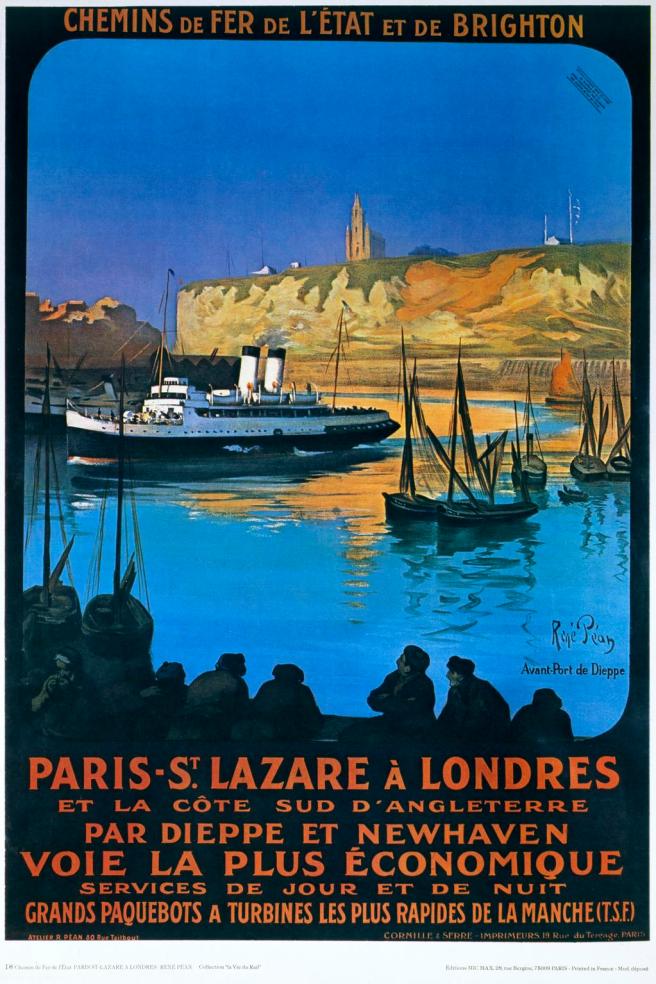
We return now to another Southend to Seine Bay convoy, this time ETC 72, a coastal convoy. On 19 August they were in mid-Channel when U-413 torpedoed Saint Enogat SE of St. Catherine’s Point, Isle of Wight. Most of the personnel survived to be picked up and landed at Juno Beach. In a strange way, her place of loss reflects her service career. Built as part of War Standard tonnage in 1918 as War Clarion, she was sold post-war to one of the French railway companies: her new name Saint Enogat reflected the Breton area served by her new owner, the Chemins de fer de l’État, but she passed in 1920 to the Société Maritime Nationale. [8]

Historic colour poster in mid-century style showing a black and white ferry crossing Dieppe harbour dotted with fishing craft seen against a backdrop of cliffs with a church on top. There are strong colours of blue (sea and sky) and orange (cliffs, reflections on the sea) to evoke warm sunny days. The text below advertises the ferry service in French.
Poster by René Péan for the Chemins de fer de l’État linking Paris & London via Newhaven & Dieppe
© The Board of Trustees of The Science Museum, London / National Railway Museum York

https://collection.sciencemuseumgroup.org.uk/objects/co229706/chemins-de-fer-de-letat-et-de-brighton CC-BY-SA-4.0

After the fall of France in 1940, Saint Enogat was seized at Plymouth and was transferred to the Ministry of War Transport (MOWT). She would return to France on the ‘Store Transport Service’ following the Normandy invasion, regularly shuttling between Southend and the invasion beaches, until her loss. Her sinking was initially attributed to a mine, but a later note adds: ‘Considered vessel more probably torpedoed by s/m.’ [9]

Our final and most famous wreck of the vessels bound for Normandy during August 1944 is undoubtedly the Liberty Ship Richard Montgomery, wrecked the following day on 20 August and regularly making headlines since.

Unlike the others, however, she was not lost to war causes. She crossed the Atlantic as part of convoy HX 301 from New York for Liverpool, arriving in Oban on 8 August, thence joining convoy ‘northabout’ round Scotland, after which she fed into a southbound convoy bound for the Thames. She then anchored in the Thames Estuary on Sheerness Middle Sand to await yet another convoy for her final destination of Cherbourg to support the invasion with her cargo of munitions.

There she broke her back and started to settle into the sand, with only half her cargo salvageable. She is designated under Section 2 of the Protection of Wrecks Act 1973 as a dangerous wreck, administered by the Maritime and Coastguard Agency through the Receiver of Wreck. [11] She lies within a well-demarcated exclusion zone and it has often been said that no other ship can now run onto Sheerness Middle Sand because of her, a most unusual case of one maritime hazard replacing the previous hazard at that location. [12]

Her story, from her background to her modern-day management, can be read in full in a dedicated article on GOV.UK

Wreck of the SS Richard Montgomery, off Sheerness, showing her upperworks and looking towards the resort of Southend-on-Sea across the Thames.
The superstructure of Richard Montgomery on Sheerness Middle Sand, Thames Estuary, seen here attracting numerous cormorants in 2014.
© Christine Matthews CC-BY-SA 2.0
https://www.geograph.org.uk/photo/4194776

Famous in her own right, the Richard Montgomery is nevertheless part of a wider story, a bigger picture, and a maritime landscape of war that fed into the continuing battle to liberate France after D-Day.

Footnotes

[1] Winston Churchill, Prime Minister’s Address to the Lord Mayor’s Banquet, Mansion House, 10 November 1942

[2] Ezra Weston, Historic England, National Marine Heritage Record (NMHR) record 766919

[3] Quoted from Deep Wreck Mysteries: Fatal Decision, broadcast ITV West, 25 January 2007, 7.30pm

[4] HMCS Regina, Historic England, NMHR record 1102944; Jacques Morgand, photograph and details online

[5] Fort Yale, Historic England, NMHR record 766513; Shipping Movement Record card, BT 389/13/246, The National Archives, Kew; Report of Total Loss, Casualty &c. No.75,092 Fort Yale, Lloyd’s Register Foundation Archive & Library, LRF-PUN-W244-0106-W,

[6] LST 921 Historic England, NMHR record 1534459; LCI(L) 99, NMHR record 1534460; convoyweb

[7] U-667, uboat.net

[8] Saint Enogat Historic England, NMHR record 1246470; uboat.net

[9] Shipping Movement record card, St Enogat [sic] BT 389/28/120, The National Archives, Kew

[10] Richard Montgomery Historic England, NMHR record, 904735; convoyweb

[11] Statutory Instrument 1973 No.1690 Protection of Wrecks (Designation No.2) Order 1973

[12] Cant, S 2013 England’s Shipwreck Heritage: from logboats to U-boats (Swindon: English Heritage)

Diary of the War – July 1944

Contemporary oil painting depicting Tower Bridge at night with  white streaks representing searchlights all heading towards the rocket flying over Tower Bridge. In the background red flames can be seen in various locations representing buildings on file.
A Flying-bomb over Tower Bridge (Art.IWM ART LD 4719) Frederick T W Cook
Searchlights track a V1 or V2 over Tower Bridge.
© IWM. Original Source: http://www.iwm.org.uk/collections/item/object/5500

Naja

Following the launch of the D-Day invasion on 6 June 1944, the citizens of Britain knew that reprisals would come. On 13 June the first of the V1 rockets, known as the ‘Doodlebugs’, struck London, and it was London and the Home Counties which would bear the brunt of the damage.

Despite this life carried on. My mother never forgot her own encounter with a doodlebug in Chelmsford, Essex, scrambling for shelter with her little brother. According to a bomb map in Essex Archives, it was probably the V1 attacks on either 18 June or 9 July 1944. [1]

Only a few days after the 9 July incident in Chelmsford, on 12 July another V1 struck near Tower Bridge. The 2-ton steam tug Naja, built in 1924 and owned by Gaselee & Son, was destroyed and sunk in the Upper Pool, east of Tower Bridge, with the loss of six men during a crew changeover.

She is the only wreck in our records known to have been destroyed by a V1.

We do know, however, that the wreck was raised immediately by PLA Wreck Lighter No.2 as shown in an image taken by City of London Police, now in the London Museum. She is badly damaged aft but the idea that has gained traction in commentary on the Naja that she suffered a direct hit cannot be correct otherwise there would have been, at best, only debris left.

It is quite understandable that she was raised instantly in a busy waterway where wreck remains would pose both a navigational hazard and a risk of accretion and siltation if not dealt with immediately.

It is a reminder that destruction and death do not always equate to archaeological remains, although the vessel was definitively written off and her register closed. [2]

Historic black and white photo of very small tug in the river against a line of much larger ships berthed on the left with the tall masts of the loading infrastructure of cranes and derricks beyond.
The tug Plaboy heading for a line of ships moored in the London Docks, July 1965. One of the Port of London Authority (PLA) tugs which at this period had punning names beginning PLA-. The 1957-built Plaboy was sold out of service in 1970.
AA064981 John Gay Collection © Historic England Archive

Footnotes

[1] D/2 65/1 Essex Record Office

[2] Appropriation Books, official No. 148526, Crew List Index Project; catalogue entry for the Registers of Shipping and Seamen, Naja, BT 110/1261/13, The National Archives, Kew

Diary of the War – May 1944

MMS 227 – Hr. Ms. Marken

The focus this month is on motor minesweeper MMS 227 and to recognise the contribution of the Free Dutch forces.. After the fall of the Netherlands, Dutch vessels contributed to the Dunkirk evacuation and to the British trooping and convoy effort, including the liner Johan de Witt, which became a troopship and convoyed many British troops around the world, including my own late father in 1944. [1] Dutch ships also served in other theatres of war such as the Italian campaign of 1943 and at D-Day. [2]

A number of small motor minesweepers were built during the war by small contractors in sheltered coastal waters around the country. As always, production was dispersed for security and to take advantage of the specialist skills of the smaller boat-builders.

These builders, like Curtis of Par, Cornwall, who built MMS 227/Marken, specialised in the manufacture of wooden ships. Wood was ideal for motor minesweepers for several reasons: to take pressure off raw materials for steel ship production and because, unlike steel, it would not set off magnetic mines.

It remained a dangerous job: over the course of both World Wars this blog has highlighted how frequently minesweepers fell victim to the very danger they were working to save others from, and small wooden craft were extremely fragile in such an explosion.

Nevertheless over 400 of these vessels were built in two classes, one slightly larger than the other, either 105ft or 127ft long. [3] In an official Admiralty photograph campaign showcasing the work of the motor minesweepers and their crews from all walks of civilian life, they were labelled as ‘The Little Ship with a Big Job.’ [4]

Several of the smaller class of minesweepers were then cascaded to Free Dutch forces operating in the 139th Minesweeping Flotilla out of Great Yarmouth and Harwich. They were all renamed after locations in the Netherlands, rather than merely numbered, as they had been in the Royal Navy.

Thus it was that MMS 227 became Hr. Ms. Marken, after the island on the IJsselmeer. (Hr. Ms. or Harer Majesteits is the prefix of ships of the Koninklijke Marine or Royal Netherlands Navy, which is conventionally translated into English as HNLMS or His/Her Netherlands Majesty’s ship.) Several would survive the war and be incorporated into the peacetime Dutch Navy to continue the postwar work of mine clearance in the North Sea.

On 18 April 1944 Queen Wilhelmina visited Dutch minesweepers at Harwich, an event that would not be reported in the press until 9 May, and even then in only the briefest of terms: ‘Queen Wilhelmina of the Netherlands recently visited men of the Dutch fighting forces and Dutch minesweepers whose crews were originally trawler fishermen.’ [4]

Historic black & white photograph of a dockside scene. Queen Wilhelmina, in a coat and hat and accompanied by 3 men in navy uniform, clutches a large bouquet of flowers in her arm. She walks along the quay with shipping beside her on the right, and dockside infrastructure, such as cranes, to the left and in the background.
Queen Wilhelmina inspects Dutch minesweepers at Harwich in the company of Dutch and British officers. To the right the name Putten can be seen, another of the motor minesweepers lent to Dutch forces. (A 22874) Copyright: © IWM. Original Source: http://www.iwm.org.uk/collections/item/object/205155024

On 20 May 1944 Marken was clearing the War Channels when she struck an acoustic mine near the Sunk Lightvessel in the Thames Estuary, and was blown in half with the loss of 16 out of her 17 crew, including her captain Gerardus Albertus Smits of the VRH (Vrijwillige Reserve Hulpschepen, approximately equivalent to the Royal Naval Voluntary Reserve). [6]

The wreck was clearly visible as broken in two until around 1981, but by 1990 had shown signs of further deterioration and beginning to be covered by sand and buried by the following year. [7] MMS 113, of similar type, lies on the western foreshore of Portsmouth Harbour, another relic of the era of the ‘little ship with the big job’.

Footnotes

[1] Oral history reminiscence, Corporal R F Cant RAF, recorded in unpublished family notes

[2] Karremann, J, 2019 “D-Day en de Koninklijke Marine”, marineschepen.nl [in Dutch]

[3] Nautical Archaeology Society, nd “Minesweeper MMS 113” nauticalarchaeologysociety.org

[4] See, for example, IWM (A 15539) et seq. in the collections of the Imperial War Museum

[5] Press release widely published in e.g. Evening Dispatch, 9 May 1944, p4, Gloucestershire Echo, 9 May 1944, p3, etc.

[6] Visser J nd “105 feet class – minesweepers” Royal Netherlands Navy Warships of World War II; Hr. Ms. Marken Wikipedia

[7] United Kingdom Hydrographic Office record No.14566; Historic England National Marine Heritage Record no. 908141

Diary of the War – June 1944

D-Day 80

Modern colour photograph of the ends of two concrete Mulberry Harbour structures at sea, exposing their respective staircases, with a ship visible in the gap between them.
Two Phoenix caisson components for a Mulberry Harbour can still be seen at Portland, Dorset, where they were towed post-war. Listed Grade II
© Des Blenkinsopp 2019 CC-BY-SA 2.0 https://www.geograph.org.uk/photo/6173674

Eighty years on from the launch of Operation Neptune on 6 June 1944, the largest seaborne invasion in history, we take a look at those craft which, for one reason or another, did not make it to the landing beaches of Normandy, but which do form part of a tangible heritage of D-Day around the southern coasts of England.

An invasion of this scale required considerable preparations, in assembling the fleet, in meeting the conditions they were likely to find geographically and militarily, and in meeting the needs of the invasion forces once the assault on Normandy began in earnest.

A key problem for the invasion forces was the issue of landing supplies in a hostile environment until French ports could be recaptured from the occupying forces. To overcome this problem, the ‘Mulberry Harbours’ were prefabricated concrete units to be towed across the Channel and assembled at Omaha and Gold, two of the five designated landing beaches. ‘Phoenix’ caissons were built to be sunk in great secrecy off the southern coasts of England to be refloated and towed across once the invasion was under way to build the Mulberry Harbours, supported by subsidiary units such as ‘Whale’ pontoons.

Not all of the Phoenix caissons could be refloated to serve their purpose, and a number of these survive at the spot they were sunk 80 years ago. They are charted in southern English waters from the Bristol Channel in the west via the English Channel facing the Normandy coast to the Thames Estuary in the east. The remains of these Phoenix units form a counterpart to the remains of the ‘as built’ Mulberry Harbours on the opposite side of the Channel. (The Portland caissons shown at the top of the blog are slightly different, in that they came back as part of a return group post-war.)

Modern colour photograph: aerial view of two sunken caissons just visible to centre right, emerging from a large expanse of murky grey-green water. A small beacon lies atop one, marking them out as a navigational hazard.
Aerial view of sunken Mulberry Harbour caissons in the Thames Estuary, off Southend-on-Sea, Essex.
© Simon Tomson 2022 CC-BY-SA 2.0 https://www.geograph.org.uk/photo/7244874
Modern colour photograph of 8 sections of Mulberry Harbour in a bright blue sea, in various states of decay and angles from each other, no longer a coherent harbour assemblage.
Remains of the Mulberry Harbour at Arromanches-les-Bains, Normandy.
By Хрюша – Own work, CC BY-SA 3.0 https://commons.wikimedia.org/w/index.php?curid=4770875

The invasion began during the night of 5-6 June. LCT(A) 2428 was a Mk V Landing Craft Tank (Armoured), which, as the description implies, was intended to carry tanks which could roll off directly onto the beach to provide covering firepower. This function would itself attract fierce return fire, so to that end the vessel was fitted with protective armour plating, hence the (Armoured) suffix.

Contemporary monochrome pen and ink drawing seen from the bridge of a landing craft under way, with the ramp being unloaded and tanks being readied for departure as the craft nears land in the distance.
A Landing Craft Tank at sea, 1944 (Art.IWM ART LD 4180) Edward Ernest James, 1944
Copyright: © IWM. Original Source: http://www.iwm.org.uk/collections/item/object/14233

LCT(A) 2428 was laden with Centaur CS IV tanks and Caterpillar D7 armoured bulldozers as she began to make her way over to Normandy. In the early evening of 5 June she broke down and anchored near the Nab Tower, to the east of the Isle of Wight. The vessel began to capsize following damage ‘sustained by weather to double bottoms on starboard side aft’ according to a military report, and shed her lading, although fortunately without loss of life. However, she remained afloat after capsizing, posing a navigational hazard, and the only remedy was to sink her by gunfire.

LCT(A) 2428 therefore lies some distance from her cargo of tanks and bulldozers, which now lie as an assemblage off Selsey Bill, Sussex – two wreck sites from one event. The remains of the tanks and bulldozers form a Scheduled Monument: read more about the scheduled site and discover more about the Landing Craft 2428 project.

Contemporary black & white photograph of a landing craft tank, ramp down, to left, temporary harbour infrastructure to right, and in the right distance, a steamer waiting offshore.
LCT Mk V 2291 (FL 7138), similar to LCT(A) 2428 but without the armour plating, discharging a bulldozer into a Landing Ship Dock. Copyright: © IWM. Original Source: http://www.iwm.org.uk/collections/item/object/205120579

An operation at the scale of Neptune required air cover and air support. The wooden Horsa glider, a personnel carrier which could be towed to deploy troops by air, came into its own in seaborne invasions on D-Day and in other theatres of war. Like the Landing Craft Tanks, some of the gliders moved off for their own specific operations on the night of 5 June 1944, while others took to the air during D-Day itself.

Among them was Horsa Mk I LH550, bound for Landing Zone N at Ranville, Normandy, which slipped tow for reasons unknown, and ditched into the sea off Worthing, West Sussex, apparently without loss of life. Unlike the Mulberry remains or LCT(A) 2428 and her cargo, the last resting place of Horsa LH550 is unknown.

Contemporary watercolour sketch of grey aircraft, cockpit facing to the left of image, the fuselage broken at right, with its tail propped up against the wing. The wing has black and white invasion stripes.
A Horsa glider lying in a field with the rear end and tail fin resting against the left wing, giving some idea of how the Horsa wrecked off Worthing might have appeared, although in fact the rear compartment was intended to be broken off on landing:
preparatory sketch for ‘Crashed Gliders: the landing zone at Ranville, 1944’
(Art.IWM ART LD 6322) Albert Richards Copyright: © IWM. Original Source: http://www.iwm.org.uk/collections/item/object/22870

Convoy ETM-1, comprising American Liberty ships, sent to Britain under the Lend-Lease programme, and their escorts, left the Thames Estuary on the morning of D-Day en route to Normandy. The convoy moved south towards the Straits of Dover when one of their number, the Sambut, was struck by fire from German positions at Cap Gris Nez. War matériel by its very nature is usually hazardous, and cargo vessels laden with such dangerous cargoes extremely vulnerable. Sambut‘s cargo of petrol cans and vehicles caught fire, which led to an explosion of the gelignite she also carried, and it was impossible to save the ship, her crucial supplies, or, unfortunately, a quarter of the personnel on board. (Read our D-Day 70 blog for more detail on the loss of Sambut.) The loss of Sambut was captured on film in real time by another ship in the same convoy, and the reminiscences of a survivor of the 92nd Light Anti-Aircraft Regiment of the Royal Artillery who was on board, recorded 50 years after the event, are also in the collections of the Imperial War Museum (Reel 2, 05:50 onwards). It is a well-documented wreck and is known and charted.

In the breadth and diversity of the craft that were lost on 6 June 1944 within English waters – aircraft, land vehicles, cargo ships and floating harbour structures – we glimpse a little of the scale of the invasion. We recognise, too, the archaeological remains of a single day in history on this side of the Channel, linked to their counterparts lost the same day on the Normandy beaches, memorials in concrete, wood, and steel.