+96
On display
Young V&A
- Imagine Gallery, Small Worlds, Case 3
Planetarium
Installation
2023 (made)
2023 (made)
| Artist/Maker | |
| Place of origin |
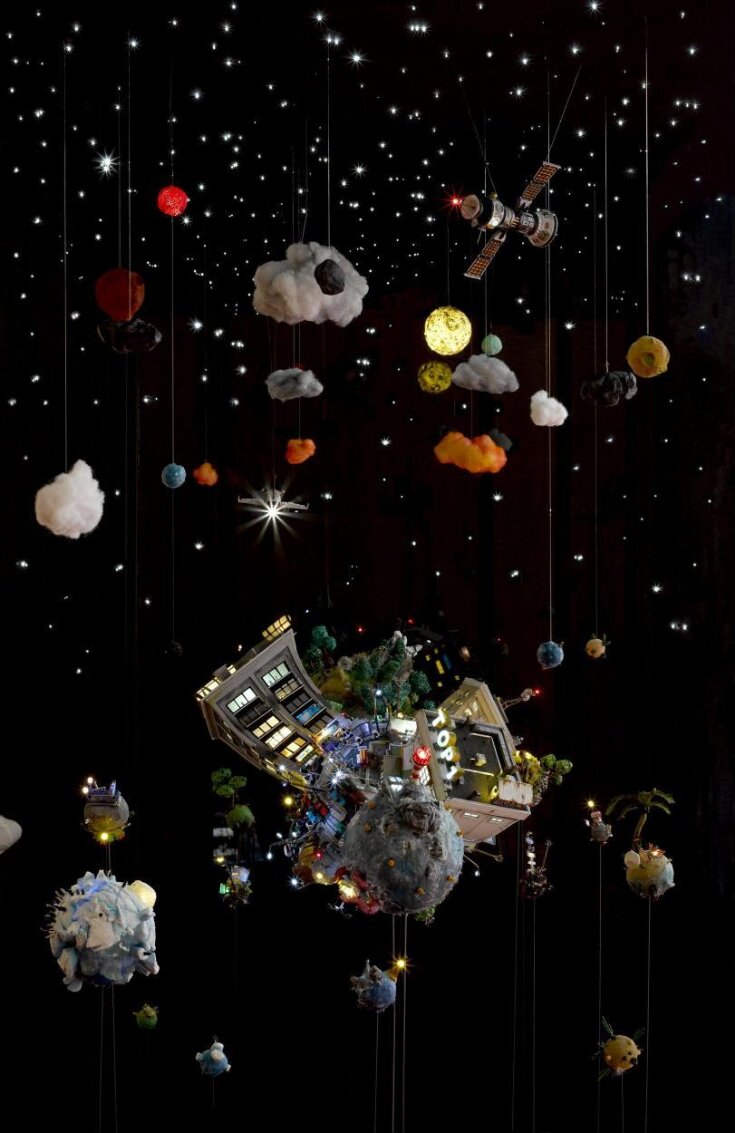
Tristan Blondeau is a self-taught artist who works in miniature. His installation, Planetarium, combines his interest in urban culture with a message of concern for the future of the Earth’s natural environments. A large central planet encrusted with concrete buildings and congested roads is orbited smaller planetary systems representing some of the Earth’s threatened ecosystems. Within Planetarium, Tristan has hidden playful ‘easter eggs’ based on popular culture, the V&A Museum, and references to his own life.
Object details
| Categories | |
| Object type | |
| Parts | This object consists of 30 parts. (Some alternative part names are also shown below)
|
| Titles |
|
| Materials and techniques | Expanded polystyrene, PVC, various woods and metals, epoxy resin, LEDs and other electronic components, PVA glue, cyanoacrylate superglue |
| Brief description | 'Planetarium,' a series of small planets and other celestial bodies, commissioned for YV&A, made by Tristan Blondeau, Paris, 2022-23 |
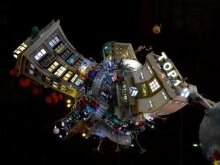
| Physical description | An installation consisting of model planets, moons and asteroids of varying size, each representing a specific environment and theme, featuring vehicles. Eight clouds hanging above the planets. Many elements of the installation are illuminated with LEDs. 1. 'YVAM-tB.14.' A very large planet representing an urban scene. The surface is dominated by large, wobbly tower blocks. Threading between buildings are congested roads filled with cars and other vehicles, lined with streetlamps. There are also other elements, such as a metro station and a skatepark. There is graffiti present on many of the walls. Mounted on a rod. 2. 'Milk Highway. A small moon representing an urban scene, with an ice cream cart, bins, a streetlamp, dog and bench. Mounted on a rod. 3. Small moon with an urban scene of a bus stop, streetlamp and numerous items of rubbish and construction materials. Mounted on a rod. 4. 'Teleport Station.' A small moon with an urban scene of a metro station entrance with lamps and an urban park wit yellowed grass and flowers, and a monument to an extraterrestrial. Mounted on a rod. 5. 'Mountain Rock.' A large planet representing a mountainous forest, covered with green, yellow and orange-brown trees. A large rocky outcropping is capped with white snow and there is a river crossing the planet. Among the trees is a tent, a boat, a picnic table and several vehicles. Mounted on a rod. 6. 'Pantry Planet.' A medium planet with rural scene featuring a tractor harvesting bright yellow oilseed rape and a field of Friesian cows. Mounted on a rod. 7. Small moon with a single tree. There is a tyre swing hanging from one of the branches and roots dangle below the planet. Mounted on a rod. 8. Small grassy moon with flowers, rock and tree stump. Mounted on a rod. 9. Small moon with a snow-covered pine tree and a log cabin. Mounted on a rod. 10. 'Sea Drop.' A large planet covered with seawater and dotted with yellow buoys. There is a large red and black fishing trawler trailing a net behind it. On the top is a wobbly lighthouse situated on jagged rocks. On one side a tentacled monster harasses a yacht. Mounted on a rod. 11. Small sea moon with large yellow buoy, with grey rocks, a gull and several red starfish. Mounted on a rod. 12. 'Paradise Beach.' A small moon with beach with a large palm tree on top. On the beach are surfboards, a campfire roasting a fish, coconuts, a deckchair and parasol, and numerous gulls and sea creatures. Mounted on a rod. 13. 'Freezy.' A medium planet with polar scene, jagged ice floes with an illuminated igloo and numerous penguins. Mounted on a rod. 14. Small ice planet with sea, icebergs and a single penguin. Mounted on a rod. 15. Small snow-covered moon with single icy outcropping. Mounted on a rod. 16. Small desert moon with cacti. Mounted on a rod. 17. Small sea moon hanging from above. 18. Small urban moon, covered with tarmac, hanging from above. 19. Small irregular-shaped asteroid with ‘falling rocks’ road sign. Hanging from above. 20. Illuminated yellow moon with large craters. Hanging from above. 21. Yellow-green moon with craters. Hanging from above. 22. 'LAVa.1200.' A small illuminated red moon. Hanging from above. 23. Red-brown moon with craters. Hanging from above. 24. 'Mercur.ICE.' A small blue-green moon. Hanging from above. 25. Small round grey asteroid. Hanging from above. 26. Small irregular asteroid. Hanging from above. 27. Large space station/satellite with dish and solar panels. Hanging from above. 28. Red and white airliner. Hanging from above. 29. Small sea moon with red buoys, hanging from above 30. Small planet on a rod with tall direction sign post (EARTH/ TB 24 PLANET) and traffic cones. |
| Dimensions |
|
| Production type | Unique |
| Gallery label |
|
| Object history | This installation was commissioned for the Young V&A’s Imagine Gallery as part of a display exploring small world play. The intention was to use Blondeau’s work to demonstrate a complex imaginary world and to explore how artists can use them in their practice. |
| Historical context | Tristan Blondeau (b. 1990, Paris) is a self-taught artist working in miniature. He abandoned a career as a baker in Parisian hotels to pursue his lifelong passion for miniatures, combining his interests in urban cultures, animation and photography to create unique, multimedia artworks. Tristan's own description of this artwork follows, written in the style of a press article describing the discovery of the newly-discovered tiny galaxy: Name of the galaxy: GYVA-25. Location: Milky Way, Earth / London, UK / Bethnal Green / Young V&A Museum. Galaxy type (Hubble Diagram): dSB(s)c (dwarf Barred Spiral with light emission) Galaxy dimensions: H2202xW2170xD1120mm Number of planets: 25 Biggest livable planet diameter / area: 25 centimeters / 1962.5 cm2 Smallest livable planet diameter / area: 2.5 centimeters / 19.625 cm2 Biggest planet / type: YVAM-tB.14 / telluric, cityscape Average height of the population: 0.6 centimeters Date of discovery: July 2023 Composition of the GYVA-25 galaxy At the heart of the Milky Way lies the galaxy GYVA-25. Its spiral formation suggests that it resulted from the collision of two stars just a few years ago (if we refer to the relativity of time as a function of a planet's mass and speed of rotation. In other words, on our scale, if the largest planet were as big as the Earth, it would take billions of years). The galaxy is made up of twenty-five planets capable of harbouring life, four satellite planets considered to be unsuitable for the development of any form of life (too hot, too cold, too acidic, etc.) and an asteroid belt. At the centre of this galaxy, the largest planet in this group, YVAM-tB.14, has a high concentration of water and energy in its core and atmosphere, making it the most suitable for the sustainable development of life and then of a population. This is why it hosts almost the entire population of galaxy GYVA-25. Its direct proximity to a water giant and a tree-bearing terrestrial planet creates an atmosphere charged with O2 that spreads throughout the galaxy and encompasses all the planets that make it up. A ecosystem unique to each planet can then develop. At the extremities of the galaxy, a planet of ice and a micro-planet of molten rock provide the planets with seasons of varying temperatures, thanks to their orbits. Since the galaxy's hot and cold spots are at its extremities, the temperature at its centre, i.e. on YVA-tB.14, is temperate, ideal. A world to explore Research has shown that a few years ago YVAM-tB.14 had 12 times fewer inhabitants. It was therefore possible to grow crops on site. As the population grew exponentially, the need for housing gradually turned grass into concrete, meadows into car parks, trees into street lights... now devoid of fertile soil, but the strength of their abillity to adapt, the inhabitants of YVAM set off to explore their galaxy in search of resources. The VA Space Programme was born. The perfect balanace of this universe means that each planet has a unique ecosystem offering fish, meat, milk, cereals and fruit. All essential foodstuffs now come from the surrounding planets. The VA space programme has also enabled the development of interplanetary tourism with the launch of the Space Shuttle. It has been operating in the galaxy for some time now, offering Galaxy Tours that enable residents to visit all the habitable planets in the system. The installation of teleportation stations has also extended the daily mobility of residents, which has greatly contributed to the economic growth of YVAM-tB.14. A balance to be preserved By taking up high in the sky, the VA space programme has enabled us to understand that each planet and element in the galaxy interacts with the others and, over time, has created this subtle and fragile ecosystem that supports life. If one factor in this perfect equation is changed, however small, the entire galaxy is turned upside down. Constantly evolving and curious by nature, the population of YVAM-tB.14 voted to send a manned space probe to seek out another distant galaxy that could offer a more spacious habitat. However, the edge of their galaxy seems to stop just a few centimetres from them on what appears to be an impassible magnetic field that looks like a glass barrier. So for the time being, in the hope of sufficiently advanced technology, the population of GYVA-25 will have to adapt in order to preserve the natural balance of their habitat. |
| Production | Tristan Blondeau was assisted by the following individuals: Victoria Tanto (model making and paint assistant) Théo Karsenty (3D modelling assistant) Peggy Martin (operations assistant) |
| Subjects depicted | |
| Summary | Tristan Blondeau is a self-taught artist who works in miniature. His installation, Planetarium, combines his interest in urban culture with a message of concern for the future of the Earth’s natural environments. A large central planet encrusted with concrete buildings and congested roads is orbited smaller planetary systems representing some of the Earth’s threatened ecosystems. Within Planetarium, Tristan has hidden playful ‘easter eggs’ based on popular culture, the V&A Museum, and references to his own life. |
| Bibliographic reference | |
| Collection | |
| Accession number | B.17-2023 |
About this object record
Explore the Collections contains over a million catalogue records, and over half a million images. It is a working database that includes information compiled over the life of the museum. Some of our records may contain offensive and discriminatory language, or reflect outdated ideas, practice and analysis. We are committed to addressing these issues, and to review and update our records accordingly.
You can write to us to suggest improvements to the record.
Suggest feedback
You can write to us to suggest improvements to the record.
Suggest feedback
| Record created | August 31, 2022 |
| Record URL |
Download as: JSONIIIF Manifest
