


The National Crime Agency (NCA) and Freeview channel Great! Romance have today launched a joint campaign highlighting warning signs of romance fraud, a crime that affects victims both emotionally and financially, costing millions of pounds every year.
From today (29 July), NCA messaging will appear on Great! Romance television channel, providing viewers with practical guidance on identifying and preventing romance fraud.
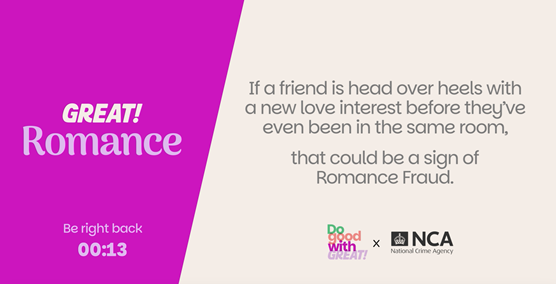
These messages will be shown to viewers in promotional airtime around ad breaks with messages connecting the dangers of romance fraud with Great! Romance films.
Figures released by Report Fraud reveal that from April 2025 to March 2026, there were 12,348 reports of romance fraud, with victims losing £116 million, more than £13,000 every hour. Of these victims, 51% were aged 50+, with the highest concentration in the 60-69 year old bracket.
Due to this victim profile, the NCA and Great! Romance have teamed up to reach an important audience and deliver viewers with practical guidance on identifying and preventing this fraud – for themselves, friends and family.
The messages include:
- "On Great! Romance the leads tend to be charming, successful and impossibly good-looking. If a dating profile looks like it belongs in one of our films, it's worth asking whether it's too good to be true."
- "On Great! Romance love conquers all, but it never needs your bank details to do it. If a new online partner asks for money, no matter how urgent it seems, talk to someone you trust first - it could save you a lot more than just heartache."
- "On Great! Romance love often moves FAST. But if someone you meet online develops feelings quickly, always has a reason they can't video call or wants to move your chat elsewhere, slowing things down and telling someone you trust can prevent a love story turning into a horror show."
Great! Romance has gifted airtime in premium, peak-time broadcast slots to raise awareness of romance fraud with audiences nationally watching on Freeview, Sky and Virgin Media.
Great! Romance, owned by Narrative Entertainment, broadcasts romantic films across all major digital television platforms. This partnership represents a pioneering media innovation, as this will be the first ever channel partnership with a law enforcement agency using non-commercial airtime to raise audience awareness.
Awareness messages will also be shared as part of a social media campaign on the NCA and Great! Romance Facebook and Instagram accounts.
Romance fraud typically involves criminals creating fake profiles on dating sites and social media. The offenders carefully build trust which feels like a genuine relationship over weeks, months, or even years, often claiming to work abroad. Once a target becomes emotionally attached, they become subjected to demands for money which they feel they should send, often responding to stories linked to emergencies, investment opportunities or plans to meet in person.
'Diana' was a victim of a romance fraudster in 2022. After the loss of her husband, she decided to go online to seek companionship. They had both been in the army and he shared detail about the covert operations he said he was doing in Mali. Diana lost £132,000 to the man, who was actually committing romance fraud after gaining her trust.
Diana said: "The first time he asked for some money it was about £4,000. He was going through a divorce and didn't have any access to his accounts because he and his wife had joint accounts and that's why he needed extra help, to pay for the actual taxes at the different ports.
"I hadn't seen him at all, we had just been messaging. I did ask to talk to him or video FaceTime, but he said that because it was a covert mission, he couldn't risk that. You know, let me see who he was.
"After a long time of giving him money, I realised I had lost nearly all my savings. I ended up giving him £132,000. He just kept asking for money and wouldn't take no for an answer because I really couldn't help him anymore. I insisted on him phoning me, and I said I wouldn't pay him any more until he actually phoned me, of which he did. And then that's when I realised he had a foreign accent and it wasn't the person I thought it was."
Diana was contacted by her bank who encouraged her to file a report with Report Fraud. The Metropolitan police investigated and the culprit was sentenced to five years in prison. In this case, Diana's savings were returned by her bank.
Nick Sharp, Deputy Director Fraud at the National Economic Crime Centre (NECC) in the NCA, said:
"Romance fraud is a serious crime and financial losses are on average over £13,000, and sometimes significantly higher. Victims are not only losing sometimes life changing sums of money though – this type of fraud can do enormous damage to the confidence, trust and faith that victims place in themselves and their relationships.
"That is why the NCA is actively targeting and disrupting the criminals behind romance fraud through investigations and intelligence sharing domestically and internationally. However, raising awareness as a form of prevention remains an equally important way to reduce the chances of someone being victimised.
"This campaign with Great! Romance is designed to do exactly that – by raising awareness and strengthening defences with the public we can significantly reduce opportunities for criminals to succeed."
Great marketing director Kate Gartland, said:
"When the NCA shared with us some horror stories about romance fraud, we knew we could support their campaign in a unique way – reaching an audience that loves a love story, via a medium that has huge impact. We're here to entertain them with the romantic content they adore, and now we're proud to be helping to protect them.
"This joint campaign with the NCA will give viewers the awareness they need to spot the tells, and protect themselves and their friends and family from these devastating crimes.
"Romance fraudsters - unlike most media agencies and buyers - know that heartland TV '55+' audiences have the most disposable cash to spend, or to lose."
The best way to protect from romance fraud is to know the signs:
- If a new relationship quickly declares strong feelings and is repeatedly in contact
- A dating site image looks altered or unrealistic
- A new contact wants to move conversations from a dating site to an encrypted platform
- Reluctant to use video calls or meet in person
- Requests for money or to take part in an investment scheme
Diana added: "The advice I would give to people who are in the same situation as I was would be to report it immediately.
"You're not stupid. You're the victim and they're preying on you, and so you need to be able to go for help as soon as possible.
"To be able to recognise someone who is scamming you. They're very clever and they're very friendly and they build a rapport with you. Then when the time is right, they begin a yarn that they're short of money. So that's why you have to be really careful. And one thing you have to watch is what you put on your profile, because that's what they'll take into consideration and they'll use it.
"I want to tell people my story because I'm still affected. I think about it every day. It doesn't go away. I just don't want people to go through the same thing I went through."
29 July 2026


