

Everything you need to know about the Bayeux Tapestry


As the Bayeux Tapestry comes to Britain for the first time in almost 1,000 years, our curators answer key questions and reveal some fascinating and surprising features of this historical document and work of art.
Who was the mysterious Ælfgyva? Is that actually Halley's Comet? Did Harold really get shot in the eye? How do you pronounce Bayeux? And how do you get tickets to see the Tapestry?
What is the Bayeux Tapestry?
The Bayeux Tapestry is an 11th-century artwork that tells the story of events leading up to the Battle of Hastings in 1066, in words and images.
The Tapestry is, in fact, an embroidery, made of dyed wool stitched onto a bleached linen background fabric.
Why is it important?
The Bayeux Tapestry is important because it is a unique visual source for the events that sparked the Norman Conquest of England, one of the most significant events in British history: England was never successfully conquered again!
Most surviving sources of the period are written. As the only remaining pictorial account of these events, the Tapestry's visual narrative helps bring the past to life.

Where was the Tapestry made?
We do not know for sure where the Bayeux Tapestry was made. Over the years, historians have suggested many places for its production on both sides of the English Channel.
However, most scholars today think the Tapestry was made in England, probably in or around Canterbury, because of the influence on its design of illuminated manuscripts made in or owned by monastic libraries in Canterbury.
Manuscripts like these feature lots of illustrations alongside the text. Some of the Tapestry's imagery is almost certainly modelled on particular Canterbury manuscript drawings. For example, the Tapestry's ships are very much like those in two Old English manuscripts, the Hexateuch and Junius 11, and a depiction of a man carrying a boulder is strikingly similar to one in an illustrated copy of the Latin poem Psychomachia by Prudentius.
Who made it?
Many people have been suggested as the Tapestry's patron, including Matilda, William the Conqueror's wife, Edith, the queen of the English king Edward 'the Confessor', and the monks of St Augustine's monastery in Canterbury. Most historians, however, think William's half-brother Bishop Odo of Bayeux was involved, mainly because he is depicted so prominently in its imagery.

We do not know who designed the Tapestry, but someone – likely familiar with manuscript drawing, so therefore an illuminator of religious books – must have transferred outline drawings to the Tapestry's linen.
When it comes to who put in the countless hours of work to actually produce the Tapestry, again, we don't know for sure. However, many scholars today presume it was made by English women, whose needlework skills were admired across Europe during this period and praised in Norman sources after the Conquest.
How long is the Bayeux Tapestry?
Bayeux Museum in Normandy, the usual home of the Tapestry, states its length as 68.3m.
The original linen fabric is 50cm high but backing fabric added later increases this to 70cm in some places, meaning the Tapestry varies in height.
What story is told on the Tapestry?
The Bayeux Tapestry opens with Harold 'Godwinson', the most powerful earl in England, departing for France on an unspecified mission (Harold's name indicates that he is the son of Earl Godwin but 'surnames' in the modern sense were not used at this time).
The Norman sources say that Harold is being sent to Duke William of Normandy, one of the claimants to the English throne, to promise him the crown. But other, mostly later, sources say Harold was going to Normandy to recover family members held hostage by William. Probably by accident, Harold lands north of Normandy, in a territory known as Ponthieu.
The Tapestry shows French nobleman Count Guy of Ponthieu seizing Harold, and then handing him over to William as, back in England, King Edward 'the Confessor' nears death.

Harold then joins William on a military expedition in Brittany and is rewarded for doing so. At Bayeux, he swears a sacred oath to William – probably to support the duke's claim to Edward's kingdom, even if under duress.
Harold returns home and is with King Edward as he dies. The monarch's last gesture – shown as the two men touching hands – seems to entrust Harold with the care of his sister, Queen Edith, and the kingdom. Contrary to his supposed promise to William, Harold accepts the crown from the royal council and becomes King of England himself.
When news reaches William in Normandy, he builds an invasion fleet and crosses the English Channel to meet Harold in battle. The two men lead their armies to Hastings, where a brutal clash ends with Harold's death and William poised to succeed him as king.
Women in the Bayeux Tapestry
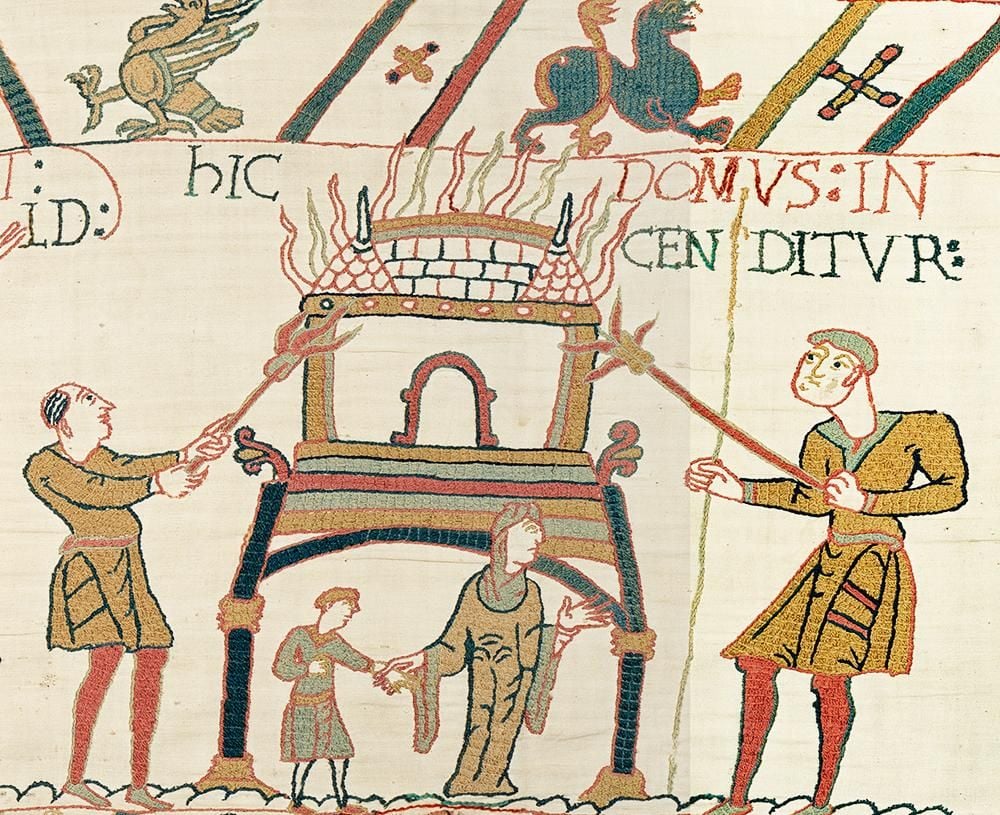
Despite the fact that the Tapestry was likely made by English women, very few women are actually depicted in the design. Only three are featured in the central frieze and only one – the enigmatic Ælfgyva – is named within the inscription.
The experiences of these three figures capture the horrifying effects of the events shown in the Tapestry on the women who lived through them.
In one scene – beneath an inscription that reads simply 'where Ælfgyva and the cleric' – a male cleric appears to invade a startled woman's space and to touch her face.
In a second scene, a woman presumed to be Queen Edith – wife of King Edward 'the Confessor' and sister of Harold 'Godwinson' – weeps at her husband's deathbed (she is visible as the furthest left of the four figures in the top right corner of this article's main image).
A third woman flees a burning building set alight by Norman soldiers whilst gripping the hand of a child.
The English women who are presumed to have embroidered the Tapestry, and who lived through the Norman Conquest, probably experienced such assault, loss and displacement themselves.
The mystery of Ælfgyva
The Tapestry shows Ælfgyva within an arched frame, apparently being assaulted by a priest; the fact that a naked figure in the lower border mimics the priest's pose suggests some sort of sexual scandal that would have been well known to contemporaries.

Ælfgyva's identity is one of the Tapestry's biggest mysteries, not helped by the fact that Ælfgyva was one of the most common female names in 11th-century England.
Historians have suggested many candidates for the Tapestry's Ælfgyva. They include Emma 'of Normandy', mother of Edward 'the Confessor', who took the name Ælfgyva when she married her first husband King Æthelred 'Unræd'; Ælfgifu 'of Northampton', wife of King Cnut; and Ælfgifu 'of York', first wife of King Æthelred 'Unræd'.
In fact, even women never known as Ælfgyva – including a daughter of William, apparently promised to Harold as a wife – have been added to the mix by scholars.
However, a recent article co-authored Michael Lewis – lead curator of the British Museum The Bayeux Tapestry experience – adds new evidence to the idea that Ælfgyva may be Emma of Normandy, by comparing the Tapestry's depiction with possible models of Emma in Canterbury illuminated manuscripts.
Emma also best fits with the likely subject of the conversations between Harold and William that precede Ælfgyva's depiction in the Tapestry – the English succession. Not only was it through his kinship with Emma that William justified his claim on the English throne, but Emma was the subject of a sexual scandal involving the Bishop of Winchester. It was also a scandal that King Edward's supporters used to suppress Emma's ambitions to hold on to power; Emma was twice queen of England and wanted to have a say in England's governance.
Did Harold really get an arrow in the eye?
The Bayeux Tapestry clearly shows a figure beneath the name 'Harold' – where the inscription says that Harold is killed – being struck in the eye by an arrow. But... most contemporary sources mention that Harold was hacked to death, so maybe Harold is the figure in the Tapestry falling to the ground below the Latin words 'interfectus est' – 'was killed'. Or... it could even be that both figures are Harold.

A problem with the first figure is that the arrow is a later, likely 19th century, addition, as are other arrows in this scene. When the Tapestry was conserved in 1982, the backing fabric was taken off and the stitching studied carefully, showing the extent of these restorations and how they changed the imagery.
It seems that the first 'Harold' figure originally held a spear. This was denoted just by holes in the earliest drawings of the Tapestry by Bernard Montfaucon in the later 1720s. However, when the Tapestry was drawn by Charles Stothard in about 1817, he joined the dots and added an arrow, probably because he knew the tradition of Harold's death. It's likely his drawings then guided the later restorers.
Is that really Halley's Comet?
Yes and no... The Bayeux Tapestry does show Halley's Comet, named after the English astronomer, mathematician and physicist Edmond Halley, who supposedly first noted its regular cycle. The comet appears in the Tapestry soon after Harold has been made king in January 1066, and the Tapestry's designers have linked it to his demise: when Harold is brought news of the star, a ghostly fleet, a premonition of the invasions to come, appears below.

In reality, however, the comet was not actually seen until late April 1066, many months after Harold became king, and early English sources, like the Anglo-Saxon Chronicle, do not connect it with the Norman invasion.
Intriguingly, a monk named William, writing at Malmesbury in the first half of the 12th century – over 500 years before Halley – not only links the comet to the invasion but also suggests that the same comet was seen before in 989 AD, when it was also a portent of doom. The observer of the 989 comet was an elderly monk named Aethelmaer (or Elmer) – also notable for his attempts to fly using a set of gliding wings! – who believed it represented a disaster for England.
What the borders of the Tapestry add to the story
The Tapestry's borders are more than just decorative frames – they also participate in the action, heightening the drama of key moments. While their 'commentary' can be ambiguous, this invites viewers to form their own opinions about the story. Here are three examples of how the borders enrich the Bayeux Tapestry.
Animal actors
A range of animals occupy the borders, from domestic, farm and wild animals to exotic foreign beasts and even fantastical creatures like dragons and centaurs.
Among the many birds in the borders, two peacocks appear above William and Harold as they talk in Normandy. Each bird mimics the man below. The 'William' peacock, coloured black and yellow like his clothing, stands calmly with folded wings as William sits enthroned beneath, while the 'Harold' peacock, also colour-matched, fans out its tail, echoing Harold's agitated gestures below.

This mirroring draws attention to the men's discussion, hinting that it had consequences. The topic of their conversation is unknown, but it is likely Harold is explaining that he is in Normandy seeking the return of his relatives. Another theory is that Harold is confirming William's claim to England's throne, promised earlier by King Edward – a promise that Harold will break, triggering the Norman invasion.
Portents of doom
The borders tease the Norman invasion in other ways too. The arrival of Halley's Comet in the upper border after Harold's coronation is often read as a portent of his downfall (as shown in the image in the previous section). It is joined in the lower border by a fleet of empty boats, directly beneath Harold as he is told about the star. The vessels are embroidered in outline only, giving them an ominous, see-through appearance. While they may simply be the ships Harold has stationed to protect England, could they instead be a ghostly premonition of the real Norman ships that will soon attack England? Or perhaps a window into Harold's mind as, confronted by the comet and his broken oath to William, he imagines vengeance coming his way?
Takeovers
At times the main story strays into the borders. Buildings occasionally thrust into the upper border, such as King Edward's royal palace, Westminster Abbey and the town of Bayeux itself. This could simply convey that these are large, important structures – but also, perhaps, that large, important things are happening in them during these moments.
Elsewhere in the embroidery, the action itself appropriates the borders to create powerful panoramas. William's invasion fleet takes over the upper border, suggesting that it was vast enough to span the horizon; and during the Battle of Hastings the lower border is overwhelmed by dead, dying and dismembered fighters whose bodies are looted where they lie. The sense is that, like the buildings, these events were of such magnitude that they could not be contained by the central frieze.

Is the Bayeux Tapestry complete?
The Bayeux Tapestry is damaged at the end and is almost certainly incomplete.
We don't know what, if anything, is missing from the end of the Tapestry. However, some scholars believe it would have finished with an embroidered depiction of William's coronation at Westminster Abbey, which took place on Christmas Day in 1066.
The Bayeux Tapestry in numbers
- 68 – length in metres
- 9 – linen panels used
- 4 – coloured dyes, creating a multitude of shades
- 5 – types of stitch
- 1065–1066 – years depicted
- 627 – figures featured
- 6 – women (3 in the main embroidery, 3 in the borders)
- 737 – animals
- 23 – trees (and 416 other plants)
- 37 – ships
- 33 – buildings
Can I view the Tapestry online?
You can view a fully scrollable digitised version of the Tapestry on the website of the Musée de la Tapisserie de Bayeux.
It allows you to choose scenes by their numbers, and zoom in and out, and provides translations of the Latin text.
How do you pronounce Bayeux?
How you pronounce Bayeux depends on where you come from. French, English and Americans each tend to use a different pronunciation.
You can hear a French speaker's guide to each of these by listening to this video clip.
Which French museum is home to the Bayeux Tapestry?
The Bayeux Tapestry is usually housed at the Musée de la Tapisserie de Bayeux in Bayeux, Normandy.
The museum's closure for refurbishment in September 2025 provided an opportunity for the Tapestry to travel on loan to the British Museum, so that it may continue to be seen and enjoyed by thousands.
After its display in London, the Tapestry will return to a newly-built museum in Bayeux dedicated to the Tapestry and due to open its doors in late 2027.

When is the Bayeux Tapestry coming to the British Museum in London?
The Bayeux Tapestry will be on display at the British Museum between 10 September 2026 and 11 July 2027.
This is the first time since it was made nearly 1,000 years ago that the Tapestry has returned to England, making it a unique and historic opportunity to see it outside of France.
How can I get tickets to see the Tapestry?
Tickets from 10 September – 31 December 2026 have sold out. If you've missed out, don't worry, there will be further ticket releases. Bookings for January to July 2027 will open later in the year. Sign up to our newsletter to be the first to hear about future ticket releases.
Members priority booking opened on 16 June, for visits from 10 September to 31 December. There are limited time slots now remaining.
Booking for UK schools is open.


