MicroCarb
MicroCarb is a joint mission between the UK Space Agency and CNES to measure sources and sinks of carbon, to help better understand the drivers of climate change.
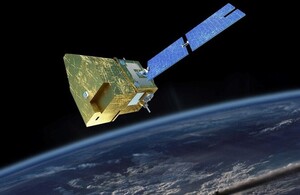
Illustration of MicroCarb in orbit. Credit: CNES
MicroCarb is the first European mission intended to characterise greenhouse gas fluxes on Earth’s surface and gauge how much carbon is being absorbed by oceans and forests, the main sinks on the planet.
A joint mission between the French space agency CNES and the UK Space Agency, MicroCarb launched into orbit in July 2025.
In September 2025, the mission released its first images, with work ongoing on fine calibration and tuning of data processing algorithms.
Climate monitoring from space
Understanding the behaviour and dynamics of greenhouse gases in the Earth’s atmosphere, and the processes by which they are produced and absorbed, is a key part of understanding our changing climate.
Adding to the work of previous CO2 missions, MicroCarb will become part of an international greenhouse gas monitoring network of satellites, and collect more precise data on CO2 emissions than ever before. This will improve our understanding and monitoring ability of the natural carbon cycle and emissions from human activity.
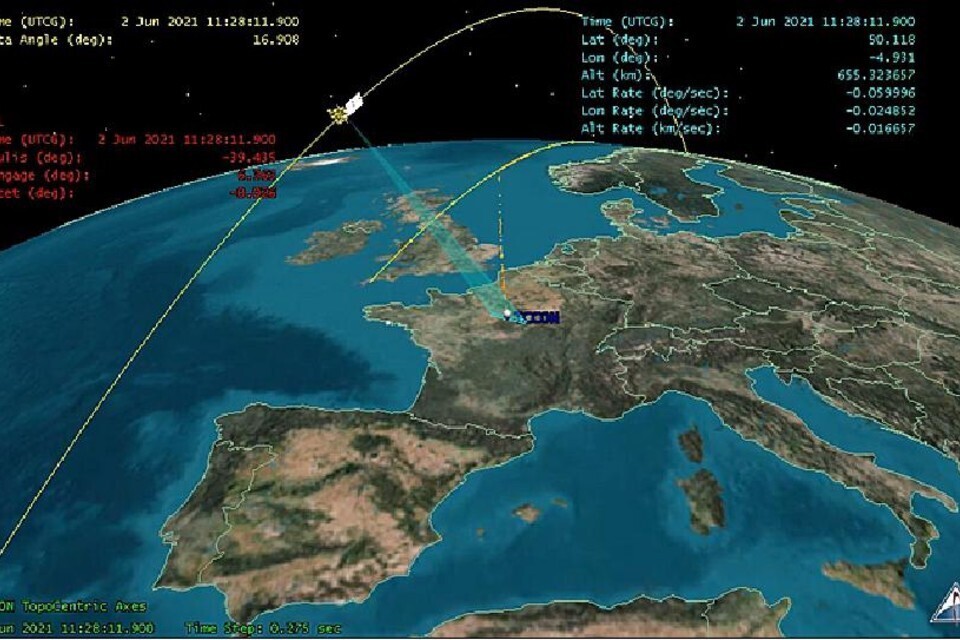
Illustration of the target pointing mode. Credit: CNES
MicroCarb will also monitor international progress towards meeting the Paris Agreement to limit global surface warming, and allow us to determine how much carbon is being absorbed by natural processes and how much is being emitted by human activity.
MicroCarb’s city-scan observing capability will map atmospheric CO2 over cities, providing insights for cities to incorporate sustainability into their urban planning.
Monitoring greenhouse gas data will allow us to anticipate how ecosystems, habitats and societies will react to climate change, and provide insights on how to mitigate and minimise damage.
Instrumentation and measurement
MicroCarb orbits at an altitude of 650km, and will repeat its cycle of observation and measurements every 21 days.
It carries an infrared spectrometer, which will measure O2 and CO2 concentrations at 4 different spectral bands in sunlight reflected off the Earth: 0.76μm, 1.27μm, 1.6μm and 2μm.
Part of MicroCarb’s work will involve observing photosynthetic activity.
The infrared spectrometer’s degree of precision will be extremely high. Measurements of CO2 concentrations will be in the order of 1ppm (part per million), with a pixel size of 4.5x9km. The city-scanning observing mode will have a resolution of 2x2km2.
MicroCarb will also retrieve Solar Induced Fluorescence (SIF), which will provide data about photosynthetic activity and enrich data from CO2 observations about carbon sinks.
How is the UK involved?
The UK Space Agency has invested £15 million in MicroCarb, allowing UK industry and scientists to play key roles in the mission.
These include:
-
Thales Alenia Space UK (TAS UK) completed the assembly, integration and testing at STFC RAL Space in Harwell, Oxfordshire
-
STFC RAL Space, also in Harwell, designed the pointing and calibration system, enabling MicroCarb to take measurements at specific locations
-
The National Physical Laboratory (NPL) has provided the SI-traceable ground calibration facility, to test its performance pre-launch, and is developing algorithms and quality metrics for the mission
-
Professor Paul Palmer of the National Centre for Earth Observation (NCEO) and the University of Edinburgh will translate MicroCarb’s CO2 observations into maps that show carbon absorption and emissions
-
Dr Rob Parker is part of the NCEO team delivering the mission’s Solar Induced Fluorescence retrieval algorithm, based on expertise from the University of Leicester
-
GMV UK are designing, implementing and quality assuring algorithms and operational processors for several CO2 data products
Updates to this page
Last updated 20 August 2026 Show all updates-
Updated with latest mission information.
-
Updates and more detail added about the mission, and the page has been restructured.
-
Updated information.
-
First published.