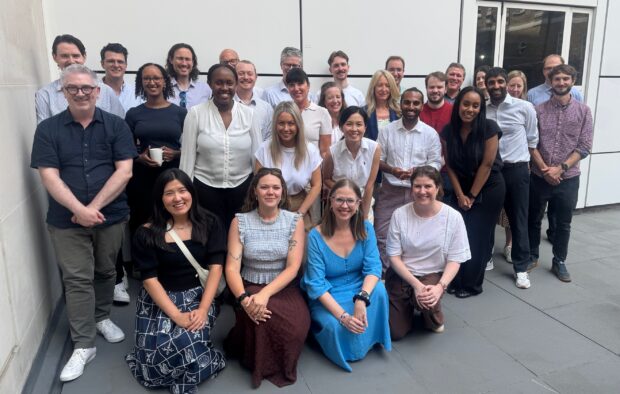
GDS and BIST (Department for Business, Innovation, Science and Trade) are taking action to deliver government’s ambitions to drive growth into every postcode, reduce the costs of doing business and create a more productive and agile environment. Helping more businesses find the support and services available more quickly will unlock innovation, encourage investment and enable them to flourish.
The government is already overhauling the regulatory landscape to reduce complexity and duplication. BIST recently published a Regulation Action Plan Progress Report, committing to reducing administrative burdens on business by 25% (£5.6bn) by the end of parliament.
GDS and BIST are also partnering to deliver on commitments made in A blueprint for modern digital government to help businesses start and scale – delivering government services that work for businesses as well as they do for citizens.
The challenges businesses face
There are continuing efforts to make things simpler on GOV.UK. Government offers a wealth of resources and information to benefit businesses, but we see potential to make it simpler for people to find what they need.
The State of digtial government review found that because information is often shared across different government services, this can lead to duplication. For example, to start a business today, people need to:
- find guidance on how to start a business
- register as a sole trader or incorporate a limited company
- set up financial accounts
- understand employment legislation such as IR35
- comply with ongoing and sector specific compliance
To achieve this, people have to find and look at multiple pieces of advice spread across numerous government organisations and website pages, using more than one logged-in account. We want to streamline this. GDS and BIST’s joint research has identified at least 160 services related to business, demonstrating just how complex the system can sometimes feel for people.
Creating a better experience
A more consistent way to access government services will help to make the experience more efficient, reduce the risk of duplication and help to counter fraudulent behaviour. To achieve this, we’re going to provide a single, proactive and personalised experience for business through GOV.UK and its channels, capabilities and components.
This will ensure that businesses only have one place to transact with government, including knowing where to start and what to do next, finding funding opportunities and getting access to people, expertise or professional networks.
We already know that when businesses access support it has a positive impact on growth, but information is often split across several different digital services or isn’t specific enough to meet people’s needs.
What we’re improving
To ensure we make progress quickly, a new team has been set up in GDS to lead the delivery of improved businesses interactions with government online.
Building on discovery and testing to date, the team will undertake extensive research with business users and translate their findings into deliverable products and services, designed with and for businesses.
Bringing together BIST’s strong relationships with HMRC, Companies House and business, as well as harnessing GDS’s expertise in digital transformation, the team will also be able to support early identification and delivery of priority improvements for GOV.UK.
How we’ll test and learn
It’s our intention to build a unified GOV.UK experience for business through phased delivery rather than a ‘big bang’ release, and we’ll co-design any solutions we put in place with businesses and government.
We want everything we develop and implement to add value and, over time, take us closer to a full-service offering. We’ll be looking for quick wins too, like GOV.UK content improvements that will form the foundations for a better offer overall.
We’ll also be collaborating with stakeholders to shape our plans, scope and priorities. So far, they have told us they’d like to see links to BIST’s own Smart Data agenda, fraud prevention and how we could benchmark against other international governments working in the same problem space.
You’ll hear more from the team soon about our roadmap for delivery and opportunities to engage.
Until then, what other issues do you think we need to address? We’d love to hear more from by email: gdsbusiness@dsit.gov.uk
4 comments
Comment by Alan Jones posted on
What are you doing to support people who are unable to verify their ID with Onelogin? I can no longer renew my driving licence online which I have previously done. I cannot verify my ID for Companies House without paying an external agency who can verify it very easily. As more services are brought online, I will become evermore excluded form Government online services.
Comment by GDS Comms Team posted on
Thank you Alan for your comment. You can contact the GOV.UK One Login team to get help, report a problem or give feedback: https://home.account.gov.uk/contact-gov-uk-one-login.
There are three ways to prove your identity with GOV.UK One Login: with the GOV.UK One Login app, by answering security questions online, or at a Post Office. The method you use will depend on your device, if you have photo ID, and what type of photo ID it is.
Recognising that GOV.UK One Login will not work for all users, all government services should also provide an alternative method for identity verification. The alternative route is determined by the individual service. While we expect GOV.UK One Login to become the primary method for accessing online government services, departments will continue to provide offline alternatives for those who prefer or are unable to use digital channels.
Comment by MarkK posted on
Please tell us what us being done for charities. The extra amount this is costing business to save civil service effort is one thing, but it's taking charities hours of unpaid time to do what used to need just a second class stamp.
Comment by Neil Edwards, Lead Business Relationship Manager posted on
Thanks for your comment. We are currently undertaking research with different kinds of users to understand the pain points of using GOV.UK for conducting business and we’ll be sharing more information about our findings in the future.