Why your product needs an AI product manager, and why it should be you

Head of AI Engineering
12 August 2025



I was fortunate enough to have the opportunity to give a talk at the AI Engineer World Fair. You can now watch the full talk on youtube. This post summarises the content of the talk for those who prefer reading to watching.
We are currently hiring AI Product Managers, so if this talk excited you, please consider applying! You can do so by going to civil service jobs and searching for “i.AI”
The Incubator for AI (i.AI) is a small team of experts created by Number 10 to deliver for the public good through AI experimentation and product building.
When you consider that the UK Government spends over £1 trillion each year delivering public services for nearly 70 million people, you can see there’s a lot to play for. But at i.AI, we pride ourselves on operating like a start-up: we move fast, we solve problems, and we build products that have a real-world impact, from the front lines of public service to the heart of prime ministerial meetings.
This remit has forced us to get very good at answering one crucial question: with all the possibilities AI presents, what should we actually build?
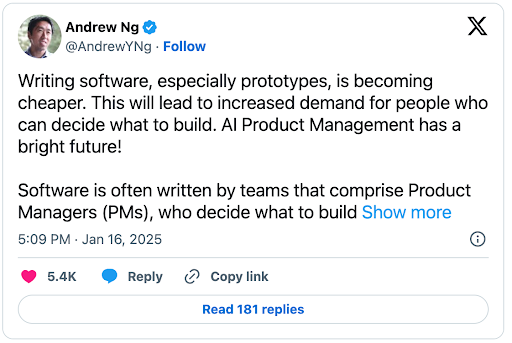
As Andrew Ng makes it clear in this post, it’s getting easier and easier to build things. AI is making impossible features possible, and AI coding agents are making software development faster and cheaper than ever. This shift makes the question of “what” to build more important than ever.
In this post, I want to make the case for the AI Product Manager, explain why AI expertise is vital for the role, and share three hard-won lessons from our work that can help you build great AI products, whether you’re an engineer, founder, or product manager.
Lesson 0: The Rise of the AI Product Manager
Before we dive in, let’s quickly recap the basics of product management. It’s a huge and vital field, but at its core, it lies at the intersection of three circles:
- The Business: Is the product viable? Will it be profitable or deliver sustainable value?
- The Technology: Is it feasible? Do we have the skills and resources to build it?
- The Users: Is it desirable? Does it solve a genuine problem for people?
The product manager’s job is to find the delicate balance between these three areas. Now, let’s add AI to the mix.
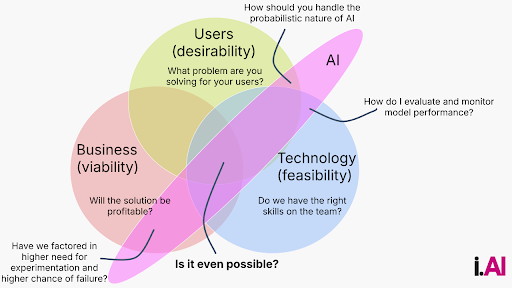
AI introduces a host of new challenges that complicate every aspect of this balancing act:
- Business Viability: Is the business prepared for longer experimentation cycles and a higher rate of failure?
- Technical Feasibility: Do we have the right infrastructure to evaluate, monitor, and retrain the AI in our product? And crucially, is what we’re imagining even possible with today's technology?
- User Desirability: AI is probabilistic and can make mistakes. How do we design a user experience that manages this uncertainty and keeps the user in the loop?
Much of the product manager’s role is amplified, but proficiency in AI and data is now paramount. Understanding the importance of data, the necessity of robust evaluations, and the inherent uncertainty of these systems is non-negotiable.
This is the domain of the AI Product Manager. They are the ones who can balance all four of these areas. We have found it invaluable for this person to have a genuine understanding of AI, which is why AI engineers can make such great product managers. This doesn't have to be a new hire or even a formal job title. But if no one on your team is grappling with these four circles, you will struggle. As Bret Taylor, co-creator of Google Maps, said on the Latent Space podcast, "There's a lot of power in combining product and engineering into as few people as possible."
So, with that foundational lesson in mind, what have we learnt at i.AI?
Lesson 1: Evaluate Your AI Capability Early
Every good product person knows you should resolve your biggest uncertainties first. This is the story of what that looks like when your biggest uncertainty is the AI capability itself.
Our work on Consult drives this lesson home. Every time the government plans a major policy change, it has a legal duty to seek public input. It does this by running public consultations, hundreds of which happen every year. Some receive over 100,000 responses, taking teams of people months and costing millions to analyse. This is a prototypical use case for AI.
Initially, we faced pressure to start delivering quickly. We made the mistake of jumping straight into product-building mode, assuming that established NLP techniques like BERTopic would be sufficient. However, when we tested the initial outputs with policy experts, the analysis was found to be inconsistent and incomplete.
We went back to the drawing board. This time, we prioritised building and evaluating the core AI capability. The result is a tool that can help analyse responses 1,000 times faster and 400 times cheaper than manual methods, producing comparable outputs. When we published our first evaluation on a live consultation, we even made the front page of the BBC News website.
Crucially, our evaluation confirmed that the process works best with a human in the loop to reconcile differences in how the AI and a human expert might interpret a theme. This insight forced us to build a completely different application to the one we first envisioned. By testing the AI first, we avoided wasting time building a product that wasn't possible or didn't meet the real user need.
The Lesson: Resolve your AI uncertainties early on with rigorous evaluations and tests with real users. Don’t assume a known technique solves your specific problem.
Lesson 2: Go Wide with Features, Then Refine
What if the core AI capability is already a commodity? For our Minute tool, this was the case. Government has countless use cases for secure and trusted AI transcription and summarisation. Excellent off-the-shelf services from providers like AWS and Azure already exist. Here, the main challenge was not the core AI but creating a frictionless experience for users.
AI can help with this, not only by powering features but also by helping us build them faster with AI coding assistants. So, we deployed a basic version quickly and then went wide, building lots of features to see what would stick. We experimented with custom templates, agenda integration, AI-powered editing, and a dedicated chat function.
This allowed us to learn a great deal in a short space of time. We saw what was intuitive to users and what wasn't. It also helped us identify a more specific and high-value niche. Our team began a collaboration with Justice AI, a team in the Ministry of Justice, to build a version of Minute aimed directly at probation workers. This version is drastically stripped back and more intuitive because it's tailored to a single, well-understood use case.
The Lesson: Because of the uncertainty around which AI features will provide value and the increasing ease of building them, you should experiment hard with new features on real users, then ruthlessly cut back.
Lesson 3: Be Ready to Pivot. Hard and Fast.
For those outside government, Ministers carry their daily documents and submissions in an iconic red briefcase, or ‘Red Box’. Our project, Redbox, started as an idea to digitise this process, using AI to securely fetch and summarise sensitive information for ministers who have to make decisions across a vast portfolio.
Pivot 1: Through user research, we found the feature people wanted most wasn't a complex briefing tool, but simply a secure, trusted way to chat with an LLM on government systems. We simplified our product to meet this need. Within weeks, 30% of the Cabinet Office were active users.
Pivot 2: The market shifted beneath our feet. Microsoft Copilot became available for free for enterprise Microsoft users. At the same time, technical standards like Anthropic's Model Context Protocol (MCP) took off, offering a much easier way to make our tools and data available to any client. Suddenly, our value wasn't in building the chat application for government, but in providing high-value, secure government data via these emerging protocols.
The Lesson: The AI market is moving at a breathtaking pace. You have to try and predict where it’s going and be prepared to pivot your strategy harder and faster than ever before.
Conclusion
So, to recap, we have four lessons:
- Lesson 0: The AI Product Manager role is vital, and it demands genuine AI proficiency.
- Lesson 1: Evaluate your core AI capability early and rigorously.
- Lesson 2: Go wide with features to learn quickly, then refine and focus.
- Lesson 3: Be prepared to pivot your entire product strategy as the technology landscape shifts.
In some ways, these are simply restatements of existing product wisdom: combine product and engineering, resolve your biggest uncertainties first, understand your users, and be agile. That's true. But I hope you can see that AI makes the original playbook both more important and more challenging. It creates whole new levels of uncertainty that demand new approaches, as well as new opportunities to build and learn faster than ever before.
Ultimately, AI is a new frontier. When you’re innovating at the frontier, much more is unknown. So be deliberate, be curious, and be strategic about what you choose to build.