- Type of dinosaur:
- large theropod
- Length:
- 12.0m
- Weight:
- 7000kg
- Diet:
- carnivorous
- Teeth:
- 60 saw-edged, bone-crushing, pointed teeth
- Food:
- other animals
- How it moved:
- on 2 legs
- When it lived:
- Late Cretaceous, 68–66 million years ago
- Found in:
- Canada,
- USA
Facts about Tyrannosaurus rex and its discovery
Tyrannosaurus rex’s name was almost very different. In 1892, some of the first known bones of Tyrannosaurus were named Manospondylus gigas by Edward Drinker Cope, who thought that they belonged to a Triceratops-like dinosaur.
The first known skeleton of a Tyrannosaurus rex was discovered later in 1900 in Wyoming, USA, followed by another in 1902. Barnum Brown discovered both T. rex skeletons, and the species was later named by Henry Fairfield Osborn.
Afterwards, scientists realised that Manospondylus gigas and Tyrannosaurus rex belonged to the same species. Normally, scientific naming rules mean that the first name given to a species should take priority.
However, as lots of scientists preferred to use the name Tyrannosaurus rex, Manospondylus stopped being used. With Tyrannosaurus rex meaning ‘tyrant lizard king’ and Manospondylus gigas meaning ‘giant porous vertebra’, it’s perhaps not that surprising that Tyrannosaurus stuck!
Currently, T. rex is the only member of the Tyrannosaurus group. Other members of the group have been named, but they aren't widely accepted by scientists.
What did Tyrannosaurus eat?
Tyrannosaurus was a ferocious predator. The teeth of T. rex were up to 20 centimetres long and it had 60 in total. In combination with T. rex’s powerful jaws, these teeth delivered the strongest bite of any known land animal. T. rex’s bite is three to five times more powerful than a lion’s, allowing it to crunch through bone.
Tyrannosaurus tooth marks have been found on Triceratops and Edmontosaurus fossils. We know Tyrannosaurus even swallowed the bone it crunched, as pieces turn up in its fossilised dung!
A large part of Tyrannosaurus’ brain processed smells, meaning it could find food over large distances. It used its good sense of smell to hunt live prey and also locate dead bodies to scavenge.
We don’t know if Tyrannosaurus hunted in packs, but based on fossils found buried together, some scientists think their relatives did. They certainly fought each other, as some Tyrannosaurus bones have bite marks from other tyrannosaurs on them. But whether they were fighting over food or for other reasons is unclear.
How big was Tyrannosaurus?
The largest known Tyrannosaurus are T. rex specimens named Sue and Scotty, which jointly hold the Guinness World Record. When they were alive, these T. rex weighed over 8,000 kilogrammes and were almost 13 metres long.
T. rex size varies between specimens, however, and it’s likely most were smaller than this.
The length of T. rex is normally estimated at closer to 12 metres long, and T. rex’s height as 3.5–4.0 metres tall at the hips. A normal T. rex weight was probably between 5,000 and 7,000 kilogrammes.
It’s not just Tyrannosaurus skeletons that are big, either – Tyrannosaurus skulls are also enormous. At over 1.5 metres in length, some of the largest T. rex skulls are longer than people are tall!
What were Tyrannosaurus’ arms used for?
Compared to its overall body size, T. rex had surprisingly small arms. How it used them is a matter of debate.
The arms were attached to strong muscles, so some scientists think they helped T. rex stand up after a fall.
An adult T. rex had an estimated top speed of around 22 kilometres per hour, while younger animals might have moved even faster. At this pace, occasional tumbles would have been likely and the dinosaur’s ability to pick itself off the ground would be vital for its survival.
Other scientists suggest the arms helped during feeding. The arms of young T. rex are more in proportion to their body, so might have been useful to grab food.
As the dinosaurs grew, their arms might have become less important as they could use their massive mouths to tackle prey instead.
A third option is that T. rex used its hands to hold onto its partner during mating.
In reality, it’s likely that T. rex’s arms were used in multiple ways, but proving so millions of years later is difficult.
Did T. rex have feathers?
Everyone wants to know what a realistic Tyrannosaurus rex looked like, as it’s one of the most famous dinosaurs.
Since T. rex was part of the theropod group, which included many feathered dinosaurs, plumage is sometimes suggested as part of its appearance. However, there’s currently no direct evidence that supports the idea of T. rex feathers.
Preserved skin from Tyrannosaurus and its close relatives shows that these dinosaurs had scales. The feathers might have disappeared as tyrannosaurs evolved to be bigger, as it would have been easier for them to keep warm because of their size.
Another large tyrannosaur, known as Yutyrannus, did have feathers, but it seems to have been an exception. While T. rex lived in a warm and humid environment, Yutyrannus lived in a cold climate so might have benefitted more from a feathery coat.
If T. rex did have any feathers, they would have been on its back – the only place for which preserved skin is yet to be found.
Taxonomic details
- Taxonomy:
- Dinosauria, Saurischia, Theropoda, Tyrannosauroidea, Tyrannosauridae, Tyrannosaurinae
- Named by:
- Osborn (1905)
- Type species:
- rex
Discover more


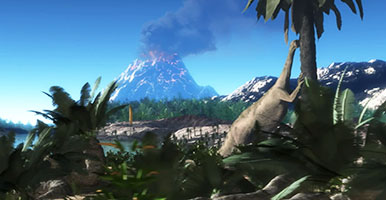
Step back in time
Find out more about dinosaurs' lives and the world they lived in.
Fun and games
Learn more about dinosaurs through toys, board games and activity kits, available from our online shop.
Explore Jurassic oceans
Take a thrilling dive back in time into ancient waters when you book tickets to our monstrous exhibition.