
Fences, along with integrated gates, play a key role in delivering security solutions both for perimeters and protecting important assets.
NPSA wish to advise that fences and gates are no longer tested to the Manual Forced Entry Standard (MFES). As a result, all fences and gates which were previously given an MFES rating will be removed from the Catalogue of Security Equipment. This guidance does not advise on protection against surreptitious attack methodologies.
This document provides advice on the requirements for security fences and gates and signpost alternative security standards that should be considered. Please use the NPSA Forced Entry Standards Guidance1 to assist you.
NPSA no longer tests fences and gates against the Manual Forced Entry Standard.
From 1st January 2026 all fences and gates will be removed from the CSE.
This guidance should be used to inform your decision making when designing your security solutions.
Your chosen Forced Entry Standards should correlate with the threat posed to your site.
Introduction
The perimeter is likely to be the first and most visual manifestation of a sites security solution that an adversary sees. This guidance is intended to aid those responsible for delivering a new perimeter solution to identify the factors that need to be considered when selecting a perimeter fence. Fences and gates can be used to secure enclaves and important assets in addition to the perimeter of your site; however, this document will focus on fences and gates predominantly as part of the perimeter security solution.
All testing of perimeter fences and gates being used should:
- be conducted to a recognised test standard
- be performed at an independent test house
- achieve a performance rating in accordance with the chosen standard.
It is important that a site conducts an Operational Requirements (OR)2 process to determine the required protective security measures. This process provides a systematic approach to defining the threat and the requirements for protection. Developing security measures outside of a structured process often leads to incomplete, inadequate or costly measures. This document will assist in structuring your thinking for your ORs. The OR will help a site understand how to operate in order that the security measures can be optimised for security, for normal, and site exceptional activity.
Threat
Sites can use a perimeter solution to mitigate a range of risks, identified through the site security risk assessment, and a suitable standard should be selected based on the threat posed3. For further information please see the NPSA website4 . Threats include:
- Criminality
- Hostile State Actors
- Terrorism
- Unlawful protest
Perimeter solutions can successfully mitigate the risk of intrusions into sites, if you understand the types of threat facing your site. It is important to understand the full range of security threats against the site before choosing a perimeter solution, however it is important that the full range of security threats against the site are determined before choosing a perimeter solution. These may include:
- To deter both hostile reconnaissance and an attack on the site
- To support the detection of intruders
- To frustrate and delay the entry of intruders
-
To assist and minimise hinderance of any response to a security incident or emergency
Depending on the type of threat posed attackers may aim to gain access to the secure site by attacking the busiest parts of a site in the quickest and most destructive way. Attackers undertaking these types of attacks are unlikely to be deterred by the presence of physical barriers. Other attackers may look to gain access undetected and if attacks are launched through the perimeter fence, there is an increased likelihood that the attack will fail due to it being detected as it reaches the perimeter. Early detection will provide time for sites to be locked down and give the police more time to respond.
If the risk of a Vehicle Borne Improvised Explosive Device (VBIED) being used is considered sufficiently high, the security perimeter may include deploying Vehicle Security Barriers (VSBs) to prevent hostile vehicle access. The VSBs may also be placed at an appropriate distance (blast stand-off distance) from critical assets to reduce the impact of an attack that does not penetrate the VSB. Maximising blast stand-off distances by deploying an enforceable VSB line will help minimise the blast damage to the asset/s. Vehicles also pose a risk if they are likely to be used to force entry through the perimeter.
Attack methodology
The requirements for the perimeter solution should be informed by threat and the attack methodologies that are of most concern. This information should then inform which technical standards should be specified in the design to ensure the appropriate level of protection is provided56. These include:
- Climbing the fence, burrowing underneath the fence, or passing items through or over the fence.
- Using a vehicle to force entry, either through the perimeter or through a formal access point such as a gate or vehicle security barrier. Vehicles can also be used to carry a Vehicle Borne Improvised Explosive Device (VBIED).
- Forcing entry during the execution of a Marauding Terrorist Attack (MTA7 ).
- Surveillance through the perimeter fences and gates, with the aim of obtaining information about a site.8
- Gaining entry through an access point either staffed or unstaffed, through deception, eavesdropping the gate code, forced entry and sabotage of the gate, or through duress.
- The risk of animals burrowing or natural erosion both of which may lead to the creation of access points for humans. Likewise, plant growth (particularly trees and bushes) within close vicinity of perimeter lines which need to be managed to ensure they don’t provide climbing aids or provide concealment that undermines detection of those approaching the fence line with hostile intent.
Skill of the attacker
Not only should you be aware of the types of attack likely to be undertaken at your site, but also the possible skill of the attacker(s). Attackers will have a range of skill levels, and it is possible that attackers will not act alone. Attacks will range from:
- Low sophistication attacks with limited skills and are also ill-prepared
- Moderate sophistication attacks where attackers have planned and considered their attack plan
- High sophistication attacks with expertly trained and determined attackers conducting well-planned attacks
Your perimeter solution should consider the type of attacks and attackers you think your site is likely to face and should reflect an adequate resistance to the sophistication of the attack.
5For Forced Entry please see NPSA’s Protection from Forced Entry
6For Vehicle Breaching please see NPSA’s Vehicle Attack Delay Standard (VADS) or ISO 22343-1
7NPSA Marauding Terrorist Attack Standard
8NPSA Beyond the Perimeter Guidance
Fences and Gates as part of an integrated security solution
Fences and gates should not be considered in isolation. Fences and gates offer considerably less security mitigation than operating as part of a holistic perimeter security solution. The perimeter solution should be supported by an effective command and control capability, appropriate operational response, and robust policies and procedures. An integrated perimeter security solution is likely to sit as just one component of the overall security solution protecting a site, as shown below.
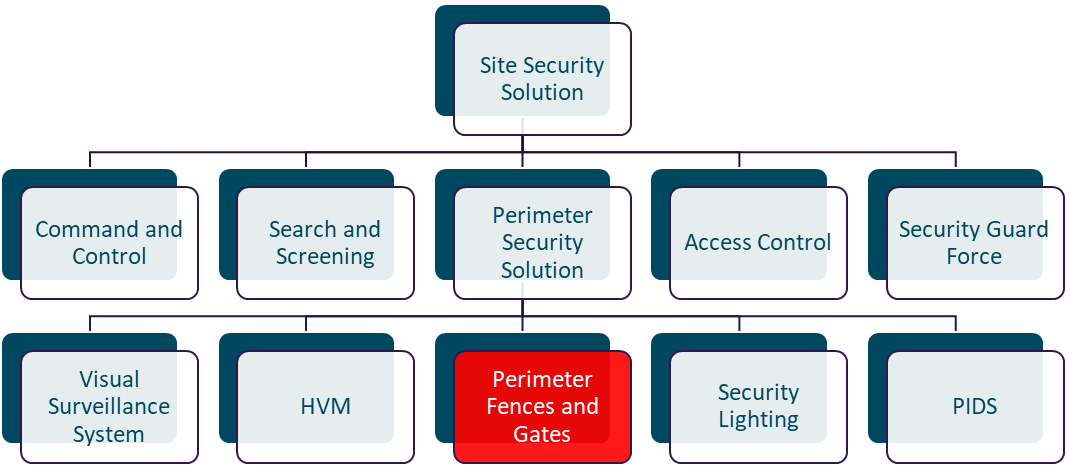
The ability to detect a breach will be considerably enhanced when the fence is deployed jointly with detection, monitoring, lighting, and guarding capabilities. Wherever possible monitoring and detection should relay back to a Security Control Room (SCR9 )10. The SCR will deliver the command-and-control functions to ensure that the perimeter fence and other capabilities are continually monitored and manage the guard force response to suspected intrusions. Whilst perimeter fencing may offer some mitigation, only when a correctly rated security fence is in place, integrated with similarly rated gates or portals, and operated in line with the SOPs, will you achieve appropriate mitigation at the perimeter. As with all security apparatus, it needs to be designed to integrate with other security equipment and disciplines as brought out in your operational requirement.
9NPSA Security Control Room Training Course
10NPSA Incident Command and Control Guidance
Perimeter solution
The perimeter fence will provide the demarcation line that defines the open and unrestricted area outside, and the secure site. It provides a controlled space for the deployment of additional capabilities that will work in tandem with the fence to identify, verify and track intruders until they can be stopped. Perimeter security is built around a perimeter fence and, in addition to the fence, is likely to consist of:
- Perimeter intruder detection systems (PIDS)
- Visual Surveillance System
- Lighting
- Hostile Vehicle Mitigation (HVM)
- Formal pedestrian and vehicle access points, such as gates, turnstiles, and vehicle barriers, where the following will take place
- Search and screening
- Policies to manage staff and site visitors
- Emergency egress and access requirements to support the response to any incident
- Guarding and response force capabilities
- Command and control
- Contingency plans to deal with a wide range of potential incidents at the perimeter
Perimeters vary in length and, without due thought, can present an adversary with numerous points at which their chances of a successful or undetected attack are higher. Poorly designed perimeter measures may also increase the number of false alarms generated by PIDS.
A properly designed and implemented perimeter should:
- Help deter potential intruders
- Limit the possibility of surveillance and hostile reconnaissance through the perimeter
- Reduce the possibility of covert entry and exit on the site
- Take into consideration ingress and egress in a steady state, and during an emergency11
- Facilitate authorised access to the site for both pedestrians and vehicles through planned access points but deny unauthorised access
- Provide an enforceable stand-off to reduce the effectiveness of threats located at the perimeter, such as limiting the ability to undertake hostile reconnaissance, managing legal protest, interference with wireless networking, and vehicle-borne improvised explosive devices
- Assist in delaying, detecting, and denying unauthorised attempts to access protected assets
- Provide appropriate facilities to enable security officers to carry out their duties. These should include protection in case of an attack
- Help minimise the risk of collateral damage to people, facilities, and infrastructure
- Integrate with other security measures in and around the site
- Consider health and safety regulations unique to the site. For example, if you have overhead power cables it may not be possible to include barbed taped coil (BTC) on-top of your perimeter solution
It is important to remember that physical security measures are only part of an effective perimeter solution. They should be implemented in a manner that supports the security and operation of the site. When designing measures, it is also essential to understand how internal teams, and support agencies such as the police, will respond to incidents.
Security Fence
NPSA uses the term Security Fence to describe a continuous barrier that offers basic to moderate climb resistance and basic manual forced entry penetration resistance. It should comply with BS172212 (1013,12 and 14) as a basic requirement.
Where required, the fence should be supportive of a detection system configured of PIDS and Visual Surveillance Systems. The perimeter fence also provides all the functions of a demarcation fence.
Perimeter fence heights vary, NPSA recommendation is for the panels to be a minimum of 2.4m in height. In addition, they should include:
- A 0.4/0.5m diameter of anti-climb topping such as barbed taped concertina (BTC)14 which should start at a minimum of 2.4m from ground level. If BTC is selected, it should be securely attached with a maximum diameter of coils after installation of 0.85m. A maximum spacing of 0.2m between the BTC is required15.
For higher security requirements, panels should be a minimum of 3.0m in height. In addition, they should include one of the following:
- A minimum 0.6m diameter BTC, should start at a minimum of 3m from ground level16 . If BTC is selected, it should be securely attached with a maximum diameter of coils after installation of 0.85m. A maximum spacing of 0.2m between the BTC loops is required17.
12Available here.
13NPSA do not recommend chain link fence fabric.
14BTC should be supported and tied to prevent it drooping and separating.
15Information relating to the fixing of toppings to security fences can be found in the NPSA Palisade Fence and Gate Design Pack and NPSA Mesh Fence and Gate Design Pack.
16Note local and national regulations regarding Occupiers Liability for toppings at these minimum heights.
17Information relating to the fixing of toppings to security fences can be found in the NPSA Palisade Fence and Gate Design Pack and NPSA Mesh Fence and Gate Design Pack.
Construction notes for security fences
The material requirements for all security fences should meet the minimum requirements as specified in the relevant parts of the current BS1722. Where abnormally severe loading or ground conditions apply, sites should seek advice from a suitably qualified civil engineer.
If your site requires a temporary security fence solution it is crucial to consider the time the fence will be required, the level of risk to the event, and the size of the perimeter to be protected. The temporary solutions available to you may be limited by the environment, the requirement for the solution to host PIDS, burrowing risk, along with other factors.
Unlike permanent fencing solutions temporary fences by nature are placed on the ground surface and do not have any foundation detail. They therefore have several limitations in use, which should be considered as part of the Operational Requirement, when determining which product could be deployed. Factors that should be considered include, but are not limited to, the following:
- Environmental
- Wind loading
- Ground water
- Ground load bearing
- Ground topography
- Burrowing
- Fence lift to create a gap
- Fence toppings
- Ability to host PIDS
- Ease of construction/removal
- Aesthetics
Large sites
Some sites covering large geographic areas may have additional factors to consider. These may include the following:
- Access to the perimeter may be limited and areas covered by vegetation would provide cover for intruders to hide and should be removed or reduced. Damage may go unnoticed and layered intruder detection is encouraged
- Long perimeter lines increase the time taken to deploy an operational response to an area where intrusion is detected. Using a layered approach can enable a lower level of security at the perimeter, enabling security resource to be focused on critical assets
- Natural or man-made features or crossings adjacent to the perimeter e.g. rivers, streams, or ditches, utilities, and railway lines and roads, which can provide weaknesses in the perimeter
Access points
Some sites will have several access points which should utilise appropriate gates, turnstiles, or vehicle barriers. Certain attack types are more likely to manifest themselves at access points because:
- They are a focal point for activity and therefore potentially becoming an attractive target18.
- Weaknesses created by the requirement to let people and vehicles flow through them.
- Vulnerability of having security staff and control equipment close to the perimeter and subsequently less protected.
If an attack is discovered outside the perimeter, it is critical to have the ability to rapidly lockdown access points. Locking systems should either be capable of remote locking or very easily triggered. They should also be capable of being rapidly unlocked so that they can also support an emergency evacuation of the site or the response of the emergency services.
Next steps
Prior to designing and delivering a new site perimeter it is imperative to plan your solution and consider:
- The range of risks to your site and the performance requirement needed, this can be done by conducting a security risk assessment, and a suitable standard should be selected based on the threat posed. For further information please see the NPSA website19
- The operating environment, the size of the site, and the environment and weather conditions the perimeter solution will be subject to
- The site operations, how frequently access will need to be granted, how will access points be enhanced, e.g. what level of protection should gates and vehicle mitigations provide
- How quickly your security will be able to attend breaches or attacks of the perimeter
- Management and maintenance of the perimeter
- Statutory requirement