

Mainline safety risk
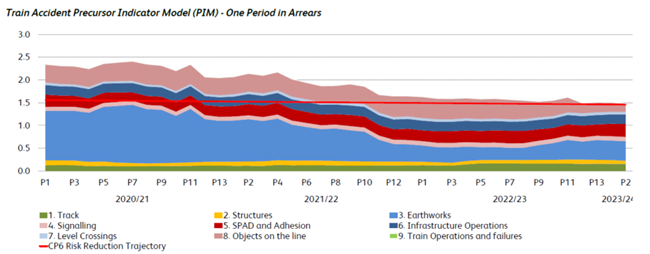
The most recent passenger risk data from RSSB’s Precursor Indicator Model (see chart at Figure 1 below) shows the change in passenger related fatalities and weighted injuries (FWI) risk from infrastructure failure incidents between April 2020 and May 2023.
Figure 5.1: RSSB Precursor Indicator Model, to Period 2, 2023 to 2024
Source: RSSB
The Met Office reports in its most recent ‘State of the UK Climate’ report (2022, published 26th July 2023) that 2022 rainfall was 94% of the 1991–2020 average. 2022 included the UK's eighth wettest February on record but January, March, April, July and August were all notably dry, particularly across England and Wales. The report also notes that five of the 10 wettest years for the UK in a series from 1836 have occurred in the 21st century.
Since 2009, the UK has had its wettest February, April, June, November and December on record in monthly series from 1836, as well as its two wettest winters. For the most recent decade (2013–2022) UK winters have been 10% wetter than 1991–2020 and 25% wetter than 1961–1990. There has also been a slight increase in heavy rainfall across the UK in recent decades. Storm Eunice on 18 February 2022 was the most severe storm to affect England and Wales since 2014.
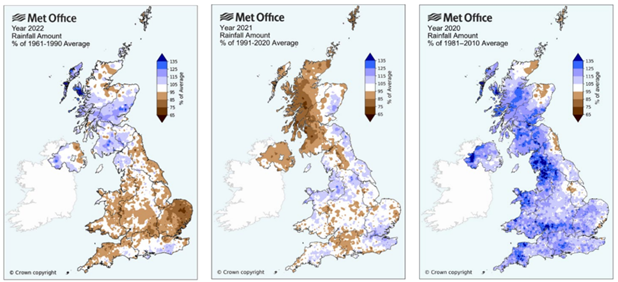
Although 2022 was a relatively benign year in terms of rainfall it should be noted that 2020 was the UK's fifth wettest year in a series from 1862, with 116% of the 1981 – 2010 average and 122% of the 1961–1990 average rainfall. February 2020 was the UK's wettest February and fourth wettest calendar month on record in a series from 1862. 2020 also included the fifth wettest winter, the fifth driest spring and, for England, the driest May on record in a series from 1862.
Figure 5.2: Rainfall in 2020 to 2022 compared with long term averages (Met Office)
Source: Met Office
In February 2022, storms Dudley, Eunice and Franklin brought major weather impacts. Although the most serious impact of these storms was related to high winds, significant rainfall was also experienced (see figure 5.3 below). The railway industry responded with widespread line closures and speed restrictions. Although this resulted in significant disruption and performance impacts, there were no major safety incidents reported.
Figure 5.3: Rainfall accumulations during February 2022 storms

Source: Met Office
It should be noted that, until the incident at Hunton Bridge tunnel near Watford on 16 September 2016, and despite the poor weather and increase in failures, there had been no derailments since 2012/13, suggesting an improved standard of consequence management following ORR enforcement in August 2012. Other key factors, such as the management of critical drainage systems, have been the subject of ORR enforcement action aimed at reducing the risk of cutting failures. Unfortunately, the accident at Carmont in August 2020 demonstrated that more work is needed to manage the risks associated with adverse weather.
Network Rail overview
Many railway structures on Network Rail infrastructure are from the Victorian era and were built from materials whose quality was poorer and more variable than modern construction materials. Most earthworks also date from when the railways were originally constructed. At that time, geotechnical knowledge was largely empirical and earthworks are frequently over steep in their design. However, earthworks and other structures can still continue to provide a suitable degree of safety integrity and performance provided they are subject to effective management arrangements. The main measures for ensuring adequate risk control are:
- Robust asset management policies and processes that deliver best practice in the management of Civils assets; and
- Implementation of a robust inspection, maintenance (including preventative maintenance), refurbishment and renewal regime that is based on adequate knowledge of the type of structure and its behaviour, condition and capability.
Safety of Civils assets is largely managed by Network Rail through a suite of Asset Policies and related engineering standards, which lay down the asset management principles described above. Additional standards detail the actions to be taken in the event of adverse or extreme weather, which can negatively affect the performance of Civils assets. Compliance with these standards presents a challenge to Network Rail as a devolved organisation. The central Technical Authority seeks to support and guide Regions to achieve requirements, but ensuring effective implementation is the responsibility of individual Regions.
Improving the resilience of Civils assets on the railway has become increasingly important, given the impact of climate change on weather conditions (see appendix one for more details.) In recent years, Regions have developed Weather Resilience and Climate Change Adaptation (WRCCA) action plans aimed at reducing the impact of extreme weather. Effective implementation of these plans is critical if they are to have a significant practical impact.
ORR inspections over a number of years have found varied, inconsistent degrees of compliance with relevant policies and standards across the network. We also find correspondingly variable levels of management maturity, as measured by our use of the Risk Management Maturity Model (RM3). Network Rail must focus on ensuring consistently effective, reliable implementation of asset management requirements – and on being able to demonstrate that by meaningful assurance.
Network Rail asset management
At the time of writing, Network Rail does not hold a complete inventory of all its Civils assets. Drainage asset registers are incomplete in some routes, despite several years of work intended to complete them. Regions have committed to complete their drainage asset registers by the end of March 2023. The continued delay in compiling this information introduces a risk that this may delay the process of inspecting, maintaining and renewing those assets which are already known about.
Further, the report produced for Network Rail following the Carmont accident by Lord Robert Mair highlighted the importance of effective installation and management of drainage assets. In particular, the report stressed the importance of dedicated, competent drainage management teams within the Regions. ORR has for a number of years been seeking similar improvements to drainage asset management. These recommendations are therefore supported, and we continue to push Network Rail for evidence of their effective implementation.
Network Rail’s asset management arrangements for Civils assets are based around a regime of examination, assessment and evaluation; leading to corrective actions to remedy any defects that are identified. In most regions, most of these examinations are carried out by contractors, the exception being North West and Central (NW&C) and Eastern Regions, which have both brought at least some of this work in-house. Completing examinations, assessments and evaluations on schedule is a major challenge for Network Rail, which has incurred significant examination and assessment backlogs, primarily affecting structures. Resolving this backlog and putting in place arrangements for longer term compliance is a key priority for ORR, and continues to be the subject of regulatory interventions.
Within the structures portfolio, the examination of tenanted arches presents specific challenges in some Regions. These have been exacerbated by the sale of space within arches to the Arch Company. Recent improved co-operation between Network Rail and Arch Co has seen improved planning and delivery of examinations in some Regions, but this is not consistent across the Network and examination backlogs remain a significant concern. However, progress is now being made towards eliminating those backlogs and placing the examination of tenanted arches on a more sustainable footing for the future.
ORR is aware of weaknesses in Network Rail’s evaluation of defects that are identified following examinations and assessments. In some instances, ineffective evaluations have led to no action being taken, or action that is inadequate or inappropriate to resolve those defects, ultimately resulting in the failure of an asset. Network Rail has acknowledged the shortcomings in its evaluation processes and has taken action in recent years to address them. This process remains ongoing.
Fundamental to many of the difficulties described above is the lack of an integrated database to enable civils assets to managed as a system. Network Rail had planned to implement a new database – the Civils Asset Management Solution (CSAMS) – but this was not delivered. Work is now underway as part of Network Rail’s Intelligent Infrastructure Programme to deliver an improved system, and ORR will continue to monitor its implementation.
Hidden shafts in railway tunnels present a risk to both the railway and any structures that may be built above them in the event of a failure. A significant programme to identify hidden tunnel shafts was recently completed by Network Rail, but progress towards assessing the risk associated with those shafts and implementing mitigation measures has stalled. ORR is seeking properly defined plans for the delivery of these activities, within reasonable timescales, so that any risks associated with these shafts is mitigated.
Network Rail’s renewals plans have at times been affected by financial constraints on the regions. This has led to a significant number of planned structures and earthworks renewals being deferred or downgraded to refurbishment or maintenance. In these cases, Network Rail states that a risk-based process should be used to identify which renewals to defer, and risk assessments should be carried out to identify any mitigation measures that should be put in place at deferred sites. ORR continues to require that appropriate decisions have been made and risk control measures are in place as necessary.
Network Rail must find an appropriate balance between renewal, refurbishment, maintenance and inspection activities – based on good understanding of asset condition and the likelihood and consequences of failure. It must also ensure it implements appropriate interim risk mitigation measures.
Adverse weather arrangements on Network Rail infrastructure
In response to enforcement activity by ORR, Network Rail has developed improved arrangements for identifying earthworks slopes considered to be vulnerable to failure during adverse weather. The increased number of slopes listed on these ‘at risk’ registers presents a very significant risk management challenge to Network Rail during adverse weather. Network Rail is exploring the use of technology, such as remote monitoring, to help manage these risks and reduce reliance on the use of site watchmen or operational restrictions on the running of trains. Progress has been slow, but completion of a trial following ORR pressure has resulted in this technology now being used more widely across the Network. Management of critical drainage systems, also key in minimising the risk of failure, has also been the subject of ORR enforcement action.
As well the impact on earthworks, adverse weather can also cause scour damage to structures, as was demonstrated by an incident at Lamington viaduct in Scotland on 31 December 2015. A train reported a dip in the track when passing over the viaduct, and subsequent investigation revealed serious damage to the structure due to scour. This incident led to a wider review of the arrangements for management of scour and monitoring during extreme weather in England and Wales. Work is ongoing to reduce risk at the highest risk structures.
It is vital that Network Rail continues to refine the effectiveness of its response to extreme weather. There is considerable scope for the adoption of technological means to monitor the condition of earthworks and structures; to monitor ground saturation; to measure flow rates in water courses; and to identify localised high rainfall. There is also potential to use drivers’ advisory systems and signalling technology to make warnings, speed restrictions and closures more specific and targeted. The importance of such contingency arrangements grows more important as renewal to modern resilience has been constrained and as climate change makes extreme weather events more frequent.
The outputs of the task forces led by Dame Julia Slingo and Lord Robert Mair, as well as RAIB’s and the industry’s own investigations into the Carmont derailment have led to a wide-ranging programme to achieve improvements in many of the areas outlined here. ORR will be relentless in holding Network Rail to account to deliver these plans.
Ancillary structures on Network Rail infrastructure
Prior to the failure at Newbury; ancillary structures were not subject to active management by Network Rail. Reliance was instead being largely placed on annual visual examinations reporting by exception on a ‘line of route’ basis. These have been shown to be of limited effectiveness, unless a defect has been identified, there is no report on the condition of the structure (other than to say that it has been examined.) The investigation into the Newbury failure identified that the bases of posts were not routinely being cleared of ballast or other obstructions to enable examination of the entire post, nor were such hidden elements being recorded as unexamined.
In recognition of these issues, Network Rail made changes to its examination regime in respect of ancillary structures, requiring more detailed reports for each structure. The new arrangements are also expected to require condition scoring for these assets, splitting them into three sections, each of which is required to be scored separately. However, implementation of the new regime met with delays, largely as a result of financial and resourcing concerns within the routes and, to an extent, the examination contractors.
Safety management arrangements for Network Rail’s Operational Property (Buildings) estate has in the past lagged behind that being achieved in other disciplines. However, progress has been made in completing up to date assessments for these assets; and a programme of hidden critical element (HCE) examinations is now complete.
However, an incident at Northwich station in May 2020, in which the gable end wall of a building collapsed and deposited 13 tons of material onto the platform, has raised concerns about the effectiveness of the management regime for station buildings. More specifically, the damage to the building by the longstanding presence of vegetation growth suggests that Network Rail will need to revisit their arrangements for vegetation management at buildings and other structures.
London Underground overview
London Underground manages Civils assets comprising over 16,000 bridges and structures, 350 km of tunnels and 235km earth structures (its 270 stations are managed separately). Many of the challenges are comparable to the mainline, in that the majority of the assets are over a hundred years old and degradation rates can be hard to measure when parts are hidden. The characteristics of the above-surface network are similar to the mainline as well, but drainage is of increased importance in the tube sections, where the risk of flooding and water seepage is ever-present.
Underpinning LUL’s asset management has been a series of programmes completed around the start of the second decade of the 21st century to ensure LUL has a comprehensive picture of its assets and their structural stability and capacity. This is largely the result of the Analytical Asset programme (completed in April 2012), coupled with the results of the Drainage Hydraulic programme (completed August 2011). This led to the development of a risk-based framework of cyclical inspections to determine on-going asset condition and any consequent maintenance works. Alongside this a Civils Engineering programme to strengthen replace or renew has been similarly prioritised based on the outputs of the analytical assessment programme. This has led to targeted significant investment to recover a backlog of condition concerns.
London Underground has had the opportunity, during recent line extensions, to explore the design and construction of new Civils assets. It has developed new materials, processes and technologies to allow easy construction and improved future access and maintenance. As an example it has moved away from traditional construction ‘in-situ’ towards off-site fabrication that is then delivered to site and installed with minimal disruption. New construction has introduced standardised, modular parts – allowing scaling or expansion to accommodate future growth.
LUL’s asset management philosophy is to view Civils engineering assets as part of the wider railway infrastructure ‘system’. When considering safety risk LUL models the ‘indirect’ contribution of its assets as well as the more obvious direct risks – the effect of trains being stationary in tunnels, for example, for Civils assets affecting the flow of an evacuation route. Due to the density of passenger numbers, frequency of service and close proximity of assets, the impact of such disruption on LUL infrastructure is more acute than on other networks.
When thinking about the behaviour of its assets LUL employs the concept of ‘asset abuse’ to describe interrelationships. Thus Civils can impact on the performance of non-Civils assets, for example when signalling and power assets are adversely affected by water ingress in a shallow brick tunnel, or when track support is compromised by earthwork deformation. Significant ‘abuse’ of Civils assets arises from external sources, e.g. road vehicle incursion. In recognition of this LUL is compiling a Third Party Asset Register.
ORR has recently begun exploring LUL’s civils asset management arrangements in more detail. This has led to some concerns being identified in those arrangements, particularly in the context of continued constrained funding. The challenges to securing effective asset management will be explored and followed up in more detail in the coming years.
Tramways and Light Rail overview
Our primary focus in the tramways and light rail sector has been on the initial integrity of new operating systems within tramways and light rail, and how they are maintained. New infrastructure generally avoids features such as deep cuttings, wherever possible. The most problematic areas occur in relation to the legacy of heavy rail where Tramways and Light Rail routes incorporate existing assets such as cuttings, bridges and earthworks. Even there, so far as possible, our focus has been to ensure initial integrity. During construction phases of Manchester Metrolink, for example, ‘inherited’ viaducts were stripped back to the core, inspected and made good.
The information taken from safety management systems demonstrates certain operating assumptions, for example, inspection intervals, to ensure that tolerances are within a safe limit. If these operating assumptions are not followed, then the infrastructure can start to degrade. Inspections have shown that some tramway companies are not good at ensuring these operating assumptions are followed.
The selection of staff and maintaining their competence is a key factor in avoiding poor maintenance of assets and ensuring that the risks at the interface are kept low.
It is essential that tramways and light railways have appropriate standards for the inspection of their specific infrastructure, action levels and maintenance documentation. The use of standards from the mainline railway is often inappropriate for tramway and light rail components and using such standards unquestioningly can import risk.
There are few tunnel sections or other structures such as cuttings and embankments. bridges and other structures tend to be the responsibility of the highways authority, nevertheless some systems have extensive structures and access to appropriate inspection and maintenance contractors is required.
Whilst tramways and light rail sometimes feature similar infrastructure to mainline and metro railways – primarily non-street running parts of tram networks, often inherited from heavy rail – consequential risks are significantly different due to the ability of trams to stop more quickly should an obstruction or other derailment risk be encountered.
Heritage Railways overview
Whilst the heritage sector creates the same sort of risk as other railways, the reduced line speed and generally lower frequency of traffic mitigate the severity of outcome. Conversely, the nature of the ageing infrastructure and the variable expertise of the volunteer workforce cause ORR to increase the priority we give to this area. We find that some heritage operators lack coherent safety management systems and this steers us towards a more proactive approach to the heritage sector than we might otherwise employ.
Many heritage railways operate on infrastructure that was previously closed down by British Rail and has been reinstated whilst others are of industrial origin – both standard and narrow gauge. The range of risks is similar to those of the mainline but the consequences are generally less severe. Serious incidents have occurred, though. In June and July of 2007, for example, a series of violent rainstorms resulted in severe damage to the Severn Valley Railway with numerous landslides, blocked and washed away lines. The railway was closed until April 2008. Investigations during repairs revealed that there were some 108 drainage culverts within the infrastructure; prior to the storms SVR had records of just 28.
Structures are a generally ageing asset and resources in the heritage sector to maintain and renew tunnels, embankments, cuttings and bridges can be very limited. Volunteers are at the heart of the heritage sector and many operate on a limited budget. Highly competent staff or contractors are needed to carry out the technical inspections required for structures. Inspection and maintenance regimes should be risk-based. As a minimum, we expect heritage operators to have a coherent inspection regime in place. We have seen evidence of good practice, such as North Yorkshire Moors’ Railway’s complete replacement of life-expired 145 year-old Bridge 30 near Goathland in 2010.
We apply the principles of the Risk Management Maturity Model (RM3) to this sector as with any other. The outcome of these inspections determine where our attention is focussed in future, although previous inspections suggests that the most effective means of intervention will be assistance to develop an effective safety management system.
The heritage sector continues to grow in popularity – ORR regulates some 215 self-contained railways above 15” gauge and one 10.25” gauge line. When normalised for its size, the risk of failure on heritage sector infrastructure is probably disproportionately greater than other networks; the consequences are, though, mitigated by the characteristics of operations. ORR has been working with the Heritage sector to ensure that guidance specific to their needs is developed for infrastructure inspection and maintenance. Work is also planned to critically review the arrangements for civils asset management in the heritage sector in more detail – starting with the examination and maintenance of structures.