
Winfrith site
Nuclear Restoration Services (NRS) is a wholly owned subsidiary of the Nuclear Decommissioning Authority (NDA) and is responsible for decommissioning the Winfrith site, as well as 12 other sites across the UK.
At NRS we are dedicated to the safe, secure, and sustainable decommissioning and restoration of nuclear sites. Our mission extends beyond merely dismantling reactors. We aim to create a positive legacy for future generations and bolster resilient local economies.

Winfrith is located on a 71-hectare site in Dorset. Construction began in the 1950s to enable vital research into reactor design. There have been nine experimental reactors on this site at various times. There are only two remaining today, the Steam Generating Heavy Water Reactor (SGHWR) and Dragon. Both of these are being decommissioned. Decommissioning started in the early 1990s.
There is also a pipeline that runs from the site to the discharge point offshore at Arish Mell. This structure is not part of this engagement. The decommissioning strategy for the pipeline is removal and we will engage with stakeholders when the timescales are appropriate to develop a detailed plan.
Transforming Winfrith for the future


NRS is focused on safely decommissioning the Winfrith site and delivering the site End State. An End State is the condition of an NDA site, following completion of all physical decommissioning and clean-up activities required. At Winfrith, the End State being worked towards is a condition, landscape, and environment that allows for the next planned use of a naturally generated heathland with public access.
This End State has been informed by working with:
- Dorset Council to establish their priorities for potential future uses of the site
- the local community to understand their values and aspirations for the site
- Government to understand national needs and financial implications; and
- the environmental regulators to ensure alignment with their current requirements.
Environment and sustainability
Sustainability
The NRS mission is to deliver our sites across the country to closure safely, securely and with due regard for the environment and support for the long-term interests of our employees, the local community and our supply chain partners.
Sustainability is an important factor when looking at the best preferred options for decommissioning and managing waste. Options assessments were performed to define the most sustainable approach to deliver decommissioning and waste management at Winfrith.
These assessments were completed by listing assessing short-term impacts such as the habitat, operator risk and public risk against long-term impacts and risks such as carbon footprint.
This allowed us to define the most sustainable approach. Sustainability is one of the core objectives in how we propose to decommission the site (eg: carbon footprint) and what we deliver (eg: biodiversity net gain).
Site habitats
The site forms part of the Dorset Heath Special Area of Conservation and a Site of Special Scientific Interest, and hosts a variety of protected species and habitats, including:
- All six native species of reptiles present the UK, i.e. adders, smooth snakes, grass snakes, common lizards, sand lizards and slow worms
- Rare birds such as nightjars, wood larks and dartford warblers, as well as hen harriers and merlins
- Great crested and common newts
- Pipistrelle bat maternity roosts
- A range of supporting habitats and rare plant species.
We are committed to meeting our legal obligations, including managing flood risk, both now and under future climate change scenarios, and minimising any potential impacts on protected habitats. By creating a landscape suitable for natural heathland to establish the site will support development of valuable and rare habitats that are unique to Dorset.


On-site disposal
The End State will be achieved by carrying out the following activities:
- demolition of redundant structures to 1 metre below ground level in most cases
- the retention of some below ground structures (basement voids associated with the two remaining reactors)
- the use of low level radioactive and non-radioactive wastes arising from the demolitions to backfill the below ground structures to achieve a final landform suitable for the End State
- the reprofiling of parts of the Winfrith Site to provide a natural drainage system
- creating a landscape suitable for the natural regeneration of habitats, and
- carrying out ongoing management and stewardship of the site.
The retention and back filling of the below ground structures is referred to as on-site disposal.
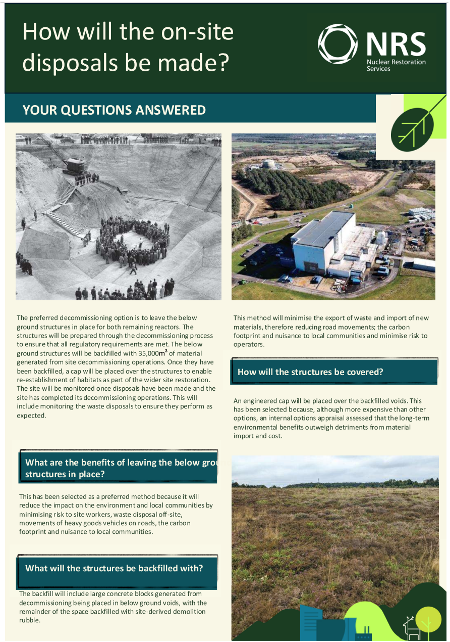
On-site disposal means that the underground building structures associated with the remaining two reactors, SGHWR and Dragon, will remain in place and the voids will be filled with demolition materials generated on the site. Before this happens the internal components of the reactor buildings will be stripped leaving only outside and supporting walls. These will then be demolished with the rubble being used to fill the below ground space. The remainder of the voids will be filled with suitable rubble generated from the demolition of other buildings on the site.
Once the voids have been filled, a secure cap will be placed over each of the structures and covered with locally sourced soil to enable local habitats to establish.
We will continue to monitor and manage the site once the voids have been filled and the site has completed decommissioning operations. This is all subject to planning permission and regulatory approvals. We are working in compliance with the Environment Agency guidance on the final stages of decommissioning and clean-up. We will also continue to work closely with Dorset Council on their evolving plans in relation to the future of the Winfrith site.
What level of radioactivity will be left on the site?

The table shows the comparisons of doses from preliminary assessment results, to a range of routine scenarios. Click to zoom in.
The levels of radioactivity in the proposed on-site disposals will be very low. The risk assessments show they are significantly below the Environment Agency’s guidance on the final stages of decommissioning and clean-up. The radioactivity levels are so low that, under Environment Agency guidance, if excavated the waste would be suitable for disposal at a suitably permitted radioactive landfill, or for recycling in non-radioactive waste facilities. We have carried out technical assessments to address how the disposals will behave over a long timeframe and through a range of climate change scenarios to assess any risks to humans and the environment.
Have your say
You can view any plans that require planning permission on the Dorset Council website Planning application search and comment – Dorset Council. Additional information around the decommissioning of the site can be found in the Masterplan provided in the link at the top of the page. Please complete this form if you have any questions.